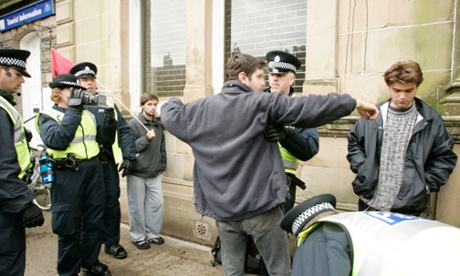
Scottish ministers have appointed a human rights lawyer to investigate a record level of police use of stop-and-search after a damning report by the police inspectorate.
An inquiry by the Inspectorate of Constabulary in Scotland found a series of failures by Police Scotland after the force increased the use of common law stop and search, dwarfing its use everywhere else in the UK.
After revealing that 83 children under 11 were stopped and searched in six months last year without any proof of a crime – despite the force’s promise that it would end, the inspectorate said Police Scotland’s record-keeping on stop and search was riddled with errors and inconsistencies.
After months of criticism, the force said it had met the inspectorate’s call for a big cut in stop and searches by immediately limiting its routine use.
The Scottish justice secretary, Michael Matheson, announced on Tuesday that John Scott QC, a leading human rights lawyer and chair of the Scottish branch of the Howard League for Penal Reform, would now lead an expert panel to investigate the future use of stop and search, including considering a ban.
“Stop and search can be a valuable tool in combating crime,” Matheson said, “but we must get the balance right between protecting the public and the rights of the individual.
“As such, it is vital that stop-and-search powers are used appropriately, and we need to make some key decisions on how such powers should be used going forward. We need a clear, consistent approach which, as a society, we can all be agreed upon.”
Both announcements mark a U-turn by the Scottish government after Matheson’s predecessor as justice secretary, Kenny MacAskill, repeatedly defended the practice, despite mounting evidence that it was being abused and unregulated. They are also a significant blow to the reputation of Stephen House, the former Metropolitan police assistant deputy commissioner who became the first chief of the new force Police Scotland.
House was a leading proponent of stop and search when he ran Strathclyde police, the country’s largest regional force. Backed by MacAskill, he insisted that its use had directly helped to reduce crime levels. But the inspectorate said on Tuesday: “The evidence that exists does not suggest any clear causal connection between the use of stop and search and reductions in crime.”
MacAskill helped to orchestrate a Police Scotland public relations offensive defending stop and search on the day that the Guardian, Glasgow’s Herald newspaper and the BBC published the first substantial evidence that stop and search had reached record levels.
A study by Kath Murray, at the Scottish Centre for Crime and Justice Research at the University of Edinburgh, found that stop-and-search rates were four times higher than the rest of the UK because Scottish police were heavily using common law powers to search without evidence – a practice banned in England and Wales.
Murray found that teenagers were being disproportionately searched: there were 145,600 searches of 15- to 24-year-olds across Scotland. In House’s then police force, Strathclyde, there were more searches of 16-year-olds in 2010 than there were 16-year-olds living there, at a rate of 1,406 searches per 1,000.
She discovered too that children under 14 were searched 26,000 times in 2010 without evidence or suspicion of a crime. That included 500 searches of children aged 10 or under, and 72 searches of children aged seven or younger.
Murray said that moving towards statutory stop and search (as against non-statutory, which is reliant on verbal consent) was a significant and necessary step, and said the the inspectorate’s challenge to improve recording and statistics around stop and search was particularly welcome.
The developments, she said, “signal a long overdue move in terms of police accountability and transparency. The detailed analyses in the HMICS [inspectorate] report show a willingness to engage with the awkward questions that have dogged Police Scotland policy on stop and search, and to acknowledge the gaps in the evidence.”
Police Scotland revealed that it was considering ending entirely the use of common law search powers or banning its use for certain age groups, but would wait until Scott’s review was completed.
Rose Fitzpatrick, deputy chief constable of Police Scotland, said stop and search remained an important tool. Even so, she added: “We recognise that stop and search must be undertaken within a public consensus, reflecting our values of fairness, integrity and respect, have consideration of equalities and human rights at its core and meet the policing needs of Scotland’s local communities.”
Scott said there was a huge amount of uncertainty about the policy and its justification. “Questions arise about the use of the considerable powers already available to the police and the circumstances, if any, in which it is appropriate to carry out ‘consensual’ stop/searches,” he said.
“This is an area in which it is important to strike a balance between, on the one hand, allowing the police to continue to address crime in all its aspects, including prevention and deterrence, and, on the other, the right of the public, including our young people, to go about their daily lives untroubled by unjustified police activity.”