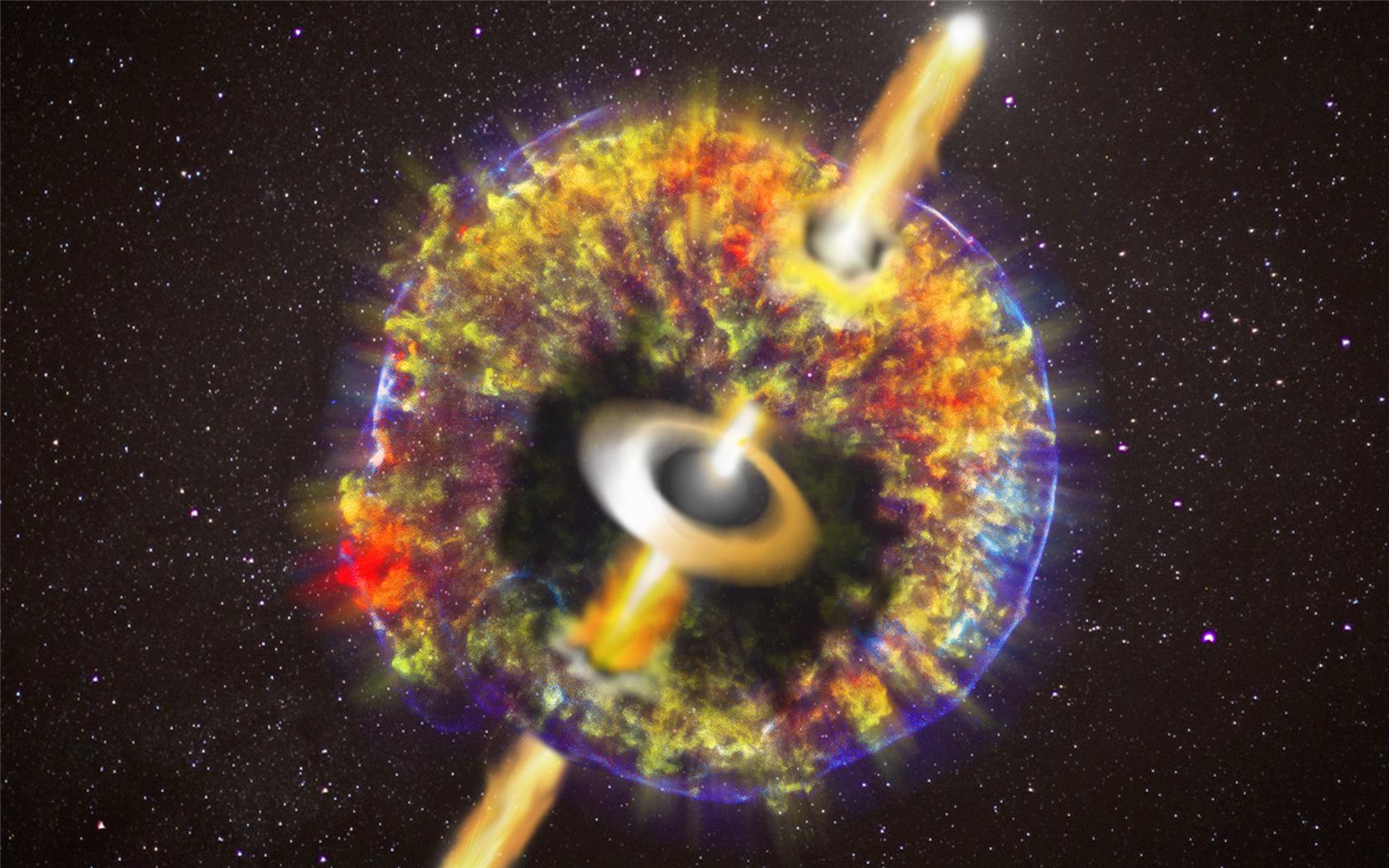
Scientists have detected a blast of material sent 130 million light years through the universe, flung towards Earth by the merging of neutron stars.
Using an international network of radio telescopes around the world, astronomers detected a jet of material that travelled through the universe at nearly the speed of light.
As it hit the Earth, it was picked up by telescopes and shook gravitational wave detectors in August 2017. That allowed scientists to pick up an explosion that happened in a galaxy 130 million light years away.
When the jet was detected in 2017, the first few days of emissions suggested it had been produced by a kilonova. They are powered by radioactive decay, and originate from the mateiral that was flung out during and after the merger of the stars.
But in the weeks that followed, X-ray and radio emissions were still being detected, and carried on for several months. Those were thought to be the "afterglow" of the merger, suggesting that the material was interacting with the interstellar gas that surrounded the explosion, as it expanded through the universe.
But the process that created that afterglow has not been understood, because previous data did not have enough detail to allow scientists to find out where exactly it had come from.
Using the vast network of 32 radio telescopes that were spread over five continents, astronomers looked at the radio glow long after the merger. They combined that data to work out wha tthe source might have looked like.
The data showed that it could not have been in line with previous models of a "choked-jet" or a "cocoon".
Instead, it suggests that the emissions were flung towards Earth by a structured jet that was expanding at nearly the speed of light. That allowed it to break through the surrounding material and into interstellar space – allowing it to blast through the universe and reach Earth.