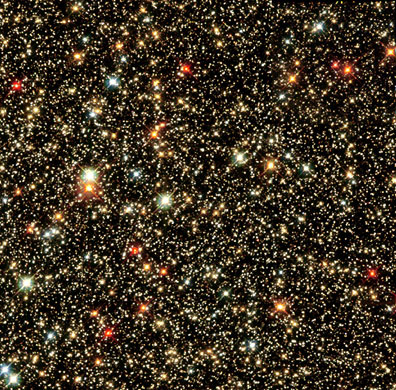
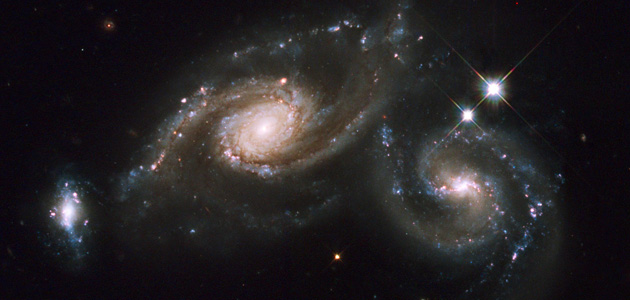
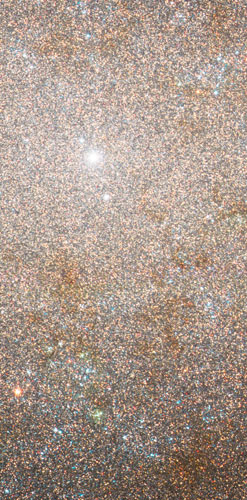
Hubble has given us a keyhole glimpse of the heart of the Milky Way. Most of our view of the galaxy is obscured by dust, but Hubble has peered into the Sagittarius Star Cloud, a narrow, dust-free region, providing this image of some of the oldest inhabitants of our galaxyPhotograph: Nasa/EsaTo mark the International Year of Astronomy, the public was asked to vote on where Hubble should aim next. They chose an interacting pair of galaxies called Arp 274. Watch a video showing how Hubble astronomers processed the image back on EarthPhotograph: Nasa/EsaThe Cat's Eye Nebula. A planetary nebula like this forms when Sun-like stars eject their outer gaseous layers to form a glowing shell. The 'planetary' part of the name is misleading and stems from the fact early astronomers mistook these nebulae for giant planetsPhotograph: Nasa/Esa
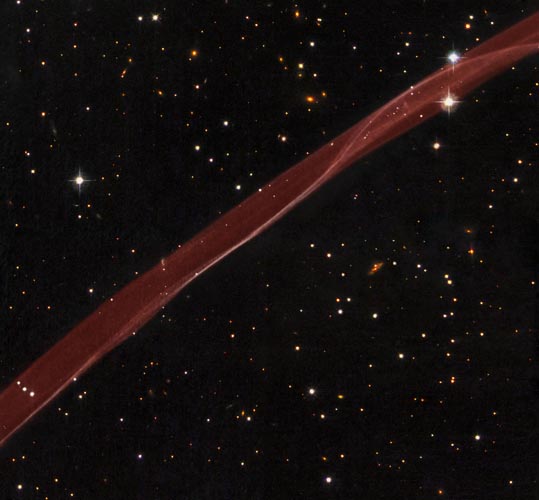
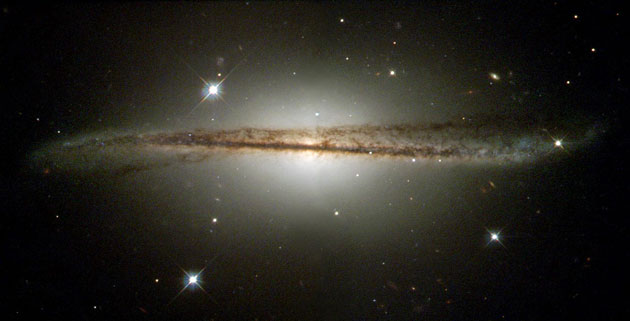
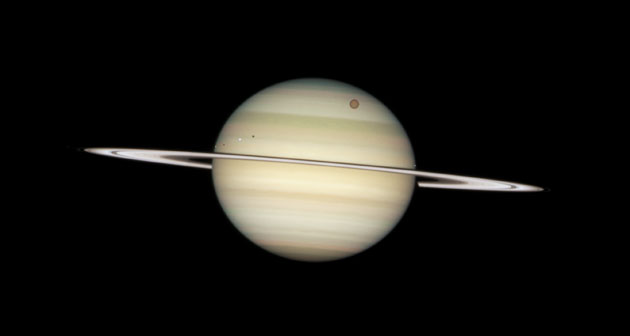
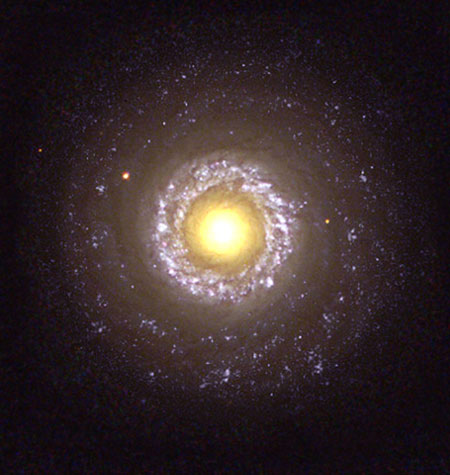
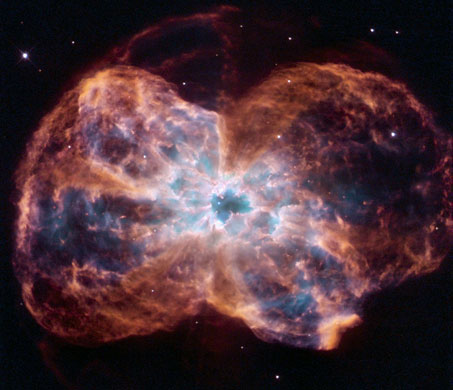
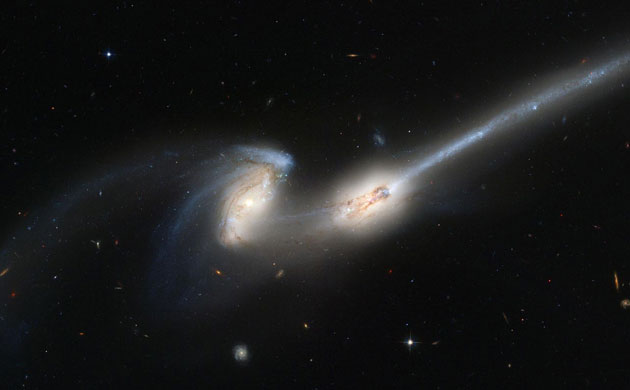
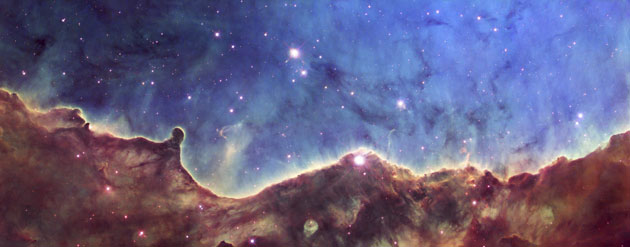
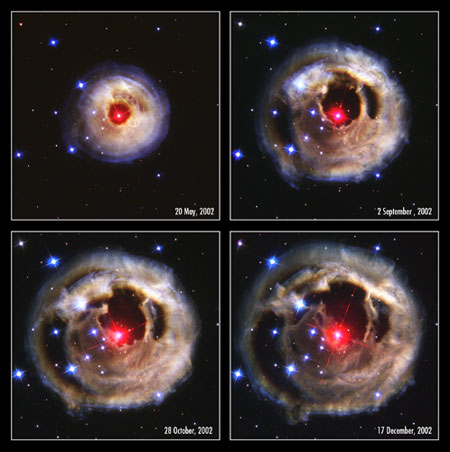
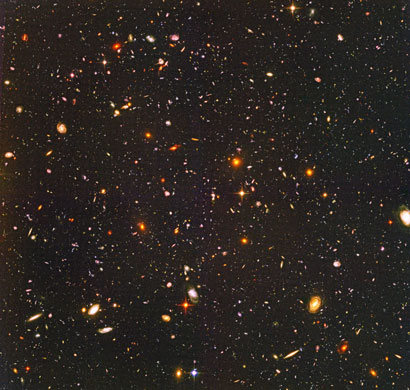
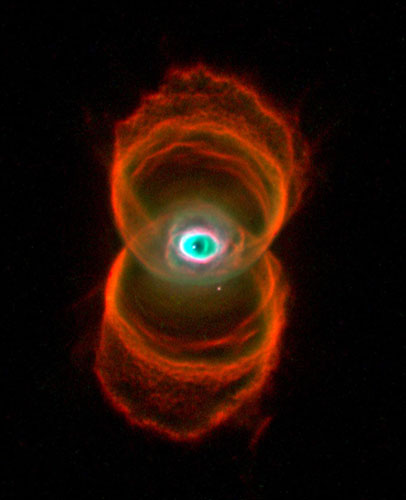
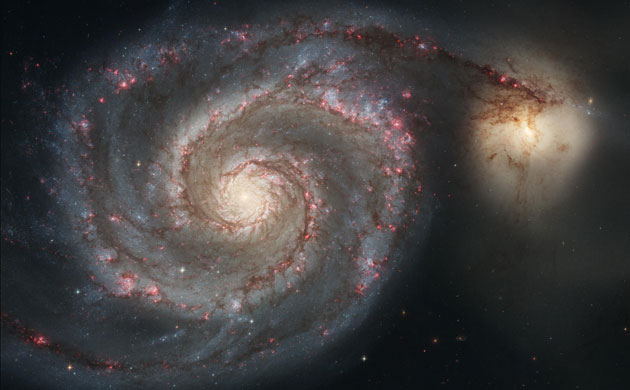
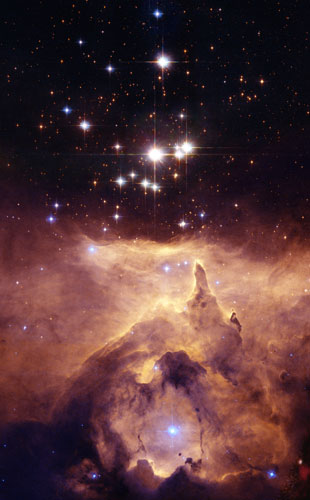
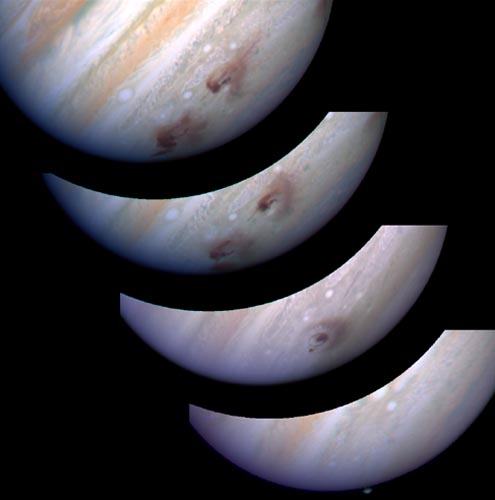
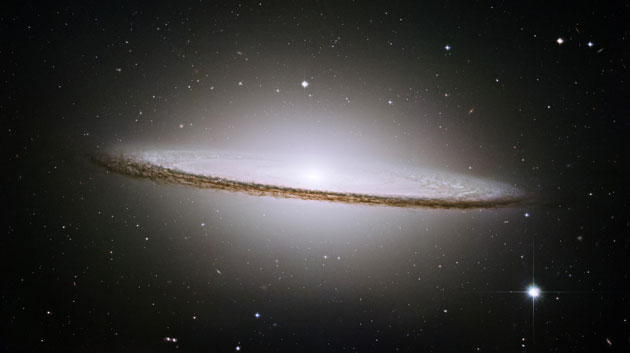
A delicate ribbon of gas, the remnant of a supernova explosion more than 1,000 years ago. On or around 1 May AD 1006, observers from Africa to Europe and the Far East witnessed the arrival of light from what is now called SN 1006, the final death throes of a white dwarf star nearly 7,000 light-years away. The supernova was probably the brightest star ever seen by humans, surpassing Venus as the brightest object in the night time sky after the Moon. It was visible even during the day for weeks, and remained visible to the naked eye for at least two and a half yearsPhotograph: Nasa/EsaAn unusual edge-on galaxy with a warped, dusty disc. The spiral arms of normal spiral galaxies, like our own Milky Way, appear flat when viewed edge-on. This galaxy, by contrast, has an unusual twisted disc structurePhotograph: Nasa/EsaHubble's Advanced Camera for Surveys reveals individual stars and star clusters in the spiral galaxy NGC 300 around 7 million light-years from Earth. A dense swarm of stars, patches of dust, and a bright star cluster are visible near the nucleus of the galaxy. Similar clusters are thought to be involved in the formation of supermassive black holesPhotograph: Nasa/EsaOn 24 February this year, Hubble captured this sequence showing Saturn's four moons passing across its face. The moons, from left to right, are the white icy moons Enceladus and Dione, the large orange moon Titan, and icy Mimas. Enceladus and Dione are preceded by their own shadowsPhotograph: Nasa/EsaA face-on snapshot of the small spiral galaxy NGC 7742, not just any old spiral galaxy but a Seyfert 2 – a galaxy that is probably powered by a black hole at its core. The thick ring around the yellow core is an area of active starbirth. Tightly wound spiral arms are also faintly visiblePhotograph: Nasa/EsaThis Sun-like star (NGC 2440) is ending its life by casting off its outer layers of gas, forming a cocoon around its remaining core. The burned-out star, called a white dwarf, is the white dot in the centre. Ultraviolet light from the dying star makes the material glowPhotograph: Nasa/Esa'The Mice': A pair of galaxies engaged in a celestial dance of cat and mouse or, in this case, mouse and mouse, captured by Hubble's Advanced Camera for Surveys. Located 300 million light-years away in the constellation Coma Berenices, the colliding galaxies were nicknamed The Mice because of their long tails of stars and gas. The pair will eventually merge into a single giant galaxyPhotograph: Action imagesA merging pair of galaxies called the Antennae. As the two galaxies smash together, billions of stars are born in clusters. The brightest and most compact of these are called super star clustersPhotograph: Nasa/EsaThis image offers a peek inside a cavern of roiling dust and gas where thousands of stars are forming. The image, taken by Hubble's Advanced Camera for Surveys, represents the sharpest view ever taken of this region, called the Orion Nebula. More than 3,000 stars reside in a dramatic dust-and-gas landscape of plateaus, mountains, and valleys that are reminiscent of the Grand Canyon. The Orion Nebula is a picture book of star formation, from the massive, young stars that are shaping the nebula to the pillars of dense gas that may be the homes of budding starsPhotograph: NASA/ESAThe Carina Nebula (NGC 3372), located roughly 7,200 light-years from Earth in the constellation Carina. This image is a composite of data taken with two of Hubble's science instruments. Data taken with the Advanced Camera for Surveys in 2006 isolated light emitted by hydrogen. More recent data, taken in 2008 with the Wide Field Planetary Camera 2, isolated light emitted by sulphur and oxygen. To create a colour composite, the data from the sulphur filter are represented by red, from the oxygen filter by blue, and from the hydrogen filter by greenPhotograph: Nasa/EsaA sequence of pictures from Hubble's Advanced Camera for Surveys demonstrating the echoing of light through space caused by an unusual stellar outburst in January 2002. A burst of light from the star is spreading into space and reflecting off surrounding shells of dust to reveal a multicoloured 'bull's eye'. This sequence of pictures from May to December 2002 shows apparent changes in the circumstellar dust as different parts are illuminated sequentially in an effect called a 'light echo'. From the first to last image the diameter of the nebula appears to balloon from 4 to 7 light-years. This creates the illusion that the dust is expanding into space faster than the speed of light. In reality it is simply the light from the stellar flash that is sweeping out into the nebulaPhotograph: Nasa/EsaThis optical image, known as the Hubble Ultra Deep Field, looks deeper into space – and hence farther back in time – than any other. It was created by combining the sensitivity of Hubble's Advanced Camera for Surveys with the penetrating power of the Near Infrared Camera and Multi-Object Spectrometer. It reveals that around a billion years after the big bang the universe was filled with dwarf galaxies (the red smudges) but no fully formed galaxies like our Milky WayPhotograph: Nasa/EsaMyCn18, a young planetary nebula located about 8,000 light-years away, taken with Hubble's Wide Field and Planetary Camera 2. In previous ground-based images, MyCn18 appeared to be a pair of large outer rings with a smaller central one, but this image reveals the true shape of MyCn18 to be an hourglass. The picture is a composite of three separate images of the visible spectra of nitrogen (red), hydrogen (green), and oxygen (blue). The results shed new light on the poorly understood ejection of stellar matter which accompanies the slow death of Sun-like starsPhotograph: Nasa/EsaSpiral galaxy M51 (NGC 5194) – the 'Whirlpool'. The arms are streams of stars and gas laced with dust. This image was taken in January 2005 by the Advanced Camera for Surveys aboard Hubble. Young stars reside in the curving spiral arms and older stars in its yellowish central core. The arms serve as star-formation factories, compressing hydrogen gas and creating clusters of new starsPhotograph: Nasa/EsaThe star cluster Pismis 24 in the core of the large emission nebula NGC 6357, which spans one degree of the sky from Earth in the direction of the Scorpius constellationPhotograph: Nasa/EsaFragments of Comet Shoemaker-Levy slam into the gas giant Jupiter in 1994. The images from lower right to upper left show: the planet's surface 5 minutes after the first impact; about 1.5 hours after the second impact as plumes erupt and are spread by winds; the following day; 5 days after the original impactPhotograph: Nasa/EsaMessier 104 (M104), the 'Sombrero galaxy'. Its hallmark is a brilliant white, bulbous core encircled by the thick dust lanes of its spiral. As seen from Earth, the galaxy is tilted nearly edge-on. At a relatively bright magnitude of +8, M104 it is just beyond the limit of naked-eye visibility but is easily seen through small telescopes. The Sombrero lies at the southern edge of the Virgo cluster of galaxies, 28 million light-years from Earth, and is one of the most massive objects in that group, equivalent to 800 billion suns. It is 50,000 light-years acrossPhotograph: Nasa/Esa
Sign up to read this article
Read news from 100’s of titles, curated specifically for you.