
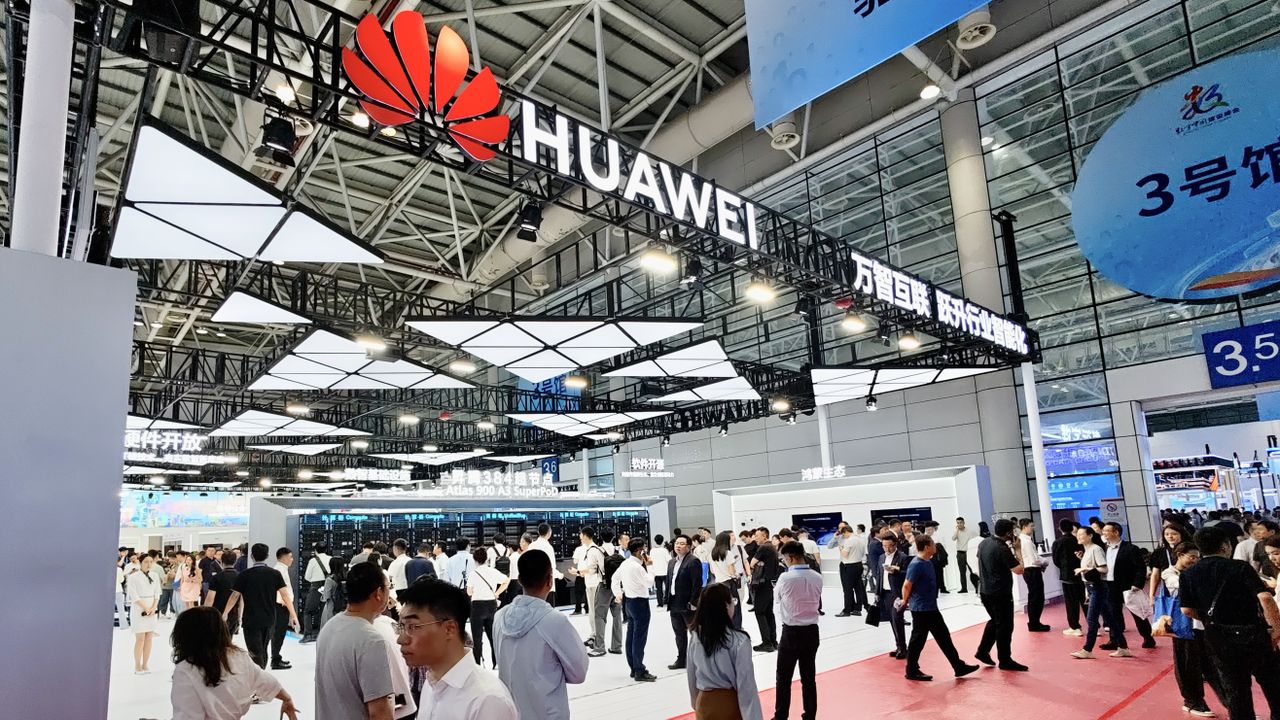
A Financial Times report has claimed that Shenzhen-based Huawei is on track to capture the largest share of China’s AI chip market this year, following growing demand from Chinese firms seeking domestic alternatives to American chipmaker Nvidia.
The report comes as Huawei reportedly expects AI chip revenue to surge to $12bn, up from $7.5bn in 2025. The company is basing its forecast of a 60% surge on existing orders for its 950PR chip, which entered mass production just last month. Huawei plans to launch an upgraded version of 950DT in the fourth quarter, as it continues to aggressively expand its chipmaking capabilities.
The move comes as NVIDIA’s China operations — once accounting for up to 25% of its data center business revenue — are being affected by export restrictions and regulatory barriers imposed by both the United States and China amid broader technological and trade tensions between the two countries.
We reported earlier that Nvidia CEO Jensen Huang confirmed in March 2026 that the company had received U.S. licenses to sell H200 AI chips to China and was restarting production to meet demand. However, despite obtaining U.S. clearance and securing orders from Chinese customers, shipments have faced hurdles, with reports suggesting potential delays due to Chinese import regulations.
The Financial Times report claims that Beijing has instructed Chinese tech companies to limit their use of Nvidia chips to their overseas operations, while supporting domestic manufacturing. On the other hand, US regulators require that all NNvidia chips ordered by Chinese clients only be used in China. These contradictory demands have led to a stalemate in customs clearance for H200 shipments to China.
Most of Huawei's AI chips are manufactured by Semiconductor Manufacturing International Corporation (SMIC), China’s leading fab. The company plans to add two additional dedicated fabrication plants this year. If it successfully ramps production, then its initial revenue forecast will likely see a boost.
In all these, Nvidia's chips remain more advanced. However, Huawei is taking a different strategic approach to compete with Nvidia in AI hardware. The company has improved its chips enough to target a rapidly growing part of the AI market: inference — the computation AI models use to generate answers and perform real-world tasks after training is complete.
According to the Financial Times, the Chinese tech group has positioned its latest 950PR processors as the hardware of choice for domestic companies running inference.
Huawei believes inference will become the biggest source of AI computing demand as AI assistants and autonomous agents become more common. Since inference workloads are generally less demanding than training massive AI models, Huawei can remain competitive despite weaker raw chip performance.
To compensate further, Huawei is linking large numbers of its chips together using its networking technology to create powerful AI computing clusters, effectively boosting overall system performance even if each individual chip is weaker.
The gamble appears to be working, starting with DeepSeek. While its latest v4 model was trained on Nvidia chips, DeepSeek used Huawei’s 950PR for inference, the company confirmed last month.
Nvidia apparently sees this as concerning.
“The day that DeepSeek comes out on Huawei first, that is a horrible outcome for our nation - It could lead to a scenario where AI models around the world are developed and they run best on non-American hardware,” said Nvidia's Huang in a recent interview with podcaster Dwarkesh Patel.
For now, Nvidia still holds several major advantages. One of the biggest is its software ecosystem. While Huawei has been developing its Cann platform as a domestic alternative to Nvidia’s widely used CUDA software, developers say it still lags significantly behind in usability and maturity. The difficulties involved in working with Cann can increase development complexity and operating costs for customers, helping NVIDIA maintain a strong grip on the global AI ecosystem.
Regardless, Nvidia’s grip on the Chinese AI chip market has weakened considerably. The sector was once dominated by the American chipmaker, largely through sales of its H20 processor — a modified version designed specifically for the Chinese market to comply with U.S. export restrictions. However, after Washington moved to block sales of the H20 to China last year, Nvidia has struggled to find a replacement product that satisfies both American export rules and Chinese regulatory requirements.
According to Morgan Stanley, China’s AI chip market could grow to roughly $67 billion by 2030, with domestic companies expected to supply around 86% of that demand. The firm also estimates that Chinese suppliers alone could account for about $21 billion of the market this year, highlighting how rapidly the country’s homegrown AI semiconductor industry is expanding.