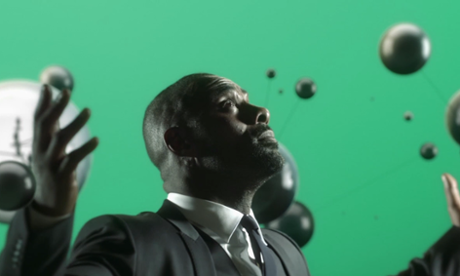
Idris Elba is the presenter of a new, 20-part interactive BBC documentary series called Story of Now, which went live at the end of January on the BBC Taster site, the corporation’s new digital playground for emerging technology and content forms.
Paul Field, CEO of video tech innovator TouchCast Studios UK, and Adrian Burton, executive creative director of branding agency Lambie-Nairn worked closely with the BBC to create an original format utilising the latest tech and design.
How did Story of Now come about?
Paul Field: The idea began with Martin Davidson, head of commissioning for history at the BBC. He’d seen the potential for our tech through pilots BBC Connected Studios had developed. He said taking TouchCast deep into specialist factual content was irresistible. He asked us to look at the entire history of life and pull out the events, ideas and innovations across 13.8bn years to explain how we got to now – the story of now.
We had to think of Story of Now not as a documentary series with a beginning and end, but as a non-linear, ever-expanding platform where the viewer is always in control of the experience. Think of it as the BBC’s answer to Ted talks. Like Ted, you can add more and more over time. Unlike Ted, they’re interactive, shot on location and in every five-minute film there are several hours of content to discover – and all the films live within one video player.
What was the creative process for the campaign?
Adrian Burton: We were initially briefed by Touchcast on the concept and bought up to speed with the technology – I’d suggest that what you experience today is merely the tip of the iceberg. Story of Now clearly challenges the way in which we currently consume content. It’s a revolutionary new platform that required a fresh way of looking at familiar problems. It’s more akin to surfing the web than watching the box – particularly for a younger audience, whose brains are simply wired differently.
Did you approach this in the same way as for other brands?
AB: Essentially yes. Although the deliverables were very specific, we were still building a brand. We needed an engaging way to bring the product to life, starting with a creative toolkit and visual framework in which Story of Now could best express itself and connect its constituent parts. A vibrant and interactive place of learning, a place to explore, discover and wonder.
We had a name, but we needed an idea. An idea from which we could build and provide a distinct visual and verbal identity. It became very clear that whilst the technology may appear quite complex the solution had better be simple. Our story began with a simple dot. A basic visual asset that allowed us to build an underlying narrative, literally joining the dots between categories and within each category. This forms the basis of the visual universe for the whole brand. It’s evident in the intro as presented by Idris Elba, through to the functionality and intuitive nature of the user interface and finally in the logo.
Whilst we were commissioned to define and create the brand’s identity, intro and interface, in this particular case the production aspect would be managed directly by Touchcast, overseen by ourselves. The process worked incredibly well.
Any key challenges or hurdles that the project faced?
PF: We started from a strong position. Our company launched in June 2013, offering users an iPad app for creating TouchCasts and a player that enables viewers to watch and interact. So we already had a robust platform that was being used elsewhere within the BBC, as well as other major clients. We believe the future of the internet is HD video and that one day everything on the web will live inside video, which will be our primary form of communication. We call this new medium the videoweb. It means anything from the web, as well as other video, pictures and games can live inside HD video. When you interact with all this other content you never leave the video. We treat video as the canvas for the web, so technically we already had the platform for Story of Now.
But we’ve launched new features for Story of Now that advance the new medium. As well as our vApps – the interactive graphics you see on screen that lead you to the rich vein of deeper content – we now have metatext and search.
Metatext is subtitles with highlighted keywords that are hyperlinks that lead the viewer to more content. Plus, you can now search inside HD video. In the case of the Story of Now, this means we’re offering the audience a video encyclopaedia. And the beauty of it is we can keep adding to it, and refreshing. The key challenge was how far we could push ourselves and the tech. We’re still pushing… and not sleeping very much!
What has the response and feedback been like?
PF: Amazing. We’re being told by senior figures at the BBC that the response is overwhelmingly positive.
Personally, I loved a tweet sent on the morning we launched by a lady who recommended Story of Now but warned her followers that she couldn’t be held responsible for making them late for work!
More like this
• How we resurrected Audrey Hepburn™ for the Galaxy chocolate ad
• How we brought Homer Simpson to life at Comic-Con
• How we made #WeveGotYourBack with Idris Elba to tackle Ebola
To get weekly news analysis, job alerts and event notifications direct to your inbox, sign up free for Media Network membership.
All Guardian Media Network content is editorially independent except for pieces labelled “Brought to you by” – find out more here.