The US is a huge and highly profitable market, but it takes commitment and perseverance to achieve results. Americans really do have it all within their borders. Many see little need for foreign travel and, as a result, the business outlook can be somewhat insular. Entrepreneurs typically need to build a presence if they want to create opportunities and nurture relationships in the US.
Omega Ingredients: Getting Close To Customers
“There’s a reluctance from American companies to buy from abroad. Their world stops at their borders and if you’re only in Europe you might as well be on the moon,” says Steve Pearce, founder of Omega Ingredients, whose company makes flavourings and fragrances for major manufacturers in the food industry. “You have to have an operation in the USA and some contacts out there as they won’t ring a European number,” he advises.
Pearce cited the US as one of its key growing markets about three years ago. He opened an office in North Carolina after making some preliminary sales. The business now has an agent in the country and its sales in the US have grown significantly in the past year. However, Pearce says it’s been a tough market to crack and the business has had to adapt, even changing its name to Maverick Innovations, following advice from a US PR company. Pearce spends a lot of time in the US, following up on leads created by the agent, exhibiting at trade fairs such as the Institute of Food Technologists (IFT) Annual Meeting, and getting his face known. “I head out there a lot to speak at conferences and to the market place,” he says. “People are getting used to seeing us around and are now starting to see us as part of the industry. It doesn’t happen overnight, you have to accept that you are in it for the long term.”
Pearce says there are big differences between the US and European food markets, and that this continues to be a challenge. “One of the big surprises is that the flavour industry in the USA is way behind where we are here. Also, they really don’t want to pay a lot for flavours - we get that a lot.”
However, he did also score a big win with a bacon flavour for a cheese sauce used by the food service industry, and this could be a future winner for the business. “There’s a huge food service industry in the US and they want industrial quantities. A customer said they wanted two tonnes of our bacon flavour, without even doing any trials. We have grown by about 1000% in the last 12 months, although from a low level.”
Lynher Dairies: Crossing the Atlantic
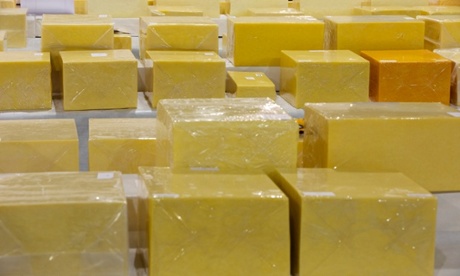
Catherine Mead is the owner of Lynher Dairies which produces Yarg cheese, a unique product made from the milk of Friesian Cows and wrapped in nettles and garlic leaves to mature. The 30-strong company, based in Cornwall, began exporting to the US about 10 years ago following an appearance at the Fancy Food Fair in New York. It outsourced its logistics and sales to the British cheese specialist Neal’s Yard Dairy, however there were still some challenges to overcome. “Our cheese has a shelf life of fourteen weeks, so we had to work out how we were going to deliver it to the US and for it to arrive in top condition. It has to mature en route, you can’t just put it on a pallet and send it out as it wouldn’t arrive in the right condition,” Mead explains. “There was an element of trial and error as the containers are en route for six weeks and we didn’t know what impact that would have on it.”
Mead and her partners solved the problem only to get hit by legislation changes. The US government introduced the Food Safety Modernisation Act, which meant foreign producers had to be audited by US officials. “They came down to do an inspection and wanted to interrogate to the nth degree. But we passed and now have to comply with two sets of compliance, rather than just one.”
Mead’s business does a healthy trade in upmarket delicatessens and is also stocked by the ethical supermarket chain Whole Foods. She says she’d like to supply more but domestic demand is too strong. “I’d like to do more business in the US but we can’t even satisfy demand in the UK so it’s just impossible,” she says.
Bremont Watch Company: building a brand
Some businesses are destined to be export companies and this is certainly the case with Bremont Watch Company. Launched in 2007, the high end watchmaker was founded by brothers Giles and Nick English and appeals to a select and affluent part of the men’s market. “Most of our UK business is in London and a big share of that is international businessmen. I realised that you couldn’t be a high-end watchmaker without being a global brand,” says Giles English. “I went out to the US in 2009 and we did an exhibition with the Walpole Group, who were doing a big trade fair in New York. I set up about 10 meetings, getting to know retailers, and that kick-started the launch.”
Like other entrepreneurs, English realised he needed presence on the ground, but felt that he needed to have close control over where and how his watches were sold. “We could’ve gone with a distributor but I thought they’d do a bad job. I thought they’d just get us into shops without finding the right places, not getting the brand positioning right,” he says. “We very quickly realised that we needed someone out there and I found a really great guy who works as our travelling ambassador.”
But creating a brand can be an expensive business, so the company took the slower approach of working on PR, celebrity endorsements and tie-ups with major brands, such as Boeing. Giles’ brother Nick also moved out to live in LA and get close to the action. “The US is a massive and diverse market and you can lose money really quickly. If I took out an advert in GQ in the US, it would cost 10 times as much as it would in the UK. So we’ve always gone down the PR route, but there’s no single thing you can do, you have to take lots of approaches,” he says.
About 25% of Bremont’s business is now in the US, however, it is on the verge of a major push with the launch of a boutique store New York. “This is our big deal and there’s a lot of risk. We are going for a boutique on Madison. It’s a big investment for us and we really hope it pays off. But in America you have to show you’re serious. If you take them seriously they will take you seriously. If you invest in them, they will invest in you.”
Read more
How to manage your cashflow if you’re exporting
Content on this page is paid for and produced to a brief agreed with UPS, sponsor of the Guardian Small Business exporting to new markets hub.
Sign up to become a member of the Guardian Small Business Network here for more advice, insight and best practice direct to your inbox.