The US dramatically escalated its confrontation with Venezuela on January 3, moving from sanctions and targeted strikes on alleged drug-trafficking vessels to direct military action. In a pre-dawn operation, US forces captured the Venezuelan president, Nicolás Maduro, and his wife, Cilia Flores, and removed them from the country.
The operation has prompted historical comparisons with the US invasion of Panama in late 1989. Although separated by more than three decades and unfolding in different international contexts, the two episodes reveal a continuity in how the US approaches intervention, sovereignty and legality in the western hemisphere.
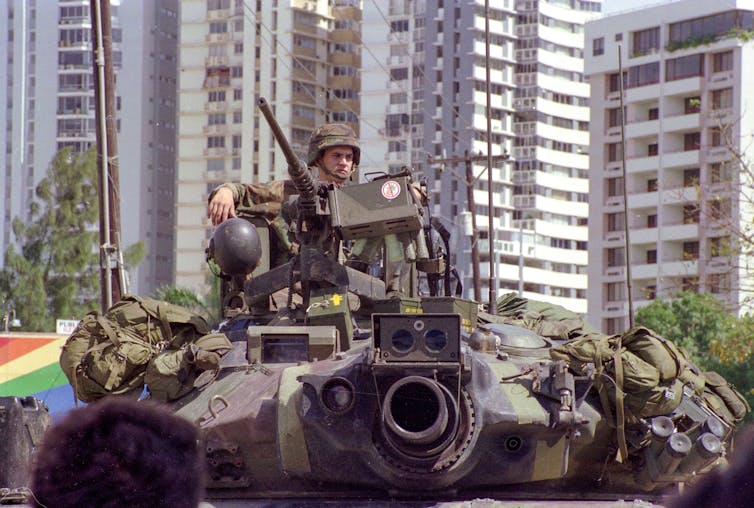
The US invasion of Panama was justified at the time through a now-familiar set of claims. US officials argued they were protecting American citizens, restoring democracy following contested elections, combating drug trafficking and upholding treaty obligations linked to the Panama canal.
However, none of these arguments provided a solid legal basis for the use of force under the UN charter. Panama had not attacked the US, there was no imminent armed threat and the operation was not authorised by the UN security council. The invasion prompted international condemnation and was denounced by the UN general assembly as a violation of international law.
Yet concern over the legality of the operation mattered far less to the US than its political outcome. The Panamanian leader, Manuel Noriega, was removed from power and transferred to the US where he was tried on criminal charges. The US achieved its strategic objectives quickly and international condemnation produced no lasting consequences.
Panama thus established a powerful precedent: a smaller state could be reshaped forcibly without multilateral approval, provided the intervention was framed persuasively and executed decisively.
Central to that framing was what I call the criminalisation of sovereignty. Noriega was portrayed by US politicians not simply as an authoritarian ruler, but as a criminal figure. This mattered because it blurred the line between war and law enforcement, enabling regime change to be recast simply as an arrest.
Panama’s sovereignty, in turn, appeared less like a legal right and more like a shield open to abuse by criminals. While legal issues remained, the framing reduced political resistance, particularly within the US. This logic has reemerged in US discourse surrounding Venezuela.
Venezuela’s authorities have long been portrayed by Washington as criminal, corrupt and illegitimate. The US has designated drug networks linked to Venezuela, such as the so-called Cartel de los Soles, as terrorist organisations. It has also issued indictments against Maduro and other government officials on narco-terrorism and drug-trafficking charges.
As was the case in Panama, this framing shifts the debate away from inter-state relations and towards enforcement against individuals. This weakens the perceived legitimacy of Venezuelan sovereignty and helps normalise coercive external action.
It may also hint at Maduro’s eventual fate. The US state department did not recognise Noriega as Panama’s head of state, which made his later prosecution easier because it was argued he was not entitled to immunity.
Maduro, in a similar way, has been described by the state department as the “de facto but illegitimate ruler of Venezuela”. This purported lack of democratic legitimacy could mean the two men ultimately face a similar outcome in court.
Democracy plays a rhetorical role in both cases. The invasion of Panama was presented as a response to cancelled elections and democratic breakdown. In Venezuela, claims of democratic illegitimacy, contested elections and authoritarian governance have been also used to justify sustained external pressure and, now, direct intervention.
In neither case does democracy function as a legal basis for the use of force. International law does not permit military action to restore or impose democracy, nor does it allow states to determine the legitimacy of other governments unilaterally. Democracy in these contexts operates as a moral narrative rather than a lawful justification.
Pattern of intervention
There are, of course, differences between the two cases. The operation in Panama saw tens of thousands of US troops deployed on the ground. The US intervention in Venezuela was more targeted, relying on a mix of economic sanctions, diplomatic isolation and the selective use of force.
But rather than signalling a transformation in strategic intent, this reflects changes in military technology, media scrutiny and political risk.
Unlike in 1989, modern interventions unfold under real-time global media coverage and social media scrutiny, sharply increasing reputational costs. Greater domestic sensitivity to foreign entanglements also raises the political risk of overt military action.
However, notwithstanding these changes, the objective in both cases remains the same: rapid political disruption designed to weaken or remove an unfriendly regime while avoiding the costs of prolonged occupation.
The international environment has also changed. Panama took place at the end of the cold war, when US dominance in the western hemisphere was largely uncontested. Venezuela unfolds in a more fragmented global order, where regional and global players are more willing to challenge US actions.
Yet this difference cuts both ways. While global opposition may be louder, the enforcement capacity of international law remains limited. As Panama demonstrated, condemnation without consequence does little to deter future interventions.
What ultimately unites the two cases is the principle of selective sovereignty. In both Panama and Venezuela, sovereignty has been treated not as a universal legal protection but as a conditional status. States governed by leaders that have been labelled as criminal, illegitimate or destabilising are seen as having forfeited their rights.
This is not how sovereignty functions in international law, but it is how power often operates in practice. Each time this logic is applied, it weakens the credibility of the rules-based international order and reinforces the idea that legality bends to strength.
Panama’s significance lies precisely in this normalisation, showing that intervention could succeed politically even when it failed legally. Venezuela suggests that this lesson has not only been learned, but refined. Where Panama involved overt illegality, Venezuela reflects a more diffused form of coercion, spread across legal, economic and military domains.
Recent events in Venezuela thus do not represent a dramatic break from past practice. They represent continuity. Panama was not an aberration of the late cold war but a formative moment in post-war US interventionism. Venezuela is its modern-day echo.
The language has evolved and the methods have adapted, but the underlying assumption remains stable: that when powerful states deem it necessary, sovereignty can be suspended, legality reinterpreted and intervention justified after the fact.
That is the real significance of the comparison. Panama then and Venezuela now show a durable pattern in how intervention is imagined, defended and repeated.

Adriana Marin does not work for, consult, own shares in or receive funding from any company or organisation that would benefit from this article, and has disclosed no relevant affiliations beyond their academic appointment.
This article was originally published on The Conversation. Read the original article.