A few years ago, Azaan Merchant was building a successful career in the world of artificial intelligence and venture capital. He was working with technology companies across the UK and California but destiny had different plans for him. Today, he spends much of his time in villages, talking to farmers and agricultural workers.
The shift may seem unusual, but Merchant believes it has led him to a much bigger opportunity: solving one of Indian agriculture's most persistent problems, reports The Better India.
ALSO READ: Weather Tomorrow July 2
Through his startup, Bharat Intelligence, Merchant and his co-founder Gaurav Sanghai are using technology to connect farmers with workers through WhatsApp, helping labourers secure more consistent work and higher incomes while giving farmers access to reliable labour when they need it.
Workers who once earned around Rs 6,000-Rs 7,000 a month are now making close to Rs 20,000. In some cases, annual household incomes have risen from around Rs 50,000 to as much as Rs 3 lakh-Rs 4 lakh.
"In some cases, families are going from Rs 50,000 a year to Rs 3-4 lakh," Merchant told The Better India. "That's a massive shift."
ALSO READ: Annapurna Yojana Status Check
The moment that changed his career
Merchant did not originally plan to work in agriculture. "I spent almost 10 years working abroad, investing in enterprise technology companies across the UK and California," he told the media outlet.
During that time, he helped grow a venture capital fund from $50 million to $400 million and worked alongside companies that later achieved valuations exceeding Rs 10,000 crore. His introduction to rural India came unexpectedly after returning home.
"I was asked to join the board of an NGO in the agri space; that was kind of my entry into understanding rural India," he says.
Curious to understand the sector better, Merchant began travelling extensively across Maharashtra. He spent months meeting farmers, studying horticulture supply chains and observing the realities of agricultural life.
"The more time I spent out there, I realised that there was a lot of potential to impact the lives of millions of people in a relatively straightforward manner," he explained.
"There was one problem which farmers kept talking about, the labour issue. It was just accepted as a problem, and no one challenged it."
Eventually, he decided to do exactly that. Two years ago, Merchant left his high-paying AI job and set out to build a solution.
A problem hidden in plain sight
India has more than 144 million agricultural labourers. Yet farmers across the country continue to struggle with labour shortages.
The problem becomes particularly acute in horticulture, where operations such as pruning, harvesting and plantation must happen within specific time windows.
Traditionally, farmers hire workers through personal contacts, neighbouring villages, labour chowks or local middlemen.
The process is often chaotic. Workers may not show up. Skilled labour may not be available. Payments can get delayed. Farmers frequently have no visibility into future labour availability, while workers rarely know how much work they will receive.
For crops such as grapes, even a short delay can affect yields and profits. According to Bharat Intelligence, the issue is not a lack of workers.
"We realised the problem wasn't the absence of people," said co-founder Gaurav Sanghai. "It was visibility, liquidity, and coordination. So we decided to solve it as a matchmaking problem."
Building a digital matchmaker for farm labour
Merchant needed someone who could build the technology behind the vision. He found that partner in Sanghai, an engineer with a Master's degree in Artificial Intelligence from IIT.
The two met through a venture incubator that paired founders with potential co-founders. "Out of all the people out there, Gaurav had the perfect technical complementary skill set," Merchant recalled. "And most importantly, he had a nation-first mentality."
Sanghai was drawn by the opportunity to apply advanced technology to a problem affecting millions. "Taking the cutting-edge technology into the part of the pyramid where people need it the most," he says.
Together, they launched Bharat Intelligence. The company was registered in 2024 and officially began operations in 2025.
No app, just WhatsApp
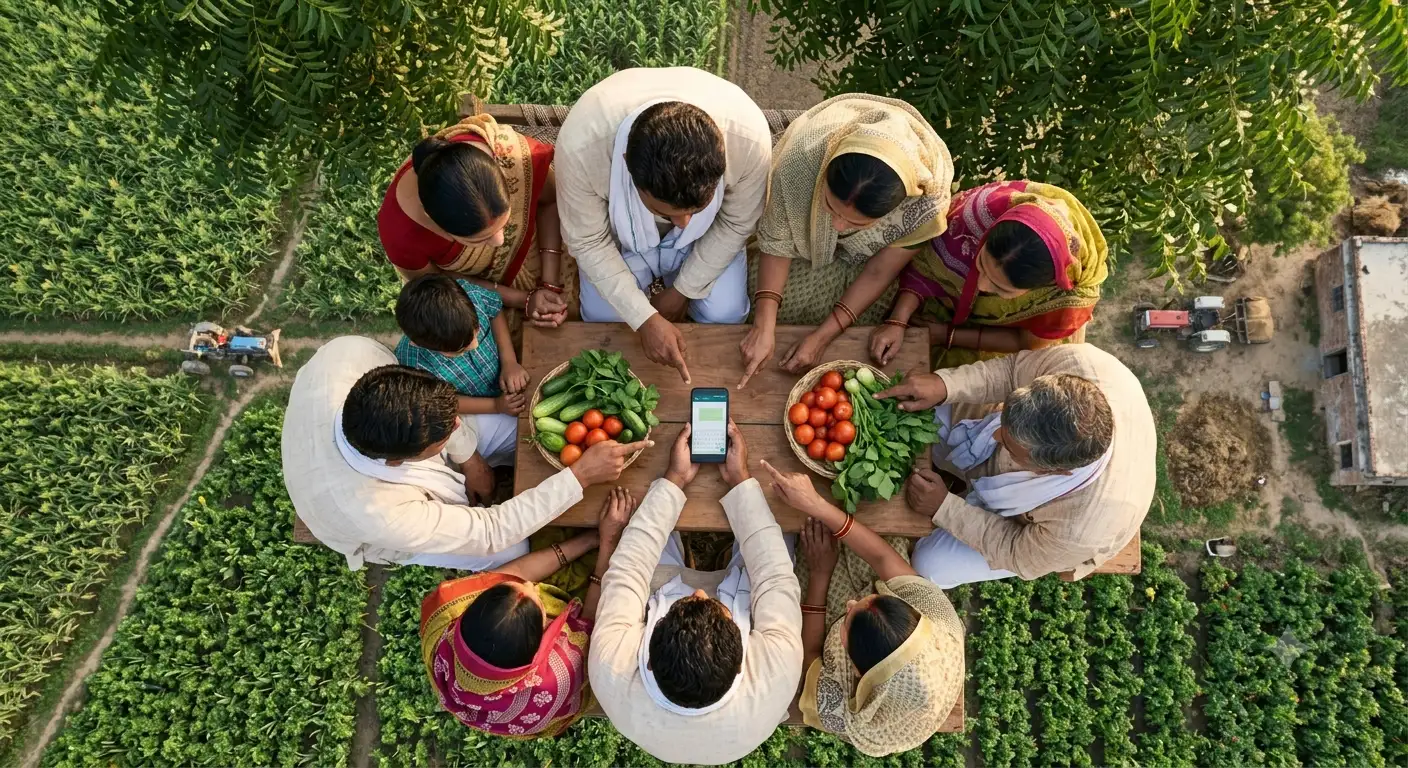
One of the startup's biggest decisions was keeping things simple. Instead of asking farmers and labourers to learn a new application, Bharat Intelligence works through WhatsApp and voice calls.
For users, the process is straightforward. Behind the scenes, however, the platform analyses close to 100 data points about farmers and their crops. These include acreage, crop type, plantation schedules, pruning dates and local farming patterns.
In grape cultivation, a single pruning date can help predict labour requirements for roughly 130 days. At the same time, the company maps labour pools across villages by tracking migration patterns, worker skills, availability and reliability.
The result is what Bharat Intelligence calls a "Rural Intelligence Knowledge Graph" — a constantly evolving map of agricultural labour.
"We want to become the operating system for labour," Sanghai explained. "A place where we understand who is where, what they do, and how to connect them efficiently."
Farmers can finally plan ahead
For farmers, the biggest benefit is certainty. Instead of scrambling for workers throughout the season, they can plan labour requirements months in advance.
A farmer growing grapes can secure workers for multiple operations across the crop cycle, while the platform handles coordination and scheduling.
Merchant said farmers are not asking for anything complicated.
"They just want labour to show up on time, nothing more." For Nashik farmer Bapusaheb Salunkhe, that reliability has made a significant difference.
"They come on time now," he said. "Earlier it was hard to find labour, but after using this platform, my problem is solved." "The platform is very convenient on WhatsApp," Salunkhe stated. "Things get done faster and always on time."
From uncertainty to stable work
The changes are perhaps most visible among workers. Before joining the platform, 28-year-old Janardhan Bhoye often dealt with broken promises and delayed payments.
"Sometimes we were promised work for five acres, but after reaching there, it would become two-and-a-half," he recalled. "Payment would get delayed, sometimes for days."
"We don't have to look for work anymore," he said. "The company helps us find it."
Workers are assigned projects throughout the season, with some receiving employment for up to 300 days a year. Many are paid according to output rather than fixed daily wages, allowing earnings to increase with productivity.
The company says daily earnings now range between Rs 800 and Rs 1,000, while monthly incomes have risen to around Rs 20,000 for many workers. "It is far better than before," Bhoye says. "It's time-effective, and overall, it benefits us."
Women are driving household income growth
Nearly half of the workers on the platform are women. Many work alongside their husbands as teams, helping families significantly increase annual earnings.
Beyond wages, the company is also working toward skill certification, digital work identities, insurance access and social security benefits for workers.
The road ahead
So far, Bharat Intelligence has completed operations across more than 5,000 acres of vineyards in Nashik.
The company has deployed around 3,000 workers, with another 2,000 expected to join. It also reports an 86% repeat farmer rate and says it generated a labour pipeline worth more than Rs 2 crore within 10 days of launch without spending on marketing.
The founders now plan to expand beyond grapes into crops such as bananas, cotton, sugarcane and coffee. Their long-term goal is ambitious: organise and deploy 10 lakh rural workers over the next five years.
For Merchant, the mission remains rooted in the conversations he had with farmers across Maharashtra.
For workers like Bhoye, however, the value is simpler. "If it continues like this, this would mean a steady flow of work, reliable income, and one less uncertainty to worry about each day," he says.
And for thousands of farm families, that certainty may be worth far more than any technology powering it.