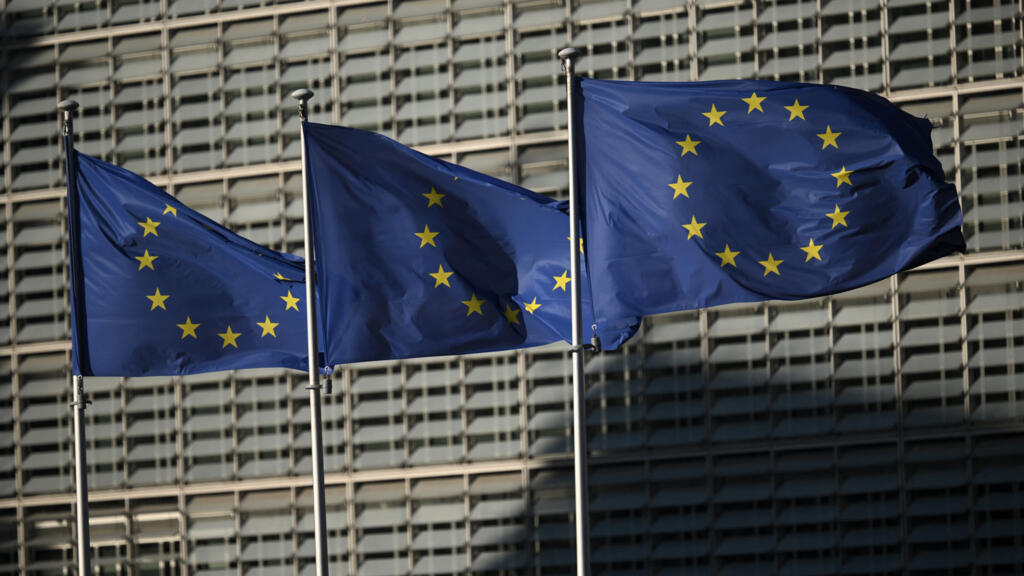
Catalysed by the actions of US President Donald Trump since his return to office one year ago, the European Union has scrambled to finalise a slew of trade agreements, underscoring the bloc’s desire to diversify as transatlantic relations are tested to the limit.
For decades, the Euopean Union – the world’s largest trading bloc – has operated within an international order anchored by close economic and security ties with the United States.
However, Washington’s renewed willingness to wield tariffs, security guarantees and diplomatic pressure as bargaining tools has reinforced a growing conviction in Brussels that Europe must broaden its partnerships and reduce its exposure to political shock waves.
Depsite being heckled as weak and irrelevant by the White House, the EU has responded with an outward-looking strategy.
Over the past year, the bloc has struck or revived trade deals across Asia and Latin America, upgraded ties with key partners in the Indo-Pacific and pushed ahead with negotiations in the Gulf.
EU and India seal 'mother of all trade deals' as leaders meet in New Delhi
Trade diversification gathers pace
Of late, European leaders have been frank about what is driving this shift. Speaking at the European Parliament last week, Cyprus president Nikos Christodoulides – who currently holds the EU’s rotating presidency – said the assumptions underpinning Europe’s prosperity could no longer be taken for granted.
“The international order we relied upon for decades is no longer a given,” he said. “This moment calls for action, decisive, credible and united action. It calls for a union that is more autonomous and open to the world.”
Shifting up a gear – into a faster, more assertive trade agenda – the EU has finalised a sweeping agreement with India, concluded its first trade deal with Indonesia and signed a long-delayed pact with the Mercosur nations of South America.
The Mercosur deal alone creates the prospect of a free trade area covering more than 700 million people.
Talks are also advancing with partners in the Gulf, including the United Arab Emirates.
EU seeks stability after Trump steps back on Greenland and tariffs
Despite transatlantic tensions, these agreements are more of a recalibration rather than a total rupture. Analysts say Europe’s drive to diversify was already under way, shaped by concerns over China’s ever-growing economic clout.
“This movement towards diversification, looking for new partners as well as building self-reliance, was driven home by the fracture of the transatlantic partnership,” according to Garima Mohan, a senior fellow at the German Marshall Fund. “The timing of these deals says something about the world we live in.”
The unpredictability of US policy has played a key role. Even when tariff threats are later withdrawn, they have underscored how quickly trade can become entangled with unrelated political disputes.
For Brussels, spreading risk across multiple partners is increasingly seen as simple prudence.
“There is a hope that things will change, given the importance of the US for us,” says Ivano di Carlo, a senior policy analyst at the European Policy Centre. “But there is also a realisation now that we are a bit more alone in this world.”
Trump reverses course on Greenland, drops tariff threat, citing 'deal'
From trade to strategic autonomy
Trade policy is only one part of a wider shift that also spans defence and energy. Russia’s 2022 invasion of Ukraine exposed weaknesses in Europe’s security architecture, while criticism from the Trump administration over low defence spending injected new urgency into long-running debates.
EU leaders have since agreed to raise defence budgets, with €150 billion in loans earmarked for areas ranging from air and missile defence to drones, cyber systems and artificial intelligence.
France has been a leading advocate of greater “strategic autonomy”, a concept that has gained ground as Washington has signalled its security priorities lie elsewhere.
EU countries give final approval to Russian gas ban, commit to wind power
As the EU cut its reliance on Russian supplies, it increased imports from the United States. Today, over 14 percent of EU oil imports and 60 percent of liquefied natural gas come from the US – improving short-term security while creating new dependencies.
“We do not want to replace one dependency for another – we need to diversify,” said Dan Jørgensen, the European commissioner for energy and housing, speaking in Hamburg this week.
For policymakers, the links between trade, defence and energy are becoming clearer.
As Garima Mohan put it, “Decoupling is easier said than done.” But by leaning into its strength as the world’s largest trading bloc, the EU is betting that diversification offers the best way through a more fragmented global order.
(with newswires)