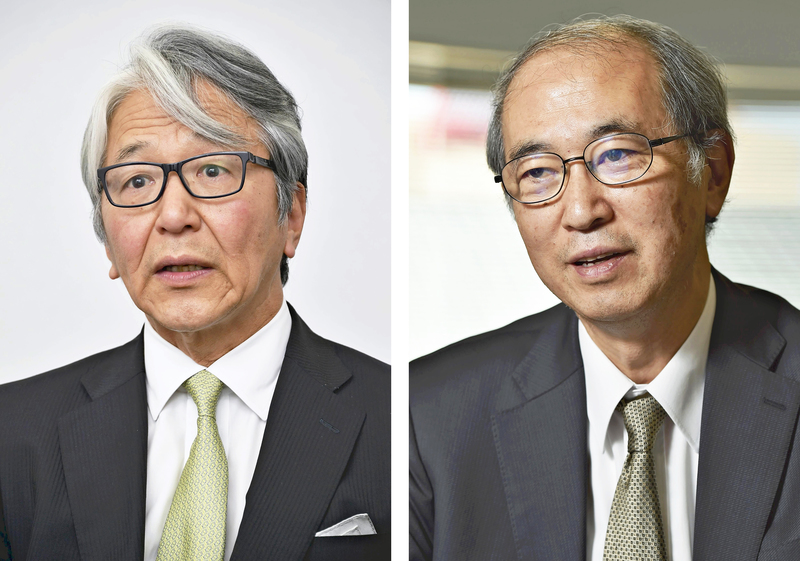
Japan-U.S. summit talks were held between Prime Minister Shinzo Abe and U.S. President Donald Trump on April 17-18 in Palm Beach, Fla. Have any results been achieved in the meeting on major problems, such as the denuclearization of North Korea, the return of Japanese citizens abducted by the regime, and the resolution of the countries' trade issues? We interviewed experts to ask them about this. The following articles are excerpted from the interviews.
(From The Yomiuri Shimbun, April 20, 2018)
Japan's presence felt in world
The Japan-U.S. summit talks were successful in many ways regarding North Korean problems. It was very significant that Japan was able to make its presence felt throughout the world -- including in North Korea, China and South Korea -- during this period of profound upheaval over security concerns in East Asia.
The summit also proved fruitful in terms of its content.
U.S. President Donald Trump accepted a proposal for talks with North Korea, which the regime has wanted for decades, without asking for anything in return. Moreover, the position of U.S. secretary of state is vacant, and there are few staff now in the State Department who have expert knowledge of the history and circumstances regarding previous negotiations with North Korea. Prime Minister Shinzo Abe has built a relationship of trust with Trump, which enabled him to serve as an adviser and teach Trump about the history of these negotiations and the importance of North Korea's denuclearization.
Regarding Japanese nationals who have been abducted by North Korea, Trump promised he would raise the issue during the talks, saying he would do everything he could to bring them back to Japan. It could be argued that Trump making such a statement was the result of various actions taken by Abe and the relationship of trust he has built with Trump.
However, there is concern about Trump's diplomatic style. He makes sudden top-down decisions, such as a decision to talk with the North Korean chief. From now on, there will also most likely be a variety of developments. The important thing is for Japan not to be left in the dark. Japan must continue to influence the United States and South Korea, using the summit results as leverage, and stay within the group of parties involved in the North Korean problems.
The Japanese government may not have known in advance about U.S. Central Intelligence Agency Director Mike Pompeo's visit to North Korea to meet with Kim Jong Un. It is important for Japan to promote information-sharing with the United States as one of the parties involved.
Regarding North Korea's nuclear and missile development, there are opinions in the United States that if North Korea ceases development of intercontinental ballistic missiles, then it would be permissible to loosen economic sanctions on the regime because the U.S. mainland would be safe.
Trump confirmed he would seek North Korea's abandonment of short- and medium-range ballistic missiles capable of reaching Japan during the talks. But there is concern that he will move forward with relaxing economic sanctions and pursue economic cooperation with North Korea if Japan does not maintain close cooperation with the United States.
I think that six-party talks -- comprising Japan, the United States, South Korea, China, Russia and North Korea -- are the best option to aim for North Korea's denuclearization. Six-party talks were actually held during the 2000s, although they ended in failure at that time. The situation now is different and there is an idea to change the style of past six-party talks into dialogue among foreign ministers.
On the other hand, the two leaders are divided in the economic sphere. Abe described the Trans-Pacific Partnership as the best option, and Trump insisted on bilateral negotiations. I think that Trump wants a visible change ahead of the mid-term elections in November.
-- This interview was conducted by Yomiuri Shimbun Staff Writer Naoyuki Shiomi.
-- Mitoji Yabunaka / Former Administrative Vice Foreign Minister
Yabunaka entered the Foreign Ministry in 1969. He was engaged in Japan-U.S. economic negotiations, and headed Japan's delegation in the six-party talks on North Korean problems. He is currently a visiting professor at Ritsumeikan University.
Talks ended in draw on ecomomy
There was no major change in the economic sphere resulting from the Japan-U.S. summit. One can say the meetings ended in a draw, with each nation insisting on its own stance.
What had been feared was a situation in which U.S. President Donald Trump linked North Korea's abduction and nuclear problems with economic issues, with Japan being forced to accept U.S. economic demands. It is laudable that Prime Minister Shinzo Abe avoided this worst-case scenario and reiterated his advocacy for the TPP.
While Trump did not formally ask Japan to start negotiating their free trade agreement, he is attempting to resolve the trade imbalance that exists between the two countries by means of bilateral trade talks and import restrictions through imposing high tariffs. This is a mistake.
For example, the policy of imposing high tariffs on steel imports is expected to benefit the United States in the short term -- it would temporarily prolong the life of the U.S. steel industry. However, it will not lead to recovering its competitiveness from a long-term perspective.
It will negatively affect not only steel producers in China and Japan, but the U.S. automobile industry and other industries that use steel products. While protectionist policies perhaps make sense in the context of the mid-term elections, they are not desirable as they will disrupt the global trade system.
At the talks, the two leaders agreed to create a new framework to discuss trade issues between Toshimitsu Motegi, minister in charge of economic revitalization, and U.S. Trade Representative Robert Lighthizer. Motegi, who has led the new TPP deal reached by 11 countries, may be the perfect person for negotiating with the Trump administration.
However, the two nations' economic dialogue has already begun between Deputy Prime Minister Taro Aso and U.S. Vice President Mike Pence. It is unclear how the new dialogue will differ from the ongoing dialogue.
The United States will likely seek the expansion of exports to Japan for its agricultural products and automobiles in upcoming trade talks, which it has demanded from Japan for a long time. Japan will likely demand the repeal of tariffs on Japanese cars, which became a focal point in the TPP negotiations. In the event of a full-scale confrontation, it will be important to search for compromise.
Looking back on previous trade talks, they often led to government-managed trade, in which, for example, Japan voluntarily restricted car exports to the United States, or promised to increase the import of U.S.-made auto parts to Japan. Japan should absolutely avoid repeating such past concessions.
The bilateral FTA negotiations desired by Trump are a one-on-one framework, which would be subject to political pressure.
Japan should first quickly bring the 11-country TPP into effect and expand the new TPP by inviting other countries like South Korea. If a new TPP comes into effect, it will disadvantage U.S. beef and other products entering the Japanese market. It is important to focus on creating a situation that forces the United States to return to the TPP.
-- This interview was conducted by Yomiuri Shimbun Staff Writer Sachiko Aoki.
-- Shujiro Urata / Professor at Waseda University
Urata is a specialist in international economics. After working as an economist at the World Bank, he assumed his current post in 2005. He is a coeditor of "Nihon no TPP Senryaku: Kadai to Tenbo" (TPP strategy in Japan: Challenges and prospects).
Read more from The Japan News at https://japannews.yomiuri.co.jp/