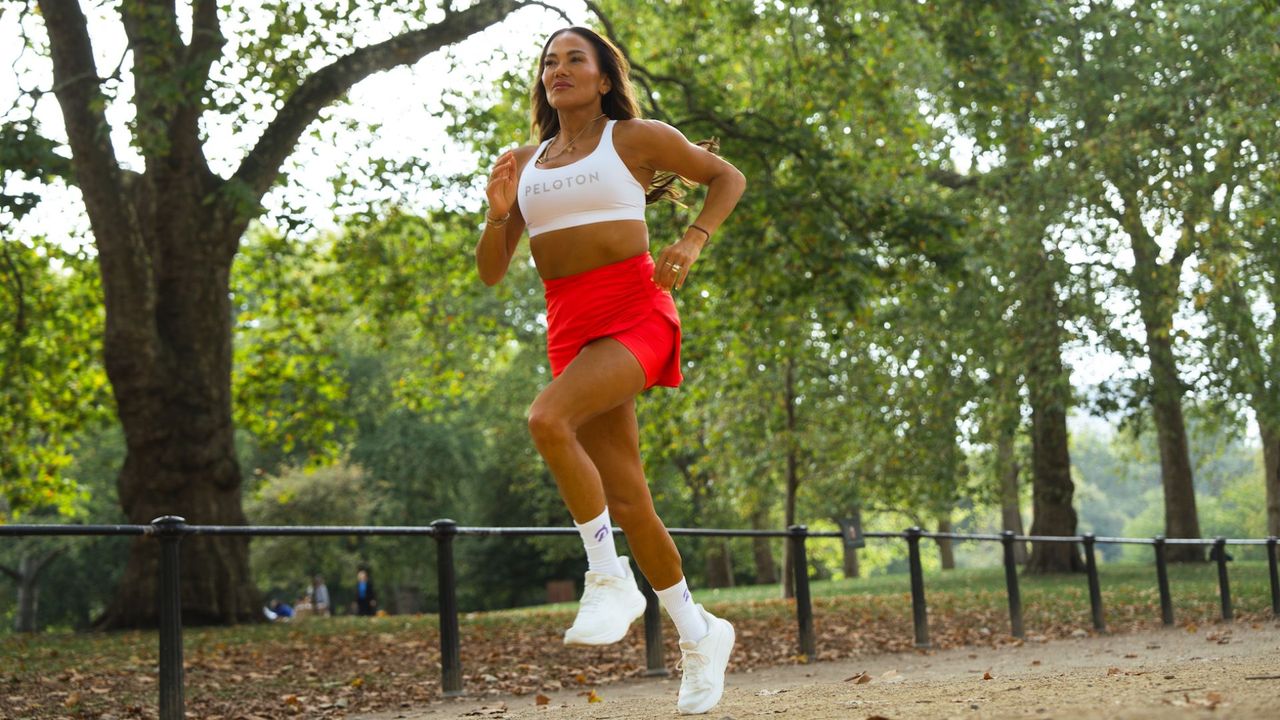
Susie Chan has been in a hurry since she first started running at age 35.
Quickly falling in love with the sport, her mileage rapidly cranked up to 50 miles a week while she rattled through numerous long-distance races and led daily Peloton classes.
Now 51, and having just completed the 81-mile Badwater Salton Sea ultra, she has no intention of giving up the big races—but she is actively training smarter rather than harder these days.
“I’m trying to be a bit more balanced,” Chan tells Fit&Well, from Peloton Studios London.
“I’ve intentionally gone down to less than 40 miles per week to give my legs a rest and make space to work a bit more on strength and mobility.”
That includes strategically scaling her training back once or twice a year, and being a lot more intentional about the harder, tougher sessions.
“I don't force it,” says the four-time Marathon des Sables finisher. “There have been days when I won’t do anything.
“I have one or two months a year when I just dial it right back and keep things ticking over.
“Obviously I work. I have to run for my job. But outside of that, if I’m tired, I’ll leave it for the day or I’ll swap out a run for a fun 30-minute bike ride, or yoga or mobility session.”
With age comes maturity, says Chan. “Your reason for running evolves as you evolve.
“At 51, having done the races that I’ve done, I don’t feel like I need to prove anything to anybody,” she says.
“Not that I ever did. But if I’m getting tired, I will just step back from it because I love my job and right now my priority is showing up for work strong and healthy.”
A post shared by Fit&Well (@wearefitandwell)
A photo posted by on
Outside of the studio, Chan is still determined to keep running for as long as her feet will carry her.
“The 35-year-old Susie would not recognise me,” she says, adding she wishes she had started running earlier in life. “It’s a complete 180° on the sort of person I was in my 20s and early 30s—for the better.
“Not so much for the fitness, though that’s great to have, but for the confidence it’s given me.”
She goes on to explain the positive community aspect of running: “I’ve found the people I enjoy spending time with, the social side of it all. I don’t know how to explain it to non-runners, but once you find running, running becomes your thing.
“It’s almost like a religion. You’ll run with runners. You’ll meet with other runners. It’s a whole community and way of life,” she adds. “I’m just so glad I found it and started doing it.”
While Chan hopes to keep running for a long time to come, she breaks down how to train smarter as you age in three clear points.
1. Swap short-term goals for long-term endurance
With countless personal records and even world records to her name, Chan is now playing the long game.
“When you’re younger, or new to running, it’s all very exciting and you can get PBs because that’s available to you,” she says. “If you’ve been running for a long time, that becomes harder and harder.”
Instead of pushing to shave a few seconds off her time, Chan backs off when feeling tired so she can keep showing up for work, and the people that she loves.
2. Become an all-rounder
In the past, Chan would run and run, sparing little time for strength or mobility.
Now, aware that muscles and bones naturally weaken as you age, she’s committing more time to running-specific strength training and weekly yoga or Pilates classes.
"At least once a week I'll do a Peloton strength class, either a full-body strength workout or one focusing on the glutes and legs," she says. "Just don't dwell on how weak my arms are."
3. Prioritize rest days
Since turning 50, Chan is paying greater respect to rest days and being more selective about the hard sessions in her training schedule.
“I’m a lot more intentional about the hard work that I do now,” she says.
“By that, I mean the faster work. It is absolutely so hard for me now. My pace is very slow and steady.
“I can run all day nice and slow, but I only really push myself like that if there’s a real fitness reason, like a goal-orientated race I'm working toward.”
If that means taking more rest days, she’s all for it.
“I’m much more balanced in my approach to training. Ten years ago I would just keep going and going.”