
Almost all English teachers will have, at some point, taught Harper Lee’s classic To Kill a Mockingbird. The story, which explores injustice and racial prejudice in America’s deep south, has long been a staple on school syllabuses around the world.
That’s why educators will have waited with bated breath for the book’s long-awaited sequel, Go Set a Watchman, to finally hit the shelves – picking up from where Mockingbird left off some 20 years on.
The re-emergence of this classic story is a great opportunity to get your students excited about Lee’s original novel. This week the Guardian Teacher Network brings you lots of ideas and resources to help you explore this much-loved tale.
Jump straight into chapter one with this PowerPoint about the literary techniques that are used in the opening. Lee’s language helps paint a vivid picture of life in the fictional town of Maycomb. Working in groups, ask students to record their first impressions of Scout, the book’s protagonist, on a large spider diagram. In pairs, challenge your class to find and describe the effect of different similes and metaphors. Or, as an individual task, ask for written paragraphs about Jem Finch, Scout’s older brother, based on what they have learned through Lee’s use of description, dialogue and action. The presentation is accompanied by five worksheets and the full resource is available on the Teacher of English website.
The book is full of complex and engaging characters for your students to discover. This worksheet by webanywhere.co.uk will help your class build a character portrait of Atticus Finch, Scout’s father, adding key information, details of small (but significant) events, and important quotations. One of Atticus’s most memorable lines – “You never really understand a person until you consider things from his point of view … until you climb into his skin and walk around in it” – comes in chapter three. As a literacy task, challenge students to explain what they think he means in 100 words.
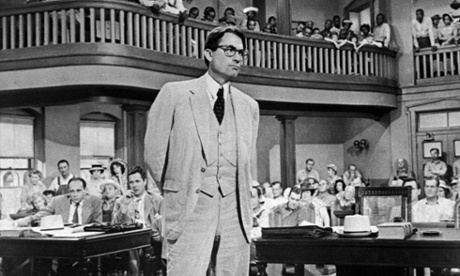
Once you’ve tackled the characters go beyond the written text and explore the film version of the story. Ask students to think critically about how the book has been adapted for the screen. There are lots of tools to help you do this including this guide by Into Film. It looks at adaptations of seven popular novels – such as Of Mice and Men, The Great Gatsby and To Kill a Mockingbird. Students are encouraged to think about the suitability of the actors chosen to portray the main characters and how effectively narrative elements such as structure and symbolism are conveyed. Do they agree with the review that describes the film version of To Kill a Mockingbird as “a masterpiece in its own right”? As an extension task, ask students to write a script for the scene where Scout and Jem are attacked on their way home from the pageant from the point of view of Boo Radley.
If you’re studying To Kill a Mockingbird for an exam, you need to get your class prepared for likely questions. This resource gives students the chance to read GCSE sample essays with examiner’s comments. Another handy resource for GCSE students asks how Lee uses of the trial of Tom Robinson to explore themes of social and racial prejudice.
Another good way to revise is through games – a great way to help students recall information. This set of dominoes by Teachit English could be used as a whole-class activity to reinforce knowledge of plot, characters and key quotations. We also have a pub-style quiz and a role-play activity that explores the events in chapter six, when Jem, Scout and Dill peek through the shutters of Boo Radley’s house, and a sequencing task. Groups could devise a quiz of their own, similar to this one on the Guardian Children’s Books site, or they could use highlighter pens to create a colourful mind map using this template.
Finally, catch up on the story from where it left off 55 years ago. Ask your class to read the first chapter of Lee’s new book Go Set a Watchman. The story is also available as an audio recording so why not sit back and let the whole class listen to what comes next? What are students’ first impressions? To Kill a Mockingbird is narrated in the first-person while Go Set a Watchman is told in the third-person. What other similarities and differences can students find? These ideas could be recorded in a newspaper-style review or blog post. Alternatively, students could use their knowledge of the themes in To Kill a Mockingbird to design a fresh book cover to contrast with or complement the new release.
Another interesting task would be to research the background to the publication of Go Set a Watchman. Although set 20 years after To Kill a Mockingbird, it was actually Harper Lee’s earliest-known work and her first submission to publishers. Can students find out what happened to the original manuscript after it was written in the mid-1950s? And what do students make of claims that Lee may have written a third novel? This resource will help students find out more about the context in which To Kill a Mockingbird was written and the period in which it is set.
Have you got a teaching resource or lesson plan you want to share with the Guardian Teacher Network community, upload it here.












