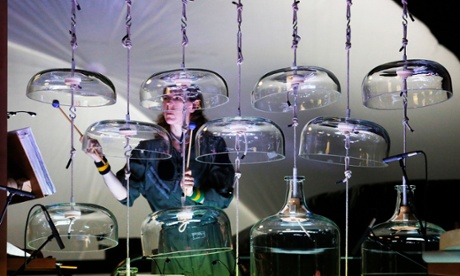
From children strumming on cardboard guitars to observing what happens when a paper plate of rice is placed on top of a loud speaker, teaching sound lends itself to a wide range of fun classroom activities.
But as well as being a blast to teach, the topic – which includes learning how sound is made and how it travels – is central to the science curriculum.
So this week on the Guardian Teacher Network we have a collection of ideas and resources to get students to prick up their ears about sound.
Primary ideas
Kick things off with a lively starter activity for primary students. Ask them to hum their favourite song while pressing their fingers gently against their neck. What can they feel? Next, play some music through a speaker that has some grains of rice on a paper plate on top. What happens when the volume is turned up? These activities and others in this lesson plan by the Hamilton Trust will help students understand that sound is caused by vibrations. Get them to give other examples of when they have “felt” or “seen” sound.
As a follow-up activity ask children to make different sounds with their bodies, for example whistling, clapping or singing. Can they change the volume of these sounds? Introduce a range of instruments – real if you have them or virtual using this whiteboard activity – and ask students to suggest how their sounds are being made. If “pitch” describes how high or low a sound is, how would you play a high note on a xylophone or a low note on a clarinet? Students can make their own instruments, such as guitars using elastic bands of different lengths and thicknesses or milk bottles filled with different amounts of water, to explore this further.
Another key teaching point, covered in this lesson plan and this whiteboard activity (both for key stage 2), is that vibrations from sound sources require a medium, such as air, to travel through. Students can investigate how sound travels through solids by tapping on the table and listening, then repeating the action with their ear to the table. Are they surprised to learn that sound travels faster through a solid than through air? Can students explain why a noise made in the distance sounds quieter than a noise made close by?
As a homework activity, students could explore the many uses of sound. Can they give examples of enjoyable sounds or noises used in an emergency situation? Are there times when sound can be damaging or annoying? Students could present their ideas in the form of a poster or cartoon strip. As a follow-up activity, challenge groups to investigate soundproofing by making earmuffs from a variety of different materials.
At the end of your sound topic, revise your pupils’ learning with this PowerPoint presentation by Twinkl on how sound is made, or get students to fill in the blanks with this end-of-unit cloze exercise by PrimaryLeap.
Secondary ideas
Recording and analysing sound signals is the focus of this whiteboard activity for secondary students. It includes instructions for two demonstrations: the first helps the class visualise how sound travels using a spring and a weight; the second is a drag-and-drop activity in which students use their knowledge of frequency, amplitude, pitch and loudness to match images of sound waves to their descriptions in words.
We also have an interactive tool that illustrates how a sound wave changes as you alter the pitch and volume. If you have access to an oscilloscope, students could say different words into the microphone and note the wave patterns that they produce. Is it easy for two people to say the same word identically? What does this tell us about the difficulties of voice recognition technology?
Exploring wave models and the speed of sound is particularly important at key stage 4. This whiteboard activity gives students the opportunity to calculate the speed of a wave, as well as frequency and wavelength. It also covers the properties of sound waves, including how to use echoes to measure the speed of sound. Students can use the resource for revision by setting each other equations to solve or words to define. There’s more for key stage 4 and key stage 5 in these whiteboard activities about wave motion and the superposition of waves.
Using news reports in the classroom can help bring the topic to life, so why not encourage students to conduct an investigation into an aspect of sound that interests them? Did they know, for example, that sonic waves can be used to suppress fires, or that our brains actually “hear” silent movies? There is even a scientific explanation of why we find some sounds unpleasant.