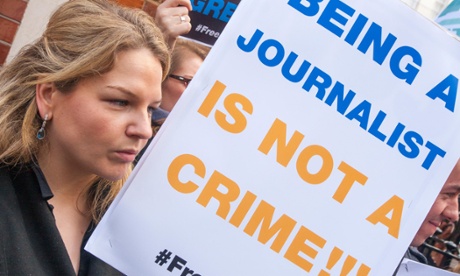
The first ever International Day to End Impunity for crimes against journalists will be held on Sunday 2 November by UNESCO to raise awareness about the fact that the vast majority of crimes against media professionals go unpunished.
On average, one journalist is killed per week, and yet only one in 10 cases of crimes against journalists has led to a conviction. In other words, 631 journalists have been killed with complete impunity since 1992. Over the last decade a total of more than 700 media workers have been killed for bringing news and information to the public according to UNESCO, a shocking statistic illustrated by the recent beheadings of American journalists James Foley and Steven Sotloff in Syria.
Teaching about the value of press freedom, and raising awareness of this important subject can be done in a range of ways.
You could focus on the International Day to End Impunity (IDEI) by asking pupils to explain what impunity means. If attacks on journalists go unpunished, what message does this send to the public and the perpetrators of such crimes? There is a short video on the IDEI website that highlights the scale of the problem. Challenge groups of pupils to create a video, role play or poster of their own on the theme of impunity.
If you want to look at the right to freedom expression, as outlined in Article 19 of the Universal Declaration of Human Rights, and the implications of its denial, start with this lesson plan and presentation by Amnesty International. Ask pupils to explain in their own words what freedom of expression means. Who should it apply to? Why is it important? And why might some organisations seek to prevent it?
Supplement the lesson with current examples of journalists whose freedom of expression has been denied, such as Dina Meza, a journalist from Honduras who has been threatened and harassed because of her efforts to investigate corruption and human rights violations. After reading about her case, ask pupils to consider what action they could take to raise awareness of people like Meza. Thirty journalists have been killed in Honduras in the last four years. What do students think should be done?
Take a look at the UK’s press freedom ranking with this news article from the Guardian. It includes a map illustrating press freedom around the world. Are students surprised that 22 countries are ranked higher than the UK? Working in groups, ask them to choose one of the featured countries to research in greater detail. Are students able to make connections between levels of press freedom and levels of democracy? If a country does not have press freedom, is it likely to have a good human rights record or decent defences against corruption? Why?
As a follow up activity, pupils could create a word wall of related terms such as censorship, intimidation, justice, democracy, transparency, surveillance, dictatorship, harassment and propaganda.
The Committee to Protect Journalists estimates there are about 20 journalists missing in Syria including John Cantlie, the British war photographer and correspondent who was kidnapped in November 2012. The committee’s website also contains a wealth of data about the total number of journalists around the world who have been killed, imprisoned, exiled or gone missing since 1992. Students could use some of these statistics to create an infographic about crimes against journalists.
Reporters Without Borders is another useful source of information. Pupils could research and write a news article in the style of this piece about the deaths of journalists that fail to make the headlines. Should war reporters such as James Foley have more protection? This short video will provide further stimulus for debate.
You might also want to consider the balance between protecting the rights of the individual with the public’s right to know. Taking Liberties is an interactive resource created by the British Library that includes a lesson on press freedom. Pupils consider what information about celebrities or politicians might be in the public interest, and whether people who encourage media attention forfeit their right to privacy. The resource is supported by the Taking Liberties website where students can share their views by taking part in an interactive poll.
Press regulation is examined further in this topic guide from Debating Matters. Students explore claims that the British press is in need of tougher regulation. A separate guide about privacy considers whether the law should prevent the press from intruding into the private lives of public figures.
You’ll find the latest news about press freedom here, along with articles about human rights reporting and the Leveson inquiry into the culture, practices and ethics of the press.