A lump of ancient rock was cracked open earlier this month to reveal something quite unexpected – the fossilised remains of the oldest known relative of modern birds.
The discovery in north-east China of the bird species that lived 130m years ago gives us a great insight into the past; it also provides the perfect opportunity to introduce the exciting topic of fossils in class.
This week on the Guardian Teacher Network we’ve unearthed a selection of ideas and resources to help you rock kids’ minds.
Primary students
Capture the imaginations of primary-age fossil hunters by exploring what fossils look like and how they are formed with these images and this lesson plan by the Hamilton Trust. A key teaching point is that fossils are only formed under very particular conditions, which makes them extremely rare. Children can demonstrate their understanding by drawing cartoon strips (of around six or eight pictures) to show the process of fossilisation.
Investigate different types of fossils with the help of this animation and this website by the Oxford University Museum of Natural History. Working in pairs, ask students to list different kinds of things that have been fossilised, such as footprints and insects. Ask about how trace, mould, resin, and body fossils differ and how are they formed. Use students’ ideas to build a word wall of key vocabulary including terms such as minerals, sediment and pressure.
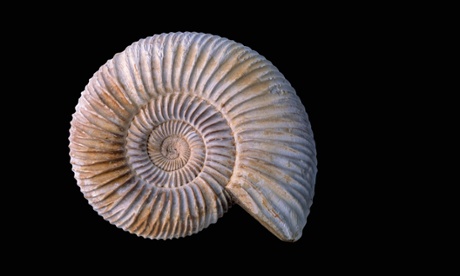
Give students the opportunity to make their own fossils by using the ideas in this lesson plan. One of the easiest and most effective models to make is that of an ammonite, a marine invertebrate that became extinct 65m years ago. Roll out a circle of air-drying clay so that it’s approximately the size of a saucer. Use a plastic tool to draw a spiral from the centre to the outer edge then decorate with ridges and lines so that it looks like this. Use a paper plate and crayons if doing the activity with younger students.
Another fun activity is to let pupils pretend they are palaeontologists by simulating a fossil dig, as explained in this resource by the Eden Project. It includes instructions for making plaster of paris casts that students can excavate. Encourage the class to take photographs and record their findings along the way in a fossil hunter’s journal like this.
Develop students’ understanding of evolution with the help of this lesson plan about the three main layers of the Earth’s crust and its transformation during the different epochs. Why would you not expect to find fossils of mammals in the very oldest epoch? Use students’ knowledge to create a wall display of the Earth’s crust with drawings – or cut out pictures – of different fossils at the correct depth.
As a follow-up lesson or homework activity for key stage 2, students could research British palaeontologist Mary Anning. What were some of her greatest fossil hunting achievements and how did her work affect scientific thinking about the history of the Earth? Older students could research whether she received the credit she deserved. Primary pupils could create biographies of Anning or diary entries about one of her finds for a display under this “Fossil Hunters” banner.
Secondary students
Kick things off with secondary students by introducing the discovery in China, looking at how the remains of Archaeornithura meemannae were discovered complete with exquisitely preserved plumage. Use the report as a reading comprehension exercise, or ask students to create an annotated diagram comparing the prehistoric bird to a modern-day one. You’ll find more fossil-themed news here. You could also get creative by following the fossil-making instructions in this resource (you can find them by clicking on “evolution” and then “activity fossils”) .
As students progress, they should be able to recognise that fossils provide valuable information about how living things have changed over time. The “evidence of evolution” section of this whiteboard resource is ideal for pupils aged 14-16.
Students can explore further why sediments form layers with this interactive whiteboard resource. It looks at how fossils are formed and how they can be used to help sequence events in time.
This article from the education Guardian contains a useful animation about the study of rock layers, known as stratigraphy, and details of an experiment to examine the “polygonal patterns” left in mud as it dries.
For more ideas, go to the How to teach … articles about dinosaurs and Darwin’s theory of evolution.
Follow us on Twitter via @GuardianTeach. Join the Guardian Teacher Network for lesson resources, comment and job opportunities, direct to your inbox.