In Tuesday’s DigiTalk, Quill’s Ed Bussey, StoryScience’s Kohlben Vodden and Outbrain’s Alex Cheeseman explained to brands how they can create an always on content marketing strategy. In this article, we round up the speakers’ top tips and publish the DigiTalk in full. The DigiTalk webinar series addresses the main challenges marketers face in creating effective content marketing strategies.
Seven steps to an always-on approach
Ed Bussey, founder and CEO of Quill
- Ownership of your content. Someone needs to be accountable for content to ensure consistency of your brand and tone of voice.
- Integration across your marketing channels - driving SEO, PR, and above the line activity. It also needs to be considered in terms of the agency roster that you might be working with. Most can’t produce content at scale on a reasonable budget and with the right level of specialism.
- Resources – it’s important that we allocate defined budgets to content. But we must also make sure that the right resources are being deployed, through experienced writers that understand your brand strategy, products and market.
- Strategy – content marketing needs to be managed in the same way as other marketing channels. Design a content plan that meets your marketing objective with defined results at the start of a campaign.
- Processes – it’s hard to scale an always-on content solution without the use of software. Have a central location where different users can collaborate, with metadata and a project management solution.
- Measurement – we must apply the same rigorous ROI analysis on content as on other marketing channels.
- Quality control – it’s challenging but necessary to manage all of the above with a consistent tone of voice, with some pre-agreed localisation for different markets.
The benefits from a data-driven approach are proven
Kohlben Vodden, co-founder of StoryScience
A meta-analysis of industry research including those from McKinsey, Hootsuite and Teradata found that brands taking a data-driven approach to an always-on content strategy can expect:
- Increased ROI by 10-20%
- Free up to 20% of marketing budget
- Improved marketing targeting accuracy
- Faster decision-making
Own your content – both the assets and data
Alex Cheeseman, head of European brand strategy for Outbrain
I wouldn’t advocate having your always-on strategy solely on a platform like Facebook or Pinterest. You may get great engagement, but there’s a few things you won’t fully own – in particular, data, and control. At some point, that platform’s organic reach could plummet and if you’re solely reliant upon them, then you’re subject to whatever changes they make. I recommend operating a hub and spoke model, where your content lives on an owned platform and is at the heart of what you’re doing, with the spokes around them being channels or platforms you can use to create engagement and ultimately drive back into your hub.
The best practice framework for an always-on strategy
Kohlben Vodden, co-founder of StoryScience
- It should always be led by data and insights
- Which in turn informs content creation
- Use data coming from the back end to optimise future content
Look at the right metrics
Alex Cheeseman, head of European brand strategy for Outbrain
Repeat visits - if you’ve paid for someone to come to your site, and they come back again for free, you’ve hit marketer’s gold. Understand which of your content assets is driving through the highest repeat visits, and which paid-for channels are driving through the most people – then focus your media spend here
Page view growth - which content is driving more page views? This is a great metric for driving audience development.
Combining campaign and always-on leads to a cumulative effect, raising the baseline of consumer engagement
Alex Cheeseman, head of European brand strategy for Outbrain
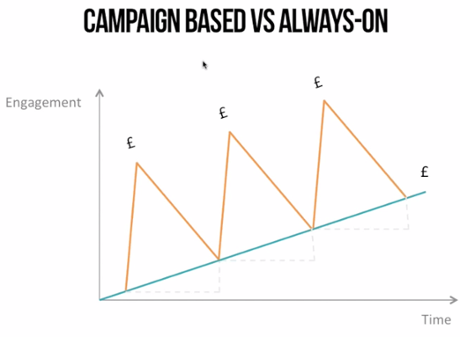
We’re not advocating to scrap campaigns - there’s certainly a time and place for campaign activity. But if you underpin a campaign with an always-on strategy, every time a campaign finishes, rather than going back to zero user engagement, what you’ll start to see is a delta, where user engagement will never shrink to zero again.
Sources of data to inform brand strategy
Kohlben Vodden, co-founder of StoryScience
- Analytics - email, web and social performance data of current brand pages. This will tell you which pieces of content are resonating, and in which segments.
- Social listening - this can be through free or paid-for platforms. Demonstrates what content is being shared, and therefore, what your audience find value in.
- Search queries - eg. Google’s keyword tool which gives an indication of the intent of people’s searches on Google.
- Distribution partners - such as Outbrain. They have a wealth of insights across their content network, and are able to report efficacy of content across regions, or even cities.
This DigiTalk was brought to you by Outbrain, sponsors of the Guardian Media Network’s digital content hub