Small islands may be the ideal setting for a baffling “locked-room mystery” solvable only by Jim Bergerac or Hercule Poirot, but real crime is rare on Britain’s tiny isles.
When it happens, it’s big news, and the Hebridean island of Canna (population: around 20) has been deluged with offers of help from around the globe since suffering its first crime in years: knitted hats were stolen from its shop, which operates with an unlocked door and an honesty box.
The crime rate on hundreds of inhabited British isles is virtually zero. The reasons are obvious: small communities trust each other and need to work together, while opportunities for passing criminals are limited by water. (When a visiting labourer pinched a mailbox from the Scottish island of Coll, police were waiting for him when he disembarked from the ferry on to the mainland.)
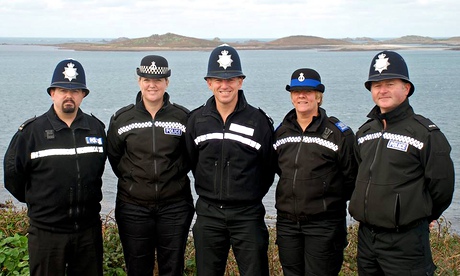
But policing such places may be more challenging than imagined by the applicants for “quite possibly the most enviable policing post in the UK or even the world”, as a job ad for a PC on the Isles of Scilly put it in April. That ad went viral, thanks in part to its description of how the successful applicant would have to be able to handle an abandoned seal pup on the high street, resolve disagreements between drunk chefs over the best type of sea-salt, and issue a parking ticket to their spouse.
Its author, Sergeant Colin Taylor, describes policing Scilly (pop: 2,200) as “like Heartbeat but less frenetic”. Recent tasks wittily chronicled on social media include alerting people to a chemical spillage and introducing the police commissioner to the police department’s cat.
Taylor is currently training on the dastardly mainland, so for an insight into policing small islands, I call Clive Mumford, Scilly’s chief crime (and everything else) reporter, who must be the only journalist who sells the newspapers he writes for, also running his family’s newsagents on St Mary’s.
“I suppose having three police officers is quite a luxury but they’ve got to have a day off,” says Mumford of the hard-pressed Isle of Scilly Police Department.
Apart from doubling-up as traffic wardens and arresting the occasional drink-driver, the biggest challenge for Scilly officers is becoming an accepted part of the community without being compromised by their island friendships. “Striking the right balance is difficult and I admire the people who do it,” he says.
One recruit was too officious and didn’t last long. “He came in all the mainland gear. He was known as RoboCop,” recalls Mumford. Too pally is no good, either: Devon and Cornwall Police usually recall officers to the mainland after three years – before, as Mumford puts it, “they become too accustomed to Scillonian ways”.