It is fashionable to say that every season brings something new for the cook. Back in November we rejoiced at the arrival of autumn. The pumpkins with their sweet orange flesh. The delicate scents of parsnips and celeriac. The mighty kale. But the stretch from December to late March, is taxing for even the most inventive cook. Not for nothing is it known as the hunger gap, which is why midwinter festivities such as Hanukah and Christmas are so welcome.
Basically, what’s left is roots. Roots, roots, roots. The only antidote to the monotony is to do unusual things to your roots, such as grating them. The inspiration for this approach is the traditional potato latke, served at Hanukah. In their purest form, latkes are nothing more than grated onion, potatoes and egg, formed into patties and fried. This is traditionally done in an awful lot of oil.
Most sources will tell you that this is because Jewish people eat latkes to celebrate the “miracle of the single cruse”. After victory over the Greeks, the Hasmonean family could only find a single cruse (or pitcher) of oil, enough to burn for one day – but it ended up burning for eight.
There’s another, Biblical story for latke, which demonstrates their culinary versatility. Judith, a daughter of the Hasmoneans, made latkes with a strong cheese in the mix, and fed them to an enemy leader. They made him so thirsty that he gulped down too much wine, got plastered and Judith seized the opportunity to chop his head off.
The only danger most of us need fear from traditional latkes is their oily richness. However, they are a really easy thing for novice or nervous cooks to experiment on, especially at Hanukah. Reduce the oil, experiment with different flavours and vegetables and you will find you can create a whole array of different vegetable dishes to get you – happily – through the hunger gap and beyond.
Latkes
Preparation time: 10 minutes
Cooking time: 15 minutes
Makes about 20
500g floury potatoes, washed, skins on
2 banana shallots or 1 large onion
2 eggs
1 tbsp cornflour
Salt and black pepper
Rapeseed oil, for frying
1 Grate the potatoes and onions on the coarse side of a box grater (or on the fine plate of a food processor).
2 In a large bowl, whisk together the eggs with the cornflour and a good pinch of salt.
3 Put the veg in a clean tea towel and squeeze the life out of them to remove as much moisture as possible. It may be easier do this in two batches. Stir the dry veg into the egg mix. Season well and combine with your fingers.
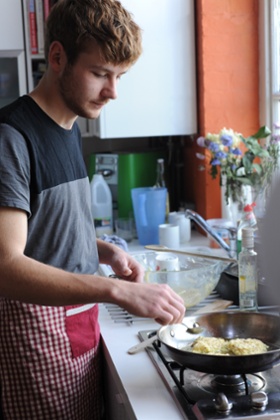
4 Fill a shallow frying pan with oil to a depth of 5mm. Heat the oil until hot, but not smoking. If you are nervous about this, drop a sugar cube-sized lump of bread in – when it turns golden brown you are ready to go. Spoon the latke mix into the pan using a dessert spoon and press each spoonful down. Cook for a few minutes on each side until brown and crisp.
5 Remove the cooked latkes from the oil with a slotted spoon and transfer on to a rack, so they stay crisp until all of them are cooked.
Serving suggestions
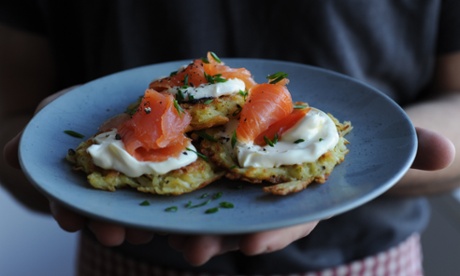
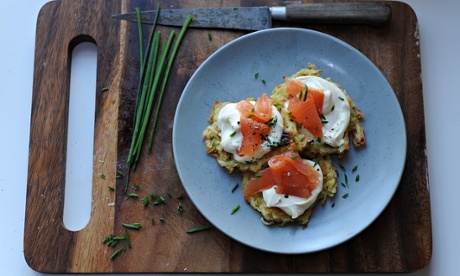
They are traditionally served with apple sauce and sour cream, but they are also good used as a base for smoked salmon with sour cream and chives. Toasted caraway seeds in the latke mix would work well with this topping.
Variations
Once you have got the hang of the basic principle, you can make healthier, everyday latkes by varying the vegetables and reducing the amount of oil in the pan. You can experiment with any root vegetable, but these are some of our favourites:
• Grated (raw) beetroot makes wonderful latkes with a little caraway. Try serving with a some horseradish stirred into yoghurt.
• A mix of half potato, half parsnip or courgette (well squeezed) is very good.
• Sweet potatoes make good latkes. Serve with a Mexican-style fresh salsa (a little supermarket seasonal cheat) of chopped tomatoes, grilled corn, olive oil, finely chopped onions, lime juice and coriander.
• Add blanched greens (carefully squeezed) into the mix. Spinach, chopped finely, is great, but broccoli, kale and cabbage (a crispy bubble and squeak) all work too. A little finely sliced garlic added to the mix is delicious in these.
• Indian latkes. Add turmeric, cumin and freshly chopped chillis to the mix. Serve with seasoned yoghurt with coriander chopped into it, and lime wedges.
• Mima’s Martian meteors. A great way to encourage your children to eat more winter vegetables. Use a 500g mix of any root vegetables you have to hand. (We go for swede, parsnip, celeriac and carrot). Replace the egg and cornflour with 100g gram (chickpea) flour, 200ml soda water (enough to make a smooth batter the consistency of double cream), 1 tsp baking powder, and 1 tsp garam masala. Form into walnut-sized balls.
Henry Dimbleby is co-founder of the natural fast-food restaurant chain Leon (@henry_leon). Recipe by Jane Baxter