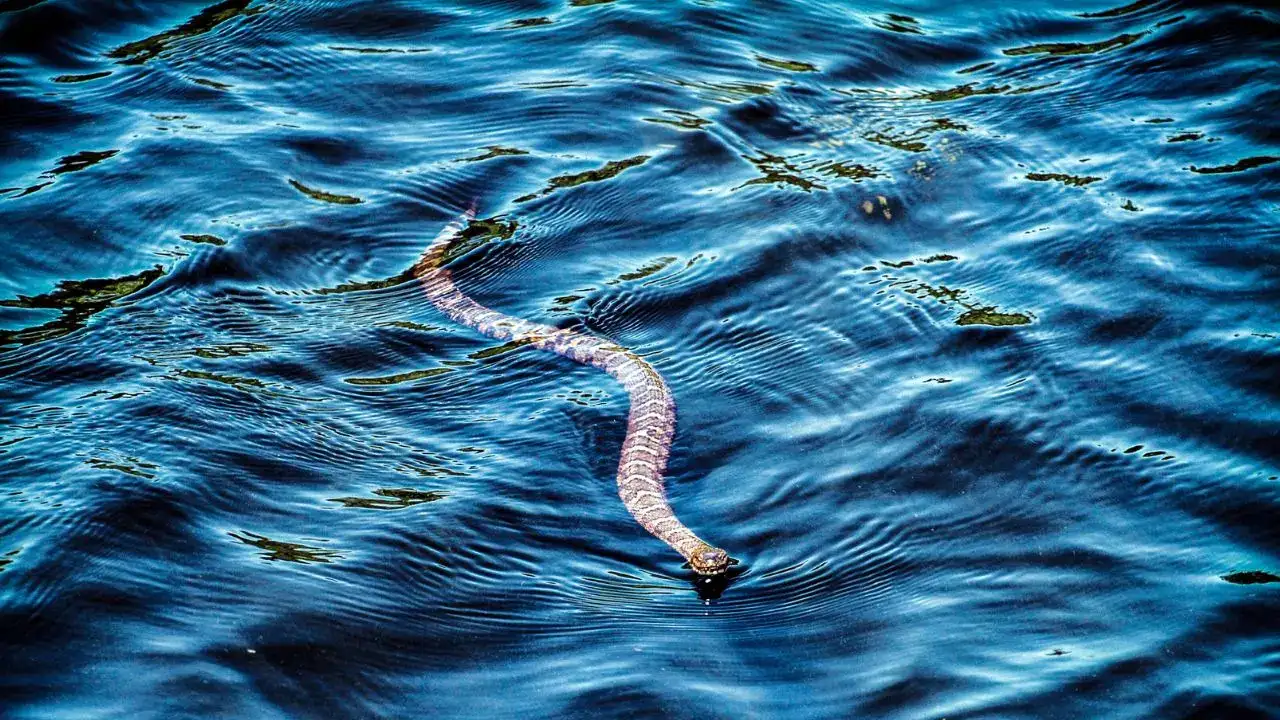
One of the most misunderstood types of reptiles in America is the cottonmouth. Whenever someone sees a dark snake close to any bodies of water like ponds, marshes, drainage ditches, and creeks, he or she automatically assumes that the snake is a cottonmouth. It is important for us to know how to identify a cottonmouth by looking into certain characteristics, rather than by using just one very distinct characteristic alone. The following features are the criteria mentioned by scientists and field guides when identifying cottonmouths:
According to the Florida Museum of Natural History, cottonmouths are semiaquatic pit vipers, which typically dwell in wetlands and water systems throughout the southeastern part of the United States. However, there are other harmless species of snakes that can also live in the same areas as these cottonmouths.
Look at the body and facial markings first
As experts suggest, it is always safer to identify cottonmouths by observing several of its physical traits simultaneously. The Florida Museum of Natural History describes cottonmouths as stout and heavy-bodied snakes with broad heads and distinctive dark facial stripes running through their eyes.
Many adult snakes tend to be dark brown in color, although some may also have darker bands or patterns. Young cottonmouths are also known to have a sulfur-yellow tail tip. Scientists suggest that the bright tail serves as an attraction tool for catching their prey, including frogs and other small creatures.
In its identification manual, the Florida Museum also warns people not to judge any species by color alone. Mature specimens tend to darken significantly with age, making the pattern hard to discern in poor lighting conditions and murky water environments.
An important characteristic of cottonmouths is their eye. The pupils are vertical and elliptical, like those of cats. In contrast, harmless watersnakes usually have round pupils. Specialists working with wildlife recommend being cautious because the above-mentioned signs can be hard to verify from afar, even due to environmental factors.
Why habitat plays an important role
Cottonmouths are mostly aquatic species. They are often spotted near ponds, swamps, creeks, canals, retention pools, and marshes. According to the US Geological Survey, these snakes are semiaquatic, predatory animals that feed on fish, amphibians, birds, turtles, and mammals. Their predilection for wetlands relates to their feeding preferences.
But the experts advise us that the habitat alone does not provide evidence. A snake swimming through the water in a lake may very well be a cottonmouth or an innocent watersnake.
According to the Florida Museum of Natural History, the watersnakes can be even more common in most wetland habitats. So, scientists advise us that habitat should be taken into account as supplementary information only.