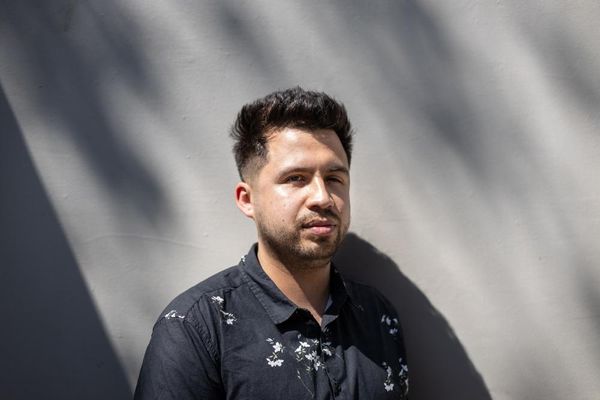
Ted Dewlan now, and how his head might look once hunted. Photograph: Ted Dewlan
How should museums treat human remains? There's been a new twist on the debate courtesy of artist Ted Dewlan. If the Pitt Rivers Museum in Oxford has to return ten shrunken heads in their collection to their original provinence, the Upper Amazon, Dewlan has offered his own head instead - after he's died of natural causes rather than being decapitated by one of his enemies, naturally.
It would hardly be exchanging like for like, mind - these are historically significant heads, taken by tribesmen as trophies, so the shrunken head of some new guy isn't much of a replacement. Yet the story touches on some eternal sore spots - the appropriation of dead bodies, the way they're displayed and of course who they really belong to: especially when the treatment of corpses is surrounded by taboos in absolutely every culture in the world.
Rationally, I would always argue that human remains should be displayed in museums - after all, there's no substitute for seeing the real thing. But on an instinctive level, I still think there's something very shocking about seeing a dead body, even when that body has been toast for centuries. Call me squeamish - I am - but some part of me thought it wrong that an entire naked, mummified corpse was lying curled up in a glass case for all to see the last time I visited the British Museum. It felt disrespectful to the person it had been, and also strangely over-intimate for the viewer. Nothing would have got me into Bodyworlds a few years ago - the whole premise seemed disturbing to me, posing corpses like they were marionettes - but a colleague said that seeing it gave him a renewed vigour for life.
Of course, context is everything. The human remains at Auschwitz bring home the full horror of what happened there. The tombs and mummies of Ancient Egypt are the three-dimensional expression of that culture's extraordinary mythology. Of course it's all dead matter, but it's the taboos we have around death which give those artefacts their charge. Or am I just being sentimental? After all, the owners of those bones are a long way past caring.