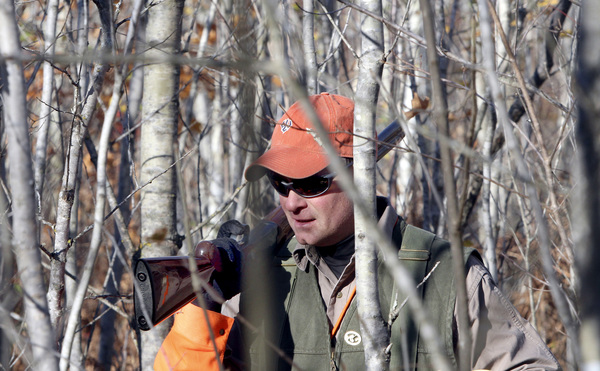
DULUTH, Minn. _ Grouse hunting is, by its nature, a walk in the woods. A couple of recent lost-hunter incidents, one in Pine County and another near Remer, serve as reminders that hunters can sometimes find themselves turned around. Both of those incidents involved hunters being lost for multiple days and requiring rescue.
With that in mind, here are some tips on how not to get lost grouse hunting, from David "Swede" Johnson, a regional director for the Ruffed Grouse Society from River Falls, Wis.
What you take with you when you go into the woods can make all the difference. Here's what Johnson takes when he ventures into the woods:
_ A pin-on compass on his vest
_ A surveyor's compass in his vest pocket
_ A Garmin Oregon handheld GPS
_ A butane lighter
_ A lightweight rain poncho (could double as rudimentary shelter)
_ Two 32-ounce water bottles
_ Clif Bars or other energy foods
_ A Leatherman or similar multi-tool (for removing porcupine quills from his dog)
Why two compasses? In case the needle on the vest compass sticks, Johnson said. (And because sometimes a lost hunter doesn't believe the first compass.)
Before he enters the woods, Johnson tries to orient himself with some major feature _ a road, a railroad, a pipeline _ that he could walk toward if he becomes disoriented. As long as he knows, for instance, where an east-west road lies, he could walk north or south to find it.
That plan could be complicated if a major swamp lies between a hunter and his known geographical feature. But much of the time, it works.
Johnson doesn't use his GPS to navigate while he's hunting.
"I use it to mark the vehicle, and then shut it off," he said. "I just want to go where the cover takes me. Then, if I can't figure out where I'm at, I'll use the Garmin to get back to the vehicle."