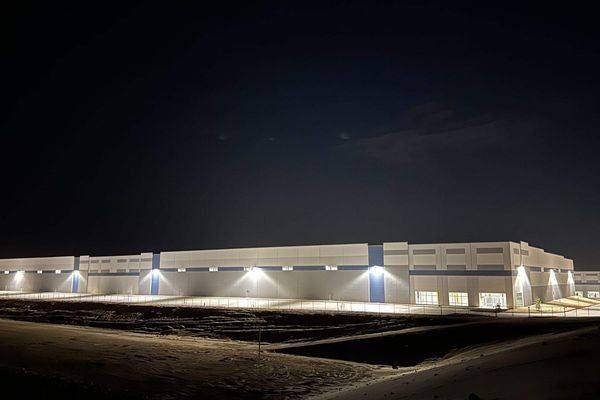
Nov. 09--Modifying a wheelchair-accessible vehicle at the BraunAbility factory in Winamac, Ind., is a technologically complex process.
A Honda Odyssey, Toyota Sienna, Dodge Grand Caravan, Chrysler Town Country or, now for the first time ever, Ford Explorer, comes into a manually powered line at the factory looking the same as when it left the automaker's factory.
There are four main areas of distinction for modifying the Explorer into the MXV: installing a gliding door; cutting the b-pillar in half; using a cantilevered seat base; employing a sliding gear shifter box.
First the vehicle is gutted, except for the headliner and dashboard, which are covered and remain intact. Most of the gutted parts, including the fuel tank, are stored to be modified and reattached later in the line. The passenger-side door is scrapped and recycled, then a new one is made at the plant.
The rear axle is removed, then the entire floor is cut out. A new floor, situated 4 to 8 inches lower and with the ADA-required harness clasps and other settings, is welded back on. The new floors are made at BraunAbility.
Modifying the Explorer to become the MVX requires slicing in half the passenger side B-pillar, or the vertical part of the frame where the rear door is connected, so that a side ramp can fit in the doorway.
The next step is to seam-seal the modified body and match paint colors. Then the modified rear axle, typically with compressed springs, is reattached.
Next comes rewiring, which, if you've never seen a vehicle's innards, is as daunting as trying to identify all the blood vessels in that nightmarish anatomy class. Adding to the dozens of wires common in modern cars, BraunAbility puts in connections for automated chair plugs, as well as the power ramp wiring.
The vehicle is pushed to the next section, where custom-made doors are reattached with either side-entry or rear-entry power ramps. The side-door hinge on the passenger side of the MXV frame is on the rear part of the doorway, not the front.
The modified doors are taller, wider and, in the case of the MXV, equipped with a rear sliding hinge similar to a minivan but without the track.
The original interior and exterior cladding are reattached, and modified rocker panels made in the factory are attached. Then the modified seats, built on a platform to compensate for the lowered floor, and equipped with wheels to roll in and out of the ramp, are reinstalled.
The seats in the MXV are cantilevered, meaning that the rear portion of the seat bottom is cut on an angle so that when a person in a wheelchair wheels into the middle section, he can easily swing his feet under the driver's seat to ride shotgun, or swing his feet under the passenger side to get into the driver's position. .
"We're maximizing every possible inch that we have," explained Jim Probst, director of vehicle platforms for BraunAbility.
Another MXV-patented feature is the gearbox, which can be moved about 6 inches left or right to accommodate either a wheelchair driver or wheelchair passenger.
Once the base-model WAV is fitted, it is shipped to one of over 200 National Mobility Equipment Dealers Association-certified mobility dealers, who then help the customer customize it even further to suit particular needs.
"It's hard to tell where Ford ends and BraunAbility begins," Probst said. "That's the point."