LOS ANGELES — Not far from Santa Catalina Island, in an ocean shared by divers and fishermen, kelp forests and whales, David Valentine decoded unusual signals underwater that gave him chills.
The University of California, Santa Barbara scientist was supposed to be studying methane seeps that day, but with a deep-sea robot on loan and a few hours to spare, now was the chance to confirm an environmental abuse that others in the past could not. He was chasing a hunch, and sure enough, initial sonar scans pinged back a pattern of dots that popped up on the map like a trail of breadcrumbs.
The robot made its way 3,000 feet down to the bottom, beaming bright lights and a camera as it slowly skimmed the seafloor. At this depth and darkness, the uncharted topography felt as eerie as driving through a vast desert at night.
And that's when the barrels came into view.
Barrels filled with toxic chemicals banned decades ago.
Leaking.
And littered across the ocean floor.
"Holy crap. This is real," Valentine said. "This stuff really is down there.
"It has been sitting here this whole time, right off our shore."
Tales of this buried secret bubbling under the sea had haunted Valentine for years: a largely unknown chapter in the most infamous case of environmental destruction off the coast of Los Angeles — one lasting decades, costing tens of millions of dollars, frustrating generations of scientists. The fouling of the ocean was so reckless, some said, it seemed unimaginable.
As many as half a million of these barrels could still be underwater right now, according to interviews and a Los Angeles Times review of historical records, manifests and undigitized research. From 1947 to 1982, the nation's largest manufacturer of DDT — a pesticide so powerful that it poisoned birds and fish — was based in Los Angeles.
An epic Superfund battle later exposed the company's disposal of toxic waste through sewage pipes that poured into the ocean — but all the DDT that was barged out to sea drew comparatively little attention.
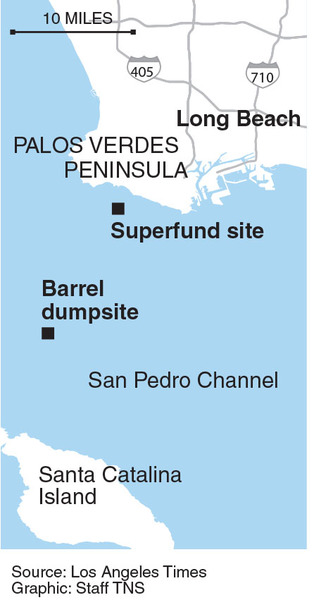
Shipping logs show that every month in the years after World War II, thousands of barrels of acid sludge laced with this synthetic chemical were boated out to a site near Catalina and dumped into the deep ocean — so vast that, according to common wisdom at the time, it would dilute even the most dangerous poisons.
Regulators reported in the 1980s that the men in charge of getting rid of the DDT waste sometimes took shortcuts and just dumped it closer to shore. And when the barrels were too buoyant to sink on their own, one report said, the crews simply punctured them.
The ocean buried the evidence for generations, but modern technology can take scientists to new depths. In 2011 and 2013, Valentine and his research team were able to identify about 60 barrels and collect a few samples during brief forays at the end of other research missions.
One sediment sample showed DDT concentrations 40 times greater than the highest contamination recorded at the Superfund site — a federally designated area of hazardous waste that officials had contained to shallower waters near Palos Verdes.
The world today wrestles with microplastics, bisphenol A (BPA), per- and polyfluoroalkyl substances (PFAS) and other toxics so unnatural they don't seem to ever go away. But DDT — the all-but-indestructible compound dichlorodiphenyltrichloroethane, which first stunned and jolted the public into environmental action — persists as an unsolved and largely forgotten problem.
Signs warning of tainted fish to this day still cover local piers. Recent studies show our immune systems may be compromised. A new generation of women — exposed to DDT from their mothers, who were exposed by their mothers — grapples with the still-mysterious risks of breast cancer.
The contamination in sea lions and dolphins continues to stump scientists, and the near extinction of falcons and bald eagles shows how poisoning one corner of the world can ripple across the whole ecosystem.
Decades of bureaucracy and competing environmental issues have diverted the public's attention. Valentine hoped digging up physical evidence from the seafloor would get more people to care, but calls and emails to numerous officials since his discovery have gone nowhere.
Rallying for the deep ocean is not easy, Valentine acknowledged, even though we rely on the health of these waters far more than we know: "The fact that there could be half a million barrels down there ... we owe it to ourselves to figure out what happened, what's actually down there and how much it's all spreading."