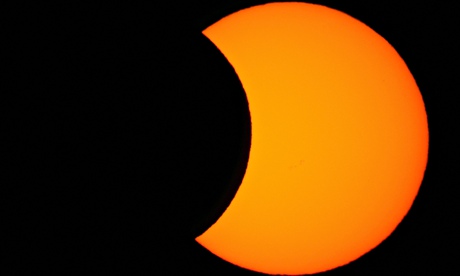
Eclipses and equinoxes have often been deployed in literature, as potent symbols or backdrops. A solar eclipse will be visible across the UK on 20 March, when it coincides with the vernal equinox. Will they provide similar inspiration for today’s authors?
Homer, The Odyssey
The climax of the epic poem, when Odysseus returns to his kingdom and to Penelope, is accompanied by a seer’s vision of an eclipse (“the Sun has been obliterated from the sky, and an unlucky darkness invades the world”) that seems to foretell the slaying of the suitors. It has been argued that this dates the work’s setting by connecting it to astronomical phenomena in 1178BC.
William Shakespeare, King Lear
“These late eclipses in the sun and moon portend no good to us,” says Gloucester, and goes on to sketch an apocalyptic world, setting the template for the myriad dystopian fictions of 400 years later. “Nature finds itself scourged by the sequent effects. Love cools, friendship falls off, brothers divide, in cities mutinies, in countries discord, in palaces treason, and the bond cracked ‘twixt son and father ... We have seen the best of our time. Machinations, hollowness, treachery, and all ruinous disorders follow us disquietly to our graves.”
John Donne, “The Sun Rising”
It is not a real one, when Donne says of the sun’s beams in his witty love poem that he “could eclipse and cloud them with a wink”; but what is proposed is an eclipse-like disempowering, in which the vibrant lovers reclaim centrality in the universe from it (“this bed thy centre is”) and the ageing star is reduced to the couple’s heating supplier.
Thomas Hardy The Return of the Native
Clym, the titular native back in Wessex, falls symbolically and disastrously for haughty femme fatale Eustacia Vye (who assumes he will take her back to Paris with him) as they watch a lunar eclipse, and is himself eclipsed in their subsequent marriage. Hardy also wrote the poem, “At a Lunar Eclipse”, in which the phenomenon is typically glumly connected to a global scenario of “continents of moil and misery ... Nation against nation, brains that teem”.
Mark Twain, A Connecticut Yankee at the Court of King Arthur
Twain’s time-travelling engineer saves his own life by using his knowledge of an eclipse’s timing, telling Arthur he will blot out the Sun if the king orders his execution. Fishily, Rider Haggard had used a similar plot device four years earlier in King Solomon’s Mines, but both authors were drawing on a story told by Christopher Columbus.
Amy Lowell, “Vernal equinox”
In a strikingly steamy poem for staid 1915, Lowell’s narrator says spring’s onset makes her “uneasy with the thrusting of green shoots / Outside, in the night” before finally asking: “Why are you not here to overpower me with your tense and urgent love?”
Hergé, Prisoners of the Sun
Like Twain’s Yankee, Tintin uses a solar eclipse to evade death: he knows the moon will block the sun from setting light to the pyre on which the Incas have placed him and his pals.
John Updike, Rabbit, Run
The first part of a quartet that Julian Barnes says adds up to “the greatest postwar American novel” begins with Rabbit Angstrom leaving his wife on the eve of the vernal equinox, a date that seems to propitiously symbolise a new beginning; but he has gone backwards not forwards, and the day of the equinox itself finds the former sports star with his old basketball coach.
Stephen King, Dolores Claiborne
The titular live-in nurse (Kathy Bates in the movie version) did not kill her elderly patient, she insists in this first-person confession, but she does admit to killing her child-abusing husband many years earlier during a solar eclipse.
John Banville, Eclipse
A solar eclipse provides the climax for this novel with obvious parallels with Banville’s Booker-winning The Sea; its protagonist is an actor who returns to his childhood after a personal eclipse, having corpsed on stage during a first night.