The Animal That Cannot Exist Without Us
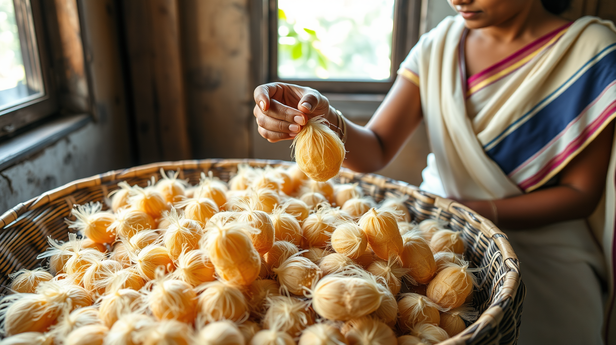
Bombyx mori, the mulberry silkworm, is the only fully domesticated insect in the world outside the honeybee. It is blind. It cannot fly. Its wild ancestor, Bombyx mandarina, still exists in China and Japan, but Bombyx mori cannot survive outside human care, five thousand years of selective breeding have made it entirely dependent on the people who rear it. A single cocoon contains a continuous silk thread between 600 and 900 metres long, spun from two salivary glands that merge at the moth's spinneret into a single filament coated in a protein called sericin. The thread is not woven. It is secreted, in one unbroken line, over three to four days.
That biological specificity, one animal, one thread, one unbreakable process, is what made silk impossible to fake and easy to monopolise.
China's Secret and the Price of Keeping It
Chinese records place the discovery of sericulture at around 2700 BCE, attributed in legend to the empress Leizu, who supposedly watched a cocoon unravel into her tea. The mythology is less important than what followed: China held exclusive knowledge of silk production for roughly two and a half millennia. The penalty for smuggling silkworm eggs or cocoons out of the empire was death. That was not hyperbole. It was enforced.
The secrecy worked. Silk became so valuable that the Han dynasty used bolts of it as currency, paying soldiers, settling debts, and buying peace with the nomadic Xiongnu tribes on the northern frontier. A bolt of silk had a fixed exchange rate against grain. The Chinese state understood, long before modern economists formalised the concept, that scarcity plus desirability equals leverage.
How Silk Built and Broke Empires Along the Trade Routes
The Silk Road was not a single road. It was a shifting network of overland and maritime routes connecting China to Rome, passing through Central Asia, Persia, and the Arabian peninsula. The Parthian empire, based in what is now Iran, controlled the middle section and refused to let Chinese and Roman merchants trade directly. They became the wealthiest middlemen in the ancient world precisely because they understood that controlling access to silk meant controlling the flow of gold.
Rome's appetite for silk was so large it alarmed Roman senators. Pliny the Elder wrote in his Natural History that Rome was losing vast quantities of gold to the East to pay for luxury imports, silk chief among them. He estimated the annual drain at 100 million sesterces, a figure historians debate, but the direction of the complaint is clear. Silk was creating a trade deficit that Rome could not close because it had no product the East wanted as badly.
The monopoly finally broke around 550 CE when the Byzantine Emperor Justinian I sent two Nestorian monks into Sogdia, in present-day Central Asia, with instructions to smuggle silkworm eggs back to Constantinople. They returned with eggs hidden inside hollow walking sticks. Within a generation, Byzantine sericulture was producing enough silk to supply the empire's own workshops. China's exclusive hold on the cocoon was over.
India's Silk, Older Than the Silk Road's Western Half
India's relationship with silk is not a borrowed one. The Arthashastra, Kautilya's treatise on statecraft written roughly in the 4th century BCE, mentions silk production and trade in its sections on commerce and taxation, which places Indian sericulture well before the Silk Road's peak. What India developed was distinct from Chinese silk: four separate silk traditions, each tied to a specific silkworm species and geography. Mulberry silk dominates production, but tasar silk comes from the Antheraea mylitta moth in the forests of Jharkhand and Odisha, eri silk from Assam and the northeastern states, and muga silk, golden, naturally lustrous, produced only in Assam, from the Antheraea assamensis moth, which feeds on the som and soalu trees found nowhere else on earth.
Kanchipuram in Tamil Nadu and Mysore in Karnataka built entire economies around silk weaving, with techniques passed through weaving families across generations. India is now the second-largest silk producer in the world after China, and the largest consumer. The Varanasi brocade tradition, the Paithani of Maharashtra, the Baluchari of West Bengal, each is a distinct answer to the same raw material, shaped by the specific history of the region that produced it.
What the Silkworm Actually Taught Civilisation
The standard account of the Silk Road frames it as a story of trade. The fuller account is a story about information. Alongside silk, the routes carried Buddhism from India into China, Islam westward into Central Asia, papermaking eastward into the Islamic world, and eventually into Europe. The cocoon was the reason the routes existed at all, but the routes carried everything else. Plague travelled them too. The Justinian Plague of 541 CE, which killed perhaps half the population of the Byzantine Empire, almost certainly arrived along the same corridors that brought silk west.
Sericulture itself, once the secret escaped China, spread fast precisely because the knowledge was biological. You needed the eggs, the mulberry trees, and the technique. All three could be carried by two monks in hollow sticks. No other commodity in history transferred so much geopolitical power simply by moving a few thousand insect eggs across a border.
The silkworm never left its mulberry leaf. Every dynasty, trade empire, and diplomatic calculation that formed around it was the world doing the moving, trying to get closer to one blind, flightless caterpillar that had no idea it was rewriting history.