A couple of times a week, I go to see a woman in a basement near where I live in south London. She is tall, physically impressive, and she carries a bag full of intimidating contraptions. I spend a sweaty hour there, mostly on my knees on the floor, or sometimes strapped to a chair. Her face stays frozen while I grunt and curse and, when we are done, every bit of my body aches. I crawl up to street level and roll home through Brixton, just managing the seven steps up to my flat because I know that there is food there. Not to mention a shower to wash away my sweat and shame.
I know what you’re thinking. I’m a married man, etc. But I can assure you that I wouldn’t be seeing personal trainer Lorraine – aka “The Queen of Pain” – were it not for my wife, Sarit. A few months ago, she was flicking through our wedding photos, trying to find images of our younger selves. “How did this happen?” she cried. “These were taken less than 10 years ago!” Her eyes moved dolefully from me to the photograph, trying to reconcile the man pictured (bright‑eyed, slim, toned, tanned and handsome) with the big white blob sitting opposite her on the sofa, staring into the middle distance and probably planning his next meal.
I didn’t like the direction this conversation was heading in. I was planning my next meal. I was planning on asking her to make it. A talk about the state of my physique was never likely to end in a lovingly prepared, sumptuous meal. I had to nip this in the bud; strike a bold attack. And, as a Jew, my default attack mode is always guilt. “Well, the only thing that’s changed over the past 10 years is that I’ve been married to you. Lovely you, making me delicious meals and gorgeous cakes. You shouldn’t feel bad about it though. See my expanding waistline as a compliment – testament to your culinary genius!”
It did not go down well. There followed a very long, very painful evening. The words “greedy”, “personality”, “weak” and “pig” were bandied about. Reader, if you try to guilt Jewish women, be prepared: they know guilt, they probably invented guilt, and they will not be beaten on home turf.
There was no dinner that night.
My wife is nothing if not a woman of action – an instrument of change. The next day she had enrolled me on to a programme run by our local medical practice. It has a name like “happy hearts” or “fidgety feet”, but it’s actually the last chance saloon for the morbidly obese in the Brixton vicinity.
This is where I met the Queen of Pain along with around a dozen or so 60-year-old women harbouring biscuit abuse issues.
Lorraine’s routines have beautiful, evocative names like “the tree climb” and “the cobra”. In my sorry physical state, the cobra is an epileptic worm in the throes of death, while the tree climb is in fact a tree felled, never to rise again.
Nevertheless, I persevere, despite the backdrop of middle-aged giggles, hoping to close the gap between myself of today and that of my wedding photos.
When I get home afterwards, when I am clean of all the shame and sweat, I am hungrier than I’ve ever been. What I want to eat is chocolate-chip cookies by the kilo, but what I should be eating is lean protein and greens.
If I am lucky, I find in the kitchen this plump, beautiful omelette made by my plump, beautiful wife. She’s using her culinary genius for the good, determined to see my diminished waistline as the ultimate compliment to her skill. Or maybe I managed to guilt her after all.
‘Fat’ omelette
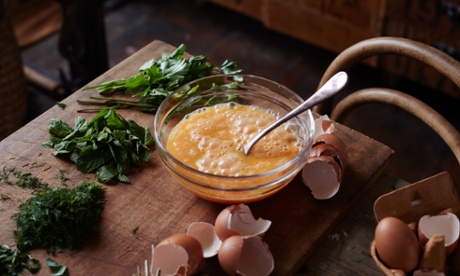
A quarter of this should make for a lovely lunch for one, along with shredded lettuce simply dressed with yoghurt or tahini. If it seems like a lot of faff just for an omelette, then think of it as a quiche without the crust, and remember that ideally you’ll be getting two days’ lunch for two for your efforts, and a tasty one at that.
Serves 4
1 large red onion, sliced
2 courgettes, sliced into 1cm rounds
1 tsp table salt
1 tsp ras el hanout
A pinch of dried chilli (optional)
Olive oil
1 garlic clove
8 eggs
1 bunch (around 30g) of your favourite soft herb or herbs, chopped (we use a mix of dill, mint and parsley)
Black pepper
1 Preheat the oven to 200C/400F/gas mark 6. You will need a 20cm nonstick frying pan, preferably one that is safe to go in the oven. Put the onion and courgettes into the pan along with around half the salt, half the ras el hanout, a pinch of chilli if you like it a bit spicy, and a tiny bit of olive oil. Roast for 20 minutes, then stir, then roast for another 15 minutes. Remove from the oven when the vegetables are completely soft and have a lovely golden shine.
2 Crush the garlic into the hot pan and mix it all together with a wooden spoon, crushing the courgettes a bit as you go. You can try them now – it should be good enough to eat as it is. Adjust the flavouring with some salt and chilli, if you think it needs it.
3 In a bowl, beat the eggs and add the herbs, along with the rest of the salt and ras el hanout, and a few grinds of pepper, then tip in the contents of the pan – scrape it all in!
4 Place the pan back on the stove and drizzle a bit of oil in it. When the pan is hot, pour the egg mixture in and leave undisturbed for a minute or so on a medium heat, until the edges start to set, then stir with a wooden spoon for a bit and leave for another minute – repeat this 3-4 times until the eggs are almost all cooked through, then place a plate or a lid on the pan, flip the omelette on to it and slide it back to the pan.
5 Return to the stove and leave for 2‑3 minutes until all the egg is cooked, take off the heat and let it rest. It will feel a bit wobbly and wet at the beginning, but don’t worry – it’s just the courgettes, and it’s what makes this dish juicy.