Teachers across the United States continue to navigate rising classroom costs while balancing instructional responsibilities. Recent reports indicate that many educators spend close to $900 of their own money each year on classroom materials. "These trends reflect a broader challenge in public education, where teachers are often expected to bridge funding gaps through personal spending rather than through long-term, structural solutions," says Jennifer Burton, Executive Director of the Northwest ISD Education Foundation (NEF).
The organization was established to create a free, sustainable support structure for Northwest Independent School District educators and students. Operating as a 501(c)(3) nonprofit entity that works in close coordination with Northwest ISD, the Foundation focuses on fundraising, grant distribution, and resource programs designed to meet educator needs. According to Burton, this collaborative model allows the district and the Foundation to function as partners, aligning priorities while maintaining independent governance and funding responsibilities.
"The work we have done here can serve as a blueprint that could be adapted by other educational institutions," Burton says. "This model shows how community-driven support can strengthen recruitment and retention while giving teachers direct access to the resources they need."
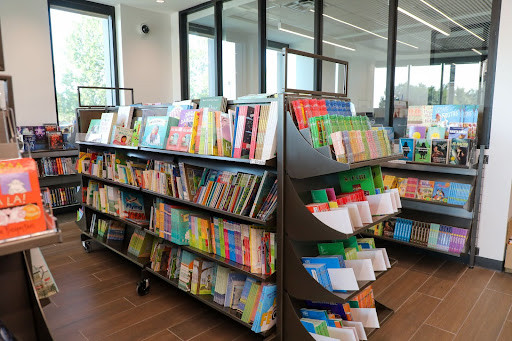
The NEF resource store and library were launched five years ago with a modest donation of classroom supplies during the early stages of the pandemic. Burton notes that what began as a small storage initiative evolved into a structured system for free classroom resources as demand from educators grew. Over time, the organization expanded into a centralized supply store with online ordering capabilities, enabling educators to request materials efficiently and with minimal administrative burden.
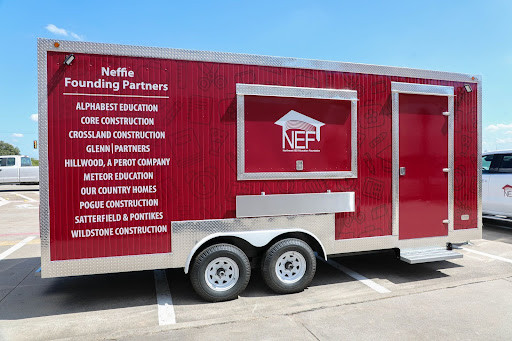
One of the Foundation's most visible initiatives is its mobile store, informally known as Neffie. Developed through targeted grant funding, the mobile unit travels between campuses to bring materials directly to educators. Burton explains that the idea emerged from conversations with teachers who faced scheduling constraints that made it difficult to visit centralized locations. By delivering supplies on-site, the Foundation aimed to remove logistical barriers and make resource access more easily available across campuses.
A classroom teacher familiar with the Neffie Store explains that the program's evolution has been shaped by direct educator feedback. "From the beginning, the focus has been on listening to what teachers actually need to be successful in the classroom," the teacher says. "Over the past four years, the store has continued to expand its resources and become more accessible. What started as a single resource room grew into an online ordering system, and now the mobile store brings materials directly to our campuses, allowing teachers to step outside and pick up exactly what they need for their students."
Burton says, "Our goal has always been to meet educators where they are. Whether that means online ordering, campus visits, or weekend access, the focus is on making support practical and accessible."
The scale of Northwest ISD's growth has amplified the importance of these programs. The district currently serves nearly 33,000 students across a geographically expanding footprint, while Burton notes that the Foundation helped reduce educators' out-of-pocket classroom spending by approximately $780,000 last year and supported over 1,500 teachers through the distribution of more than 234,000 classroom items. With long-term projections exceeding 100,000 students as new campuses continue to open, she explains that the Foundation's infrastructure was designed with scalability in mind, allowing programs to expand alongside enrollment growth while maintaining consistent service delivery.
Despite operational progress, Burton notes that maintaining sufficient inventory remains one of the organization's most persistent challenges. As demand for supplies and their price points increase, so does the need for purchasing power to maintain the Foundation's stock efficiently and in larger volumes. From her perspective, long-term partnerships and sponsorships represent an opportunity to stabilize inventory pipelines and extend the Foundation's reach across additional campuses and programs.
"We have built the systems and processes to support educators at scale," Burton says. "What we are seeking now are partners who see the long-term value of investing in classrooms and helping us sustain this work."
As the Northwest ISD Education Foundation continues to examine how to strengthen teacher support structures, its approach reflects a broader shift toward community-driven collaboration. Looking ahead, Burton emphasizes that the Foundation remains focused on expanding its model and welcoming new partnerships that align with its mission. "This work is about building something sustainable," she says. "When communities come together to support educators, it creates a lasting impact for students and schools alike."