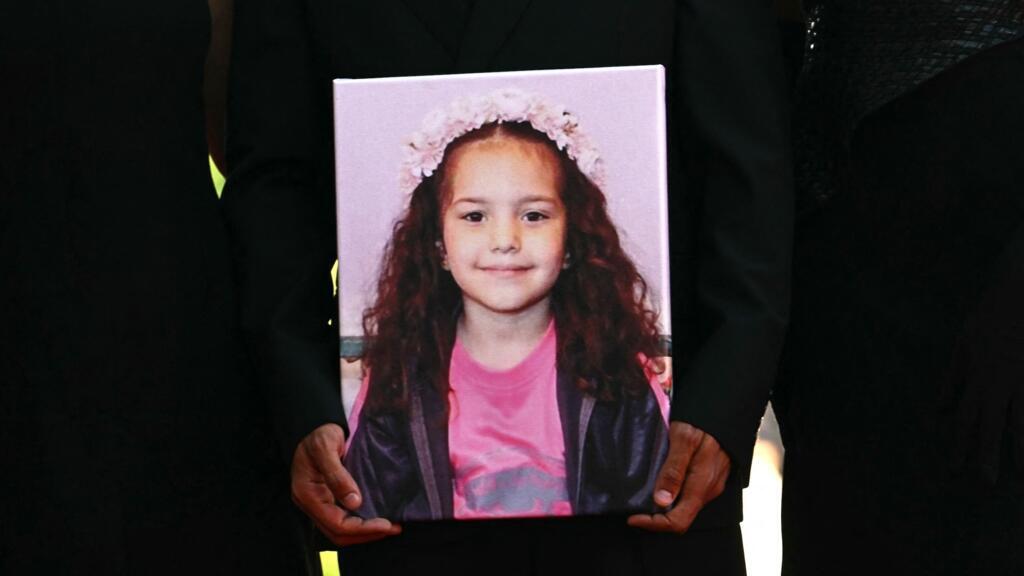
Tunisian filmmaker Kaouther Ben Hania's The Voice of Hind Rajab is based on a recording of a six-year-old girl trapped under fire in Gaza, calling the Palestinian Red Crescent for help. RFI spoke to the director about why it was so important to her to make this film, which was released in France this week.
On 29 January 2024, cousins Hind Rajab and Layan Hamada were killed with their family as they tried to flee the fighting in Gaza City in their car.
Surrounded by Israeli tanks, the two girls dialled 101, the Palestine Red Crescent Society's emergency line.
Their last moments, their last words, were recorded.
"They're shooting at us!" 15-year-old Layan says. "The tank is right next to us. We're hiding in our car."
A few moments later, six-year-old Hind comes on the line. "I’m so scared. Come and get me," she tells the dispatcher in Ramallah, miles away in the West Bank.
Hind stayed on the line for several more hours as humanitarian staff sent an ambulance to fetch her. It never arrived.
Days later, she was found dead in the remains of the car. The ambulance was a short distance away, destroyed.
Ben Hania heard of Hind's fate on the radio, after the Red Crescent released its recording of the call.
"As soon as I heard the voice of Hind Rajab, it had such an impact on me. I felt desperate, powerless and so angry," the director told RFI, saying she knew straight away she had to do something.
"My job was to find the best way, the best angle to tell this story. Part of this was respecting the order of events and above all, the Palestinian Red Crescent gave me these precious recordings of Hind talking to the staff. Everything I needed for the film was in this document."
A voice preserved
The result is The Voice of Hind Rajab, which won the Silver Lion award at the 2025 Venice Film Festival in September.
"Cinema cannot bring Hind back and erase the atrocities committed against her. But cinema can preserve her voice [...] because her story is not just hers. It is the tragic story of an entire people, a people suffering from genocide inflicted by a criminal Israeli government that acts with impunity," Ben Hania told the audience in Venice.
'Recognition brings obligation’: How declaring genocide could reshape war in Gaza
The war began with the Hamas-led attack on southern Israel on 7 October, 2023, in which some 1,200 people were killed and more than 250 taken hostage.
Gaza's Health Ministry says nearly 70,000 Palestinians have been killed and over 170,000 wounded in Israel's retaliatory offensive. The toll has gone up during since the 10 October ceasefire, both from new Israeli strikes and from the recovery and identification of bodies of people killed earlier in the war.

Accepting the prize in Venice, Ben Hania dedicated it to the Palestinian Red Crescent "and to those who risked everything to save lives in Gaza".
"They are true heroes," she said.
Slow-motion tragedy
RFI interviewed the operators who took the girls' call soon after their bodies were discovered.
Omar Alqem, a young Red Crescent volunteer, said he was in a state of shock when he realised what was happening.
"I felt like I was floating above my body. I couldn’t understand what I had just witnessed. I tried to regain my composure. I told myself: I can’t give in to emotion, or else I’ll stop doing this work. But it’s not possible to stop. In this war, too many people depend on us," he told RFI's correspondent Sami Boukhelifa.
Alqem spoke to Hind for about ten minutes, but felt helpless in the face of her distress. "She was able to explain to me who was around her in the car. I tried to imagine the situation, where she was hiding in the vehicle. I understood that six members of her family had all died around her. And then I thought: this is too much, I can’t go on."
From that point on, his colleague Rana Faqih took over. A member of the Red Crescent for 13 years, she began by introducing herself. "I told her, 'My name is Rana.' The poor little girl was in shock. She told me her name was Soujoud, then Hind…" Faqih recalled.

"Sometimes she would tell me, 'They’re all sleeping.' And sometimes she would say, 'They’re all dead. There’s blood everywhere. There are tanks.' She sees them. She hears the gunfire and the planes..."
While Rana continued to reassure Hind, her colleagues called the Israeli authorities to obtain permission to send a rescue mission to Gaza City, where Israeli troops were deployed.
"We got the green light [from the army] to send an ambulance to the area where Hind was. We were still in contact with her, and at the same time with our paramedics," recounted Faqih.
"And suddenly, we heard gunfire. We never would have thought that the ambulance was being targeted. It was almost right next to Hind. And then, communication with the paramedics and with Hind was cut off. We had no news for 12 days."
On 10 February 2024, the Israeli army withdrew from the area. The ambulance was found twisted and charred. The two paramedics, Hind, her cousin and the other members of their family were all dead.
'I want a loud death': Cannes Film Festival to honour slain Gaza journalist
Film meets reality
While actors play the roles of the humanitarian staff in Ben Hania's film, the voice of Hind is real.
"At the end of the film, I used images of the ambulance that was bombed and the car that Hind was in which was riddled with over 300 bullets," the filmmaker recalls.

"These images were widely shared on the internet, especially on social media, but they lose their impact because they're wedged between two other events."
She hopes that by focusing on the lead-up to Hind's death, the film will give viewers a fuller sense of the tragedy.