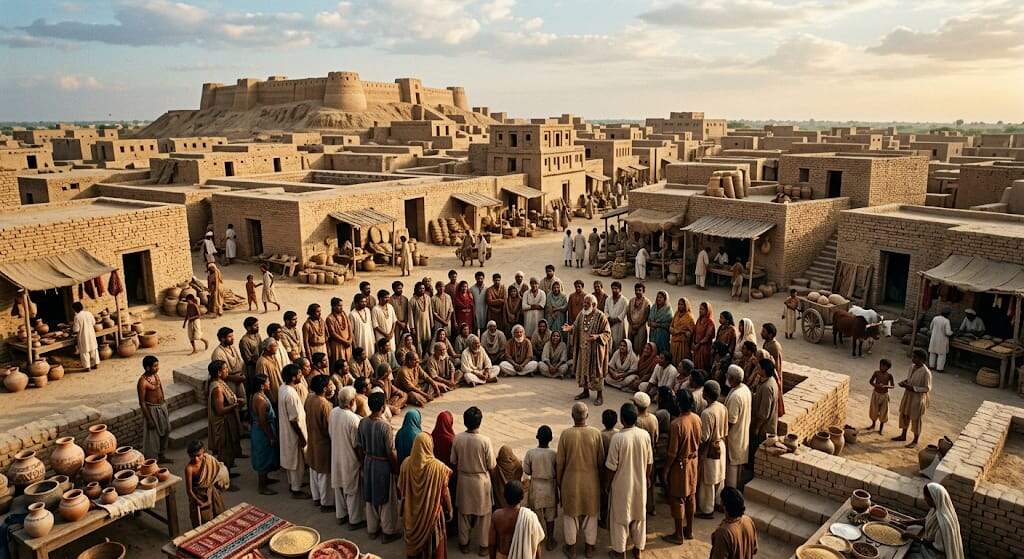
The Indus Valley Civilisation flourished across what is now Pakistan and north-western India, becoming one of the world's earliest urban societies alongside ancient Egypt and Mesopotamia, dating back 4,500 years. Yet despite building sophisticated cities, extensive trade networks and advanced drainage systems, archaeologists have found scarce evidence that it was ruled by powerful kings or pharaohs. There’s no evidence of grand royal palaces, monumental statues celebrating rulers or lavish royal tombs. Archaeologists have found no clear evidence that the civilisation was governed by a single monarch. Instead, decades of research suggest it may have relied on shared civic institutions, skilled administrators and community cooperation, making it one of history's most intriguing experiments in urban governance.
Get breaking news anytime, anywhere. Download the TOI app now!
Why archaeologists believe there were no kings that ruled the Indus Valley civilisation
Most early civilisations left unmistakable signs of royal authority. Egyptian pharaohs built pyramids, Mesopotamian kings commissioned monumental inscriptions, and rulers across the ancient world celebrated their victories through statues and palaces.
The Indus Valley Civilisation presents a striking contrast. Excavations at major cities such as Harappa, Mohenjo-daro, Dholavira and Rakhigarhi have uncovered carefully planned streets, sophisticated drainage systems, standardised bricks and large public structures, but no buildings that can be confidently identified as royal palaces or temples dedicated to ruling elites.
Archaeologists have also found no royal burials filled with treasures comparable to those discovered in Egypt or Mesopotamia. Instead, graves across the civilisation are generally modest, with relatively little difference in wealth between individuals. This absence of obvious royal monuments has led many researchers to conclude that political authority may have been more widely distributed than in other Bronze Age societies.
How cities functioned without monumental rulers
Despite the absence of grand palaces, royal tombs or inscriptions celebrating kings, the Indus Valley Civilisation managed to build some of the ancient world's most sophisticated cities.
According to Dr Sharmistha Rakshit in Deciphering Authority: Revisiting the Political Landscape of the Indus Valley Civilisation , the civilisation appears to have relied on an organised system of governance centred on administration rather than a single, powerful ruler.
The remarkable uniformity of city planning, standardised bricks, weights and measures, extensive drainage networks and carefully managed trade suggests that civic institutions coordinated public life across settlements spread over thousands of kilometres.
Instead of monuments glorifying kings, resources seem to have been invested in infrastructure that benefited entire communities. While the exact political structure remains unknown because the Indus script is yet to be deciphered, the archaeological evidence points towards a society where collective administration and shared civic planning may have taken precedence over royal authority.
What recent discoveries reveal about the civilisation
Modern archaeological research continues to challenge traditional ideas about how early civilisations developed. Studies of settlements, craft production and urban planning increasingly suggest that the Indus world placed greater emphasis on collective organisation than displays of royal power.
Unlike many neighbouring societies, there is little evidence of large-scale warfare, military fortifications designed for conquest or monuments celebrating victorious rulers. Instead, public investment appears to have focused on infrastructure that benefited entire communities, including reservoirs, drainage systems, marketplaces and water management.
The civilisation's undeciphered script means many questions remain unanswered, but the archaeological record consistently points towards a society where civic planning and standardisation played a more visible role than individual rulers.
Why the Indus Valley still fascinates archaeologists
The Indus Valley Civilisation declined around 1900 BCE, likely due to a combination of environmental changes, shifting river systems and economic transformation rather than a single catastrophic event. Even today, its script has not been deciphered, leaving many aspects of its political organisation unknown.
Yet its cities remain among the most impressive achievements of the ancient world. The possibility that millions of people lived in complex urban centres without powerful kings, monumental palaces or dynastic rulers challenges long-held assumptions about how civilisations emerge and thrive.
More than four millennia later, the Indus Valley continues to remind archaeologists that successful societies can be built not only through royal authority, but also through planning, cooperation and shared civic institutions.