Get all your news in one place.
100’s of premium titles.
One app.
Start reading
The Guardian - UK
The Guardian - UK
Science
Katy Stoddard

How the Guardian reported the search for gravitational waves

A visualisation of gravitational waves, Max Planck Institute for Gravitational Physics (Albert Einstein Institute) at the Leibniz University, Hanover, 11 February 2016.
A visualisation of gravitational waves, Max Planck Institute for Gravitational Physics (Albert Einstein Institute) at the Leibniz University, Hanover, 11 February 2016. Photograph: Julian Stratenschulte/EPA

Gravitational waves were predicted as part of Einstein’s theory of general relativity. Scientists have been searching for evidence of their existence ever since.

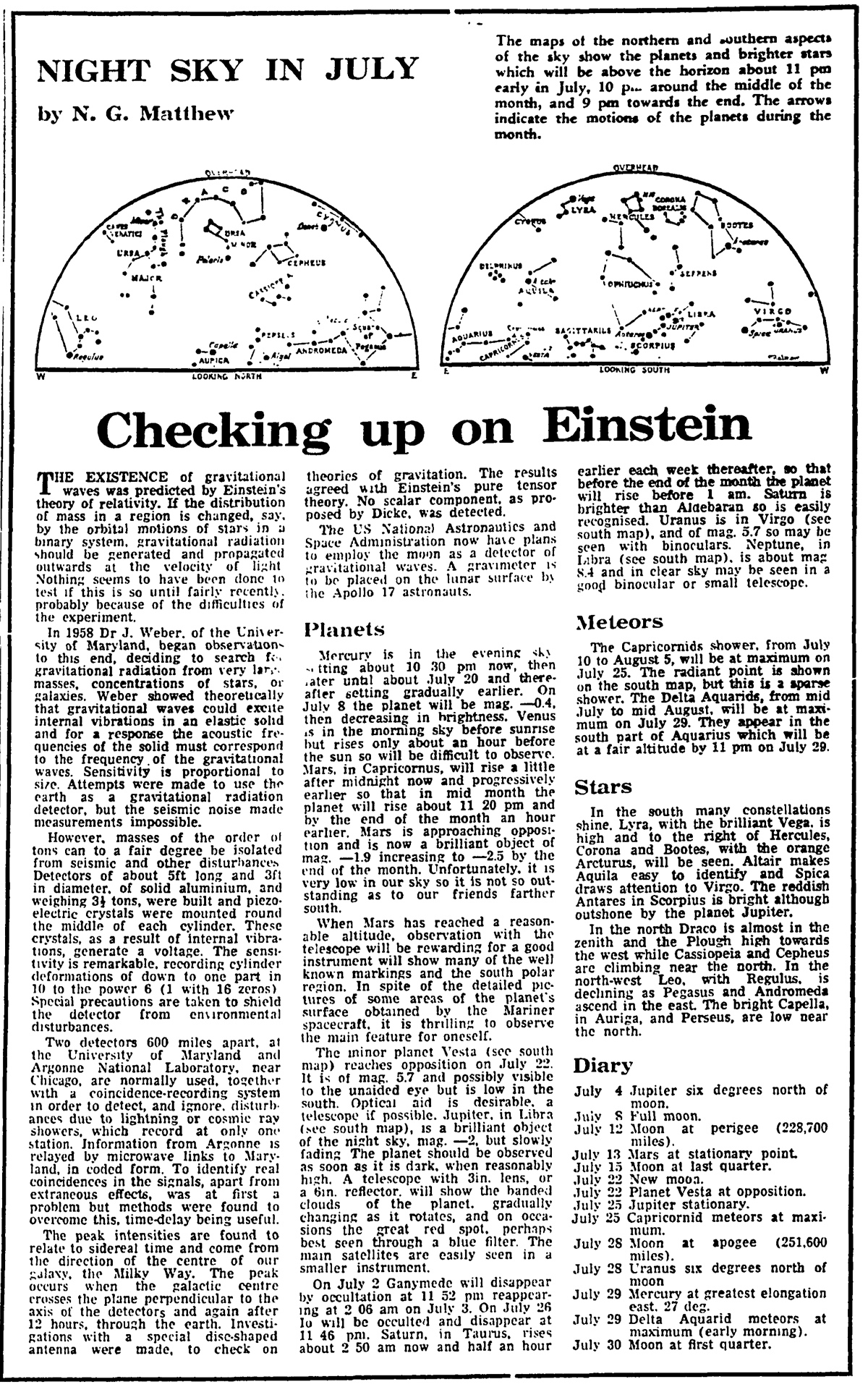
In 1971, the Guardian’s Night Sky column reported on attempts by Dr J Weber, at the University of Maryland, to detect gravitational radiation from very large masses. NASA meanwhile was planning to place a gravimeter on the moon.

The Guardian, 3 July 1971
The Guardian, 3 July 1971.

The Observer reported a breakthrough in 1979, after scientists at the University of Massachusetts observed a pair of pulsars orbiting around one another.

The Observer, 11 February 1979.

A collaboration between Germany and the UK was announced in 1990, proposing the world’s first gravitational wave observatory. Professor Jim Hough, pictured, is a leading expert in the field of gravitational waves.

The Guardian, 12 October 1990
The Guardian, 12 October 1990. Read the full article.

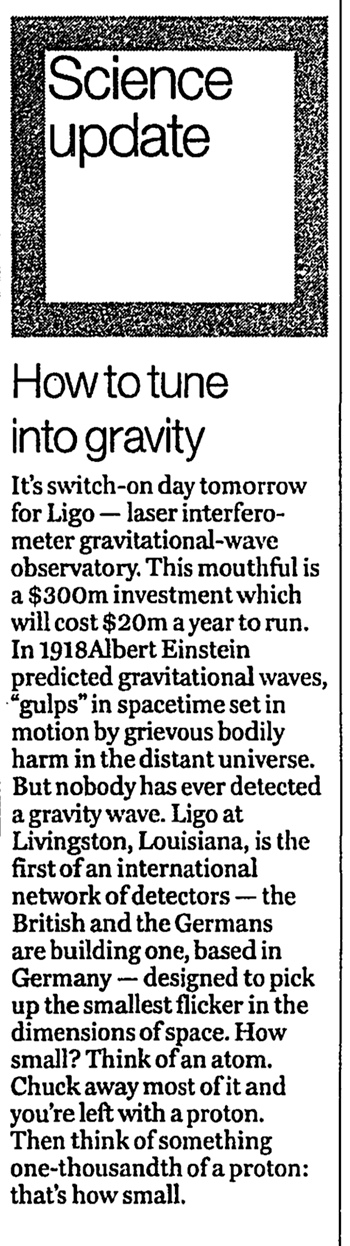
Ligo - the laser interferometer gravitational-wave observatory in the United States - was switched on in November 1999. Now, 16 years later, their goal has been achieved.

The Guardian, 11 November 1999.
The Guardian, 11 November 1999. Read the full article.
Sign up to read this article
Read news from 100’s of titles, curated specifically for you.
Already a member? Sign in here
Related Stories
Top stories on inkl right now
Our Picks
Fourteen days free
Download the app
One app. One membership.
100+ trusted global sources.