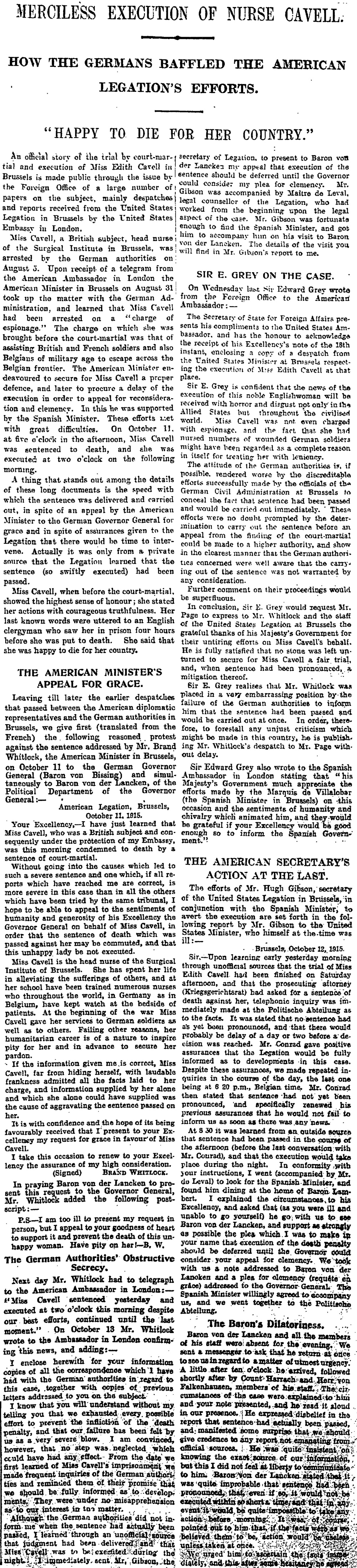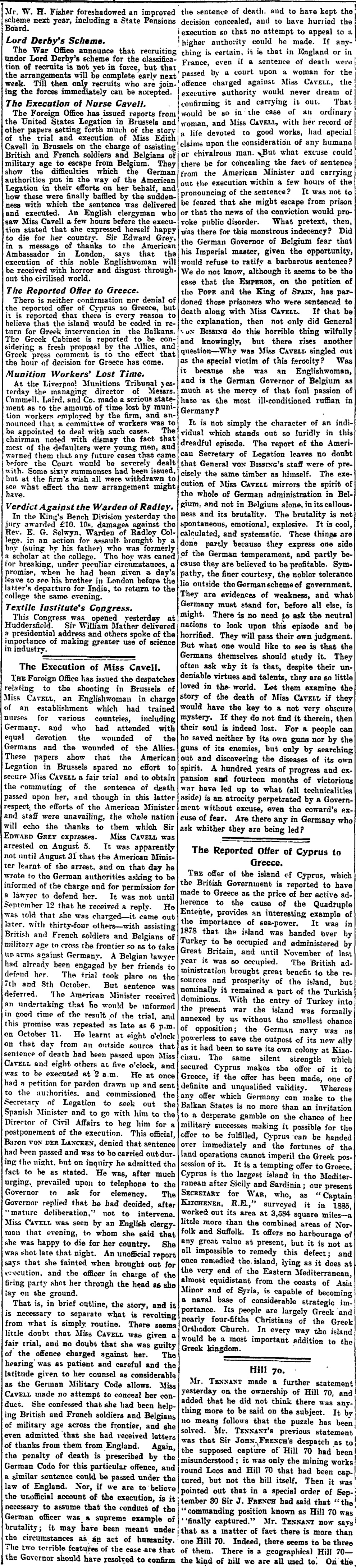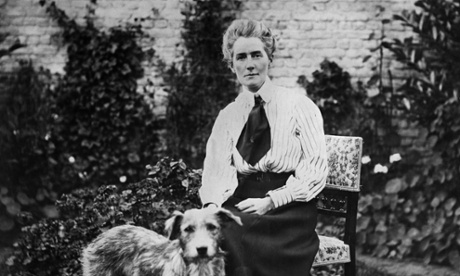

On 16 October 1915, the Manchester Guardian ran a news in brief from the foreign office - ‘English lady executed in Brussels’. ‘Miss Edith Cavell,’ the article went on, ‘lately head of a large training school for nurses at Brussels, was executed on the 13th inst. It is understood that the charge against Miss Cavell was that she had harboured fugitive British and French soldiers and Belgians of military age and assisted them to escape from Belgium.’
The full story of the ‘merciless execution of Miss Cavell’ emerged in the paper almost a week later, on 22 October. Although she had been arrested for espionage in August, this charge was not raised at her court martial. Despite pleas for clemency from the American and Spanish ministers in Brussels, she was sentenced to death at 5pm on 11 October and executed at 2am that night.

In an editorial, the Guardian commented that, though ‘there seems little doubt that Miss Cavell was given a fair trial, and no doubt that she was guilty... in England, even if a sentence of death were passed upon a woman, the executive authority would never dream of carrying it out. The execution of Miss Cavell mirrors the spirit of the whole of German administration in its callousness and its brutality.’

A day later, the paper ran the testimony of the British chaplain who had visited Cavell in her final hours. He found her ‘perfectly calm and resigned’; during their meeting she told him, ‘Patriotism is not enough; I must have no hatred or bitterness towards anyone.’