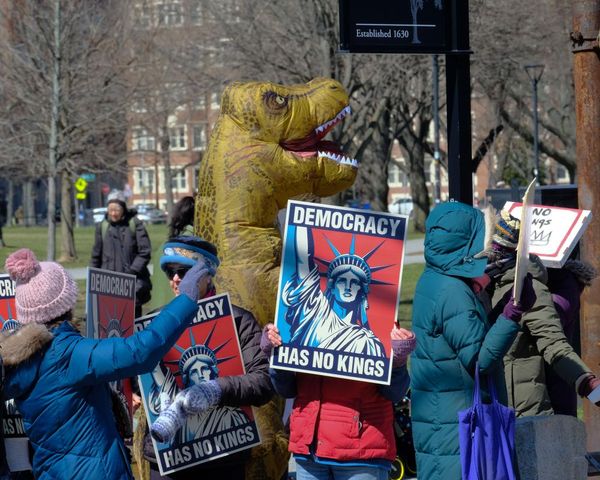
The generally accepted form of a U.S. startup is now that of a monarchy. Companies and their founders are increasingly indistinguishable — a state of affairs that isn't going down well with workers agitating for a seat at the table.
Why it matters: It's nothing new for companies to be dominated and controlled by a single individual — Rupert Murdoch, Sumner Redstone, John Malone, and other media moguls spring naturally to mind.
- What's new is that this time around, there doesn't seem to be any kind of valuation discount when a company lives at the whim of its founder. Quite the opposite.
- Tesla is a prime example of a company that trades at a premium thanks to the imperial predilections of its CEO.
What they're saying: "When you get to a certain count — customers or employees or both — there's no pleasing everyone," wrote Basecamp founder Jason Fried in a recent blog post trying to take back more control of his company. "You can't — there are too many unique perspectives, experiences, and individuals."
- Similarly, Patreon founder Jack Conte recently uploaded a six-minute YouTube video explaining his decision to lay off 36 employees, despite recently closing a $155 million fundraising round.
- The video features Conte saying "I," "me," or "my" no fewer than 31 times, or about once every 12 seconds on average.
Context: It is now normal for tech companies to go public with a dual-class share structure giving control to the founders — even though doing so makes that company ineligible for inclusion in the S&P 500 index.
- Companies choosing the dual-class option (or having even more classes than that) include Coinbase, Snap, Airbnb and Bumble. All of them are associated closely with their respective founders.
- These founders are following the trail blazed by Mark Zuckerberg, who has retained dynastic control of Facebook for himself despite owning only a small fraction of the company. (Zuckerberg's control does not end even when he dies: He can bequeath it to his daughter, should he so wish.)
The bottom line: The cult of the founder has infected both the public and private markets to such a degree that investors no longer require a discount for allowing such a monarchical system.