We all abhor terrorism so much that we hardly need say so, don't we? Of course not. We love it. And why not? Nothing else offers such a heady cocktail of sanctimony, cruelty and glamour. Civilisation requires us to repress our latent lust for violence; how satisfying to be suddenly licensed to release it in the name of the oppressed.
The recent association of terrorism with unattractive religious fanatics has obscured its underlying appeal. Nonetheless, that appeal persists, even if the response it prompts in most of us remains only vicarious. The continuing ubiquity of Alberto Korda's image of a messianic Che on bedroom walls and T-shirts bears witness to our sneaking sympathies; as do many of the films that we go to see.
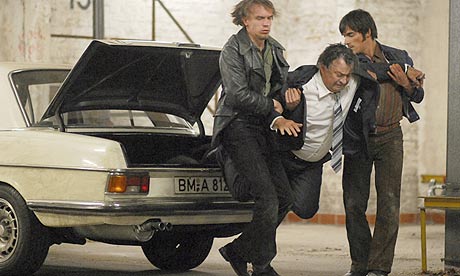
Screen terrorists have enthralled us from The Battle of Algiers to Die Hard. Last month we had Hunger and Bullet in the Head. After Christmas, we'll be expected to make two separate cinematic pilgrimages to pay homage to Che as exalted by Steven Soderbergh. And this week, we have The Baader Meinhof Complex.
Like Patty Hearst, this is a film calculated to expunge any idea that terrorists can simply be dismissed as an alien breed. Baader, according to this (apparently accurate enough) account, is a familiar kind of racist, misogynist thug. Meinhof is a victim of the all-too-recognisable confused guilt that besets so many of Europe's privileged young. As such, the pair make ready surrogates for our own, darkly unacknowledged selves.
Not that Uli Edel, the director, feels much need to probe the souls of either of them. Instead, he wallows for two and a half hours in the butchery in which they and their comrades engaged. Fat, ugly capitalists get their satisfyingly bloody comeuppance. The proceedings are accompanied by much flashing of the miniskirted female thighs that were such a notable feature of the period being depicted. An unexpected amount of nudity is somehow shoehorned in.
It's terror porn, good terror porn and, of course, just what we want. Should we feel anxious that our appetite is somehow abnormal, we're assured that, at the time, one in four young Germans openly expressed their support for the Baader-Meinhof gang.
Yet, this film also reflects and feeds a countervailing fancy, namely our thirst for peril. Threats such as impending environmental catastrophe and economic meltdown might be thought enough to keep us awake at night, if awake at night is what we want to be. Somehow, however, grand but insensate hazards such as these don't satisfy our innate desire for endangerment. We crave a more animate bugaboo.
Confederacies of violent zealots seem able to meet this need, at the same time as they continue to captivate us. In recent decades, terrorists have wrought carnage on a scale that comes nowhere near matching that caused by road accidents. Far from being dispirited, we will them to do better, limning helpfully the chemical, biological, cyber and nuclear opportunities that have so far seemed so stubbornly beyond their grasp.
Their under-performance doesn't inhibit us from transforming our lives to combat them. We cheerfully invade other people's countries, throw away our liberties and put up with extraordinary inconvenience in pursuit of our "war on terror". This struggle has a glamour of its own, also fuelling and fuelled by cinema. Next week, hot on the heels of Batman and James Bond, will come Leonardo DiCaprio's Roger Ferris in Ridley Scott's Body of Lies.
Of course, neither our sympathy for the devil nor our crusade against his acolytes is altogether misplaced. Edel's protagonists ask whether terrorists might have destabilised the Nazis, who had held sway over their country just a few decades earlier and showed signs of re-emerging in what, to them, appeared almost as ugly a guise.
Equally, however, The Baader Meinhof Complex tells us that if you really do want to defeat terrorism, then you've got to be prepared to meet it with a total jihad of your own. To stamp out their enemy within, the German authorities created a full-scale police state, complete with Gestapo-style surveillance and blanket stop-and-search. It worked.
Islamist bombers may have succeeded in instilling deference to their creed, but Jacqui Smith, it seems, is also on the right track. Each of their enduringly symbiotic enterprises will doubtless continue to fascinate, and therefore to spawn many a further cinematic gorefest.