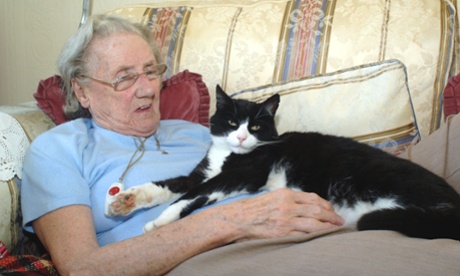
The last time Amanda Wakely’s 69-year-old mother, who has Alzheimer’s, went missing, it was night-time, and she had no coat or handbag. The police were called, and there was even talk of using a helicopter to look for her. Luckily, she was found quickly, but, as Wakely points out, whenever her mother goes missing, multiple people and agencies get involved: her care workers, the adult services department at Hampshire county council, the police and Wakely herself.
Fortunately, Hampshire is about to provide her mother with a GPS device, worn as a pendant around her neck. As soon as a carer lets her know that her mother isn’t at home, Wakely will be able to log onto a secure website and pinpoint her mother’s location – saving time and money for the agencies who would be involved in finding her, as well as making sure her mother is safe.
Since the authority embarked on its new telecare initiative in August 2013, many more elderly residents have been able to remain in their own homes, resulting in significant savings. Councils are operating under severe financial constraints: since 2010, according to a Local Government Association report, they have had to make savings of £3.53bn from adult social care budgets. So why hasn’t telecare been widely adopted elsewhere? To understand the reasons, it’s useful to look at the Hampshire model.
Before 2013, telecare provision in Hampshire was piecemeal. Social workers had to deal with several different providers, which was confusing and time-consuming and resulted in few referrals. Having looked into the business case for telecare, Hampshire appointed the Argenti telehealthcare partnership, headed by PA Consulting, to implement a new system. Gill Duncan, director of adult services, says the partnership approach has been key: “Locking yourself with one provider locks you into one set of technologies, while a partnership allows you to be more fleet of foot as things develop.”
Telecare is now part of the core social care offer, provided mostly to elderly service users, but also to some younger users who are physically disabled, or have learning disabilities or mental health problems. All of the council’s social workers have now been trained to understand when telecare would be appropriate, and how to make a referral.
When they see a new service user, they carry out an assessment of their needs in conjunction with both the user and their carer.
If it is agreed that telecare would be appropriate, the social worker fills out a referral request using a simple online form. They are not asked to decide which technology is needed. This, says Steve Carefull, adult social care specialist at PA Consulting, has contributed to the project’s success. It is the Argenti team, whose members sit alongside the adult social care team in the council offices, who carry out a detailed assessment in the user’s home and install the appropriate equipment.
Several telecare options are available for service users. A lifeline pendant, for example, has a button that, when pressed, immediately connects the user to a 24-hour monitoring centre. The call handler asks the user, through a loudspeaker on the lifeline device, if they have a problem. If the user doesn’t respond, the handler can phone them and if they don’t answer, the call handler will then phone a named contact, such as a relative or neighbour.
There are also automatic medication dispensers (for service users who may forget which medication to take, and when) and door sensors, which will create an alert if, for example, a user has left the house and not returned within a pre-programmed time. A falls detector, worn round the neck or wrist, can automatically alert the monitoring centre if the wearer has a serious fall.
Referrals have increased from five or six a week under the old system to 50 or 60 a week now – more than originally anticipated – and there are now over 2,000 telecare users in Hampshire. User satisfaction is high: 95% of service users who responded to a survey said they would recommend the service to someone else.
Since the Argenti telecare service went live, Hampshire has made net savings of £1.1m, or more than £500 for each person receiving telecare. Most of this came from older people being able to rely less on paid carers or live in their homes for longer, delaying entry into residential care.
Telecare has enabled service users to lead a more independent life, and in one case has enabled a young woman with multiple disabilities to attend university. Care manager Vicky Wellington says that carers, too, have a freedom they didn’t have before. “Some carers have been able to leave the house for the first time in months or years.”
The council is now developing integrated care teams where GPs and social workers and community nurses work more closely together. Analysis by Argenti has shown that fall detectors can save the NHS money by making sure making sure a faller does not lie undiscovered for hours, leading to an avoidable hospital admission, and Duncan believes this will encourage the NHS will make greater investment in telecare.
Linda Sanders, telecare lead at the Association of Directors of Adult Social Services (ADASS), says that implementation has often been held back because district councils may have different community alarm systems linked to being discrete housing providers, making it complicated to adopt a large-scale whole county approach. She would welcome wider adoption, however. “Telecare should be viewed nationally as a key tool to further the public’s health, and every older person or person with a long-term condition should have access to a full telecare service, with a responder service in cases where relatives can’t respond,” says Sanders.
Hampshire’s experience is a rare example of a system that reduces costs while improving the quality of life for service users and carers. As Wakely says of her mother: “There are no fire risks, the cooker’s disconnected and she’s got her meals provided for her. As long as we can manage the wandering with GPS, there’s no reason for mum ever to go into a home.”
Content on this page is paid for and produced to a brief agreed with PA Consulting Group, one of the sponsors of the Guardian Ageing Population series.