
When Mary Portas bought a hand-made cuddly toy from her stand, 18-year-old Christine McDonald knew that forfeiting a Saturday morning lie-in to set up her market stall had been worth it.
Browsing her stall, Portas told McDonald to hike her prices up, advice that the young trader has taken on board.
Now 22, McDonald is preparing to start selling her products from a shop in Stockport town centre – but she wouldn’t be where she is today without her debut at the Teenage Market, an event set up by brothers Joe and Tom Barratt to breathe new life into flagging UK markets.
The business partners, now 22 and 21, were in their teens when they set up the Teenage Market – which gives young people a free platform to trade at specially organised events – three years ago.
Inspired by fair the Vintage Village, the Stockport-based brothers decided to organise a pop-up style market trading event for young people in their home town. “We saw the success [the Vintage Village] had on a Sunday – it really brought the community to the area,” says Joe Barratt. “But we had no idea if there were young people that were at the right level to come to a market and trade. It was a big risk on our part.”
Despite these risks, the first Teenage Market, held in Stockport in April 2012, was a success. After sharing a call for entries video on social media, the brothers were overwhelmed with interest. “We had entries flying in straight away. For our first event we had 70 young traders apply to take part. We immediately realised there were young people out there with the right skill set, resources and creative talent, but they didn’t have a platform.”
Today the Teenage Market has close to 25 local authorities on its books, has been endorsed by high street champion Mary Portas, and Joe has left university to focus on the business full-time. Meanwhile, Tom is studying culture, criticism and curation at Central St Martins in London.
The Teenage Market sells licence packages to local authorities for either £750 a year, or £1,000 for two years. This gives authorities the licence to run as many Teenage Markets as they wish, with support from the Teenage Market itself.
Joe explains: “We say to any local authority, the benefits that they get socially for their town are huge. They outweigh the monetary amount an authoriy might usually charge – around £15 – for a stall. It’s about supporting young talent and promoting entrepreneurship in a town.”
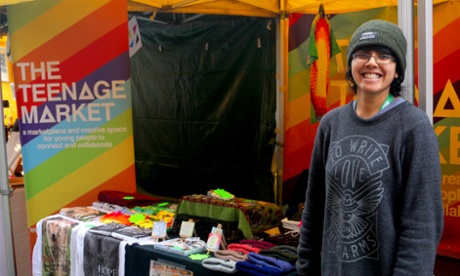
To get involved in a Teenage Market, teens create trader or performer profiles on the Teenage Market website and then apply to take part in upcoming events.
The long-term goal is to integrate the teens into a more regular market – “to provide a healthy, sustainable future for the market sector,” Joe says. This is an ambitious goal for an industry that, according to the National Market Traders Federation (NMTF), is in “considerable decline”. In 2009 there were an estimated 38,100 traditional market traders in the UK, a 14% reduction since 2004.
Joe Harrison, chief executive of the NMTF – which runs a National Youth Market – describes getting more young people involved in market trading as an industry priority. “You have an ageing population of traders and, in order to encourage a younger customer base, we need to get a younger trader base,” he says.
“Market trading is a great way into entrepreneurship. It isn’t easy work, but with the right drive it is a great opportunity to start a business without having the red tape as a noose round their neck.”
Richard Shaw is the enterprise champion for Enterprising Young People, an organisation that helps young people aged 14 to 24 bring their business ideas to life. When The Teenage Market came to Barnsley this year, Shaw got involved, and helped organise the most recent one in July this year.
“Getting young people involved with the markets is quite difficult, I suppose the age of market traders goes up as time goes on .” Shaw says at the Barnsley Teenage Markets, the atmosphere is different to a traditional market. Singers and dance troupes provide some entertainment, and friends of traders flock in to help form a slightly younger customer base.
“At the last one there was a 14-year-old girl who hand-makes leather handbags, and a variety of fashion-based stalls and traders who make things like organic lip balms. Artists also come to sell their wares, and young beauticians set up pop-up services on the day,” he adds.
Ware says young people learn many important skills for running a business by starting off in a market. “It comes down to the simple things like turning up on time, making sure they have enough cashflow on the day and managing the stall,” he says. “Also, they learn how to interact with customers and how to display their products.”
Despite the eye-catching events, not everyone in the market sector has welcomed the Teenage Market, Joe says. “Market traders say: ‘You are not necessarily giving young people a realistic view on the world out there [by giving them a free platform]. But we say the market sector is struggling and it is about trying to show young people that market trading is an option.”
He says his ultimite aim is to make sure there is a Teenage Market within the reach of every young, entrepreneurial person. “When we started out we had traders traveling from Blackpool and Leeds, coming to Stockport. We know there is the demand out there.”
Sign up to become a member of the Guardian Small Business Network here for more advice, insight and best practice direct to your inbox.