Goddesses chant in gibberish, share a smoke with their subjects and fight with them over blessings as the Daklas, a community of rootless nomads, spread their mats onstage to perform before us. A boy picks up a currency note with his eyelid, while a father and his two sons’ journey to a mythical Lake of Alcohol and Land of Meat. The play within a play format has a storytelling quality to it, the actors start their performance with the beats of the tamte, the soundscape that defines their community. Through movements and a sing-song presentation of the story, the father and sons journey through the landscape of caste and exploitation.
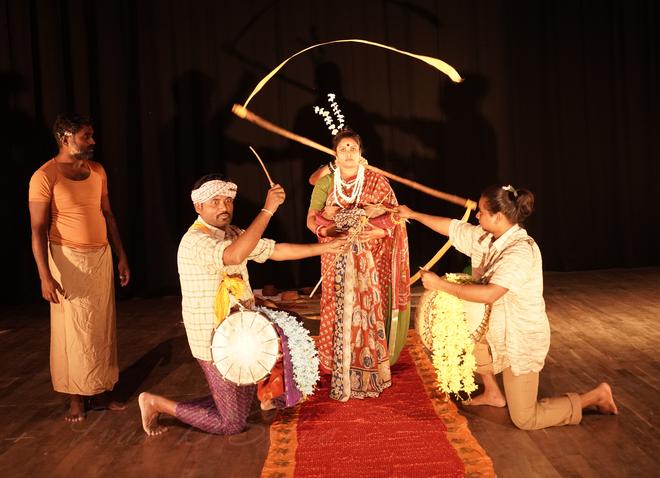
Daklakatha Devikavya is the epic reimagined by a community. It has been adapted from the writings of renowned Kannada poet and Dalit rights activist and thinker KB Siddaiah by Lakshman KP, the director, playwright and music composer of this production. The play is being applauded for the authenticity of its strong Dalit voice and the new interventions in form. With 30 shows in prestigious stages such as the Ranga Shankara festival, ITFOK Kerala, META 2023, Kadal Fest and the upcoming Serendipity Festival, the play is being seen as one of the most politically and aesthetically exciting works in contemporary Indian theatre this year.
Instruments of change
The myth of Dakla devi is a part of the community’s Kulapuranas or clan epics. Lakshman wanted to conceptualise the play as a Dalit epic, and he was trying to discover the true voice of the communities referred in the play. “I wanted to portray a community, not just one person. Dakla becomes a metaphor for hunger, dignity, love, belonging, joy and many things.”
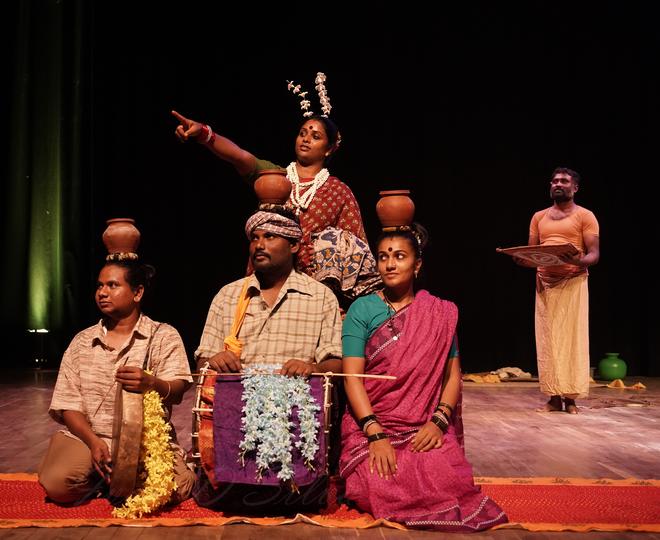
The instruments Tamte and Areye dominate the play’s soundscape. The musicians who play them enact the role of Dakla’s two sons. The director chose to feature these instruments because of the extreme marginalisation they faced on the Indian stage, particularly the Kannada stage, because of their association with specific castes.
Lakshman has always known the power of these instruments. For instance, the Tamte was used for protests. “I cannot imagine any folk rituals in Karnataka without these instruments,” he says.
In fact, Dalit history can be found in these instruments, and in the songs and stories of the communities, says Lakshman. “If you want to access Dalit history, you have to depend on oral traditions. The instruments, too, are archives — they carry a tradition and have many things to say.”
In the play, the director has relied on the actors’ bodies and sparse aesthetics as a form of expression. And, surely, one cannot help but make note of the impactful performances; be it the Zen-like still walk of the charismatic Devi (effortlessly played by the graceful Bindu Raxidi) or that of the doting meat- and alcohol-loving father, played effectively by a vulnerable and compelling Santhosh Dindagur (who won the Best Actor in a Lead Role award at META 2023).
The monologue by Bharath Dingri, a musician and actor (who won the Best Actor in a Supporting Role award at META 2023), talking about his mother’s volcanic desire to get him educated, was touching.
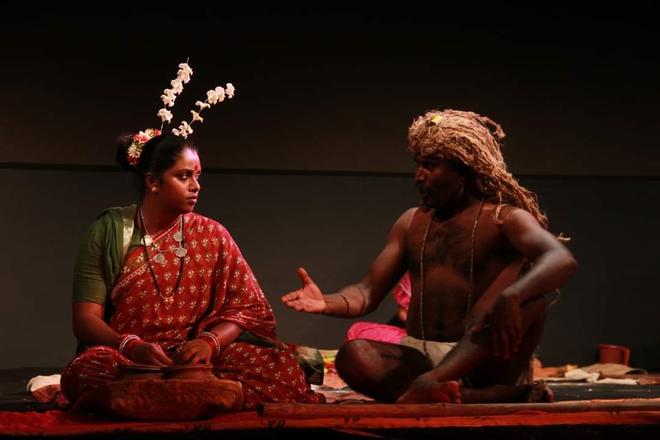
“There are minimal gestures and stage props; that’s what helps us enlarge our imagination. When there are less things on stage we have more space for imagination,” says Lakshman, who attributes his minimalist taste to the influences of Japanese Noh, which he learnt at the Intercultural Theatre Institute in Singapore.
The play doesn’t tell a conventional “story” as such. It has the quality of a ritual — it is ephemeral, impressionistic and non-linear. And, these rituals are not from real life; instead they are original theatrical gestures choreographed exclusively for the play. “Theatre is not just about telling a story. it should be much more. Here, the body should say something; gestures should convert them into poetry and transform it to a poetic space. We are not imitating something that is written, instead we are trying to create a new language for those poems. That is what we are interested in.”
The Play will be staged on November 9 at Ranga Shankara in Bengaluru.
For the love of the stage
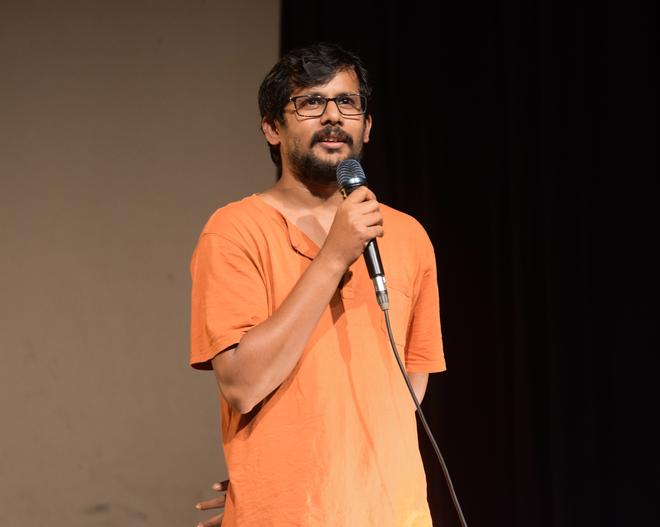
Theatre-maker Lakshman KP was presented the Shankar Nag Award for 2023 by Ranga Shankara at its annual theatre festival titled ‘Narratives & Narratives’.
Instituted on November 9, 2014, in memory of Kannada theatre and filmmaker Shankar Nag, the award is given every year to a young theatre-maker. Talking about the honour, Lakshman says, “I thank Ranga Shankara for choosing me. When people make you feel special, I don’t know how to respond. Because, feeling special in the public sphere is a privilege in this country.”
This is not a recognition of an individual, he adds. “There is an ecosystem that has nurtured me so far. Without my teachers, friends, Jangama Collective (the theatre group he is a part of) and family, I’d feel orphaned and abandoned.”
On the struggles he has faced in his artistic journey so far, Lakshman says it has been about “choosing my tone and the stories that I want to tell. The question is why I have to do art or create work. I become very doubtful of my work as I create it. I am still figuring out the tone of my work; because that is connected to my identity, politics and aesthetics”.