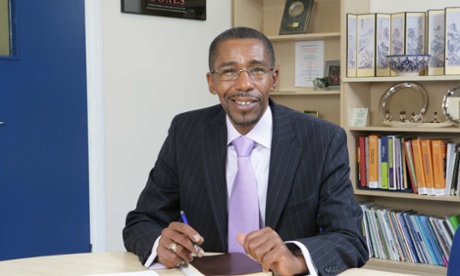
When Devon Hanson took on Evelyn Grace Academy in Brixton, London, he had his work cut out. Students were underperforming, the school was rated “requires improvement”, behaviour was poor and staff turnover was high; Hanson was the third head in five years and in the summer he joined 32 teachers were leaving.
But, when Ofsted came knocking two years later, the school was rated “good” in all categories and more than 70% of students were exceeding expected rates of progress in English and maths.
It’s not the first time Hanson has turned a school around. He previously spent five years as head of Walworth Academy, which he describes as a “dire place” when he took it on. Prior to that he was deputy head of Stockwell Park high school [now Platanos college], which hit the headlines as it handed out almost 300 fixed-term exclusions in a year. Both these schools improved under his guidance.
Hanson, who moved from Jamaica to Peckham aged 10, puts his success down to some unorthodox approaches.
At Evelyn Grace he introduced a police liaison officer to get students to see a more human side to law enforcement. He says that many children have heard of bad experiences with the police: “It was important to me that, rather than their growing up with this hostility, they get to know the police and realise that law and order is necessary in society.”
The officer, based at the school throughout the week, wears his uniform, but doesn’t have any of the attachments, like handcuffs, that might frighten children. As well as walking around the academy and chatting to students, he goes into PSHE and citizenship lessons and gives career talks.
Once students feel comfortable with the officer they realise that they’re simply a human being doing their job. Then, if they do happen to be stopped in the street by a police officer, Hanson believes, the conversation is less likely to erupt into a confrontation.
Hanson also makes sure he meets with his pastoral team every morning. “It’s really important that the pastoral team are seen to be doing their job, and their job is to ensure that the teachers can teach. In most schools you find around 98% of children behave well, but if 2% are constantly given the opportunity to disrupt and the others see that then they join in. It has a ripple effect.”
Another step Hanson has taken to keep students safe is to drive or walk round the surrounding area in a three-mile radius of the school at the end of each day. He goes to the places where students tend to hang out and encourages them to go home. He wanted them to understand is that if they loitered on street corners and outside shops, trouble is more likely to find them.
“They needed to learn the skills to avoid certain pressure points. If they heard about a fight, they’d run to watch it,” he says.
“I’m so proud, I go up to certain spots, like KFC in Brixton, and I’m not saying they’ve gone totally, but even on a Friday I’m lucky if I see two students. Yet, there are around 200 to 300 students hanging around the place from other schools.”
He’s become so well known on the circuit that children from other local schools are beginning to respond to him. “On Friday I was driving the minibus and a group of girls started waving to me and said ‘We’re going home, we’re going home’,” he laughs.
Hanson is committed to improving things for his students, in part, because of his own experience of school. He attended a “sink school” and felt the teachers there did very little to raise his aspirations.
While working in south London he’s noticed that despite students getting good grades when they leave school, some of them still hang around on the street rather than going on to further education or work. Something has been missing, and Hanson believes it’s resilience.
“Most of these children were told, pass [your exams] and you can get anywhere in the world. So they’d make an application and if it was refused for some reason, then they’d just down tools.”
Hanson has worked hard to ensure that resilience and confidence are instilled into students. One way he does this is by taking them on trips to unfamiliar environments. As well as classic visits to the theatre, students go to France and Spain as part of the languages curriculum. And a Stem (science, technology, engineering and mathematics) competition is seeing some travel as far as Florida in the US.
“You can hear a pin drop when they’re travelling to these places because while they can seem terribly confident when they’re in their neighbourhood, take them out of their comfort zone and they’re like fish out of water,” he says. “I’ll never forget a child who was going to the theatre and asking his friend, which river is this? We were on Waterloo Bridge, which is 10 minutes away. For me, broadening their horizons is something we really have to do.”