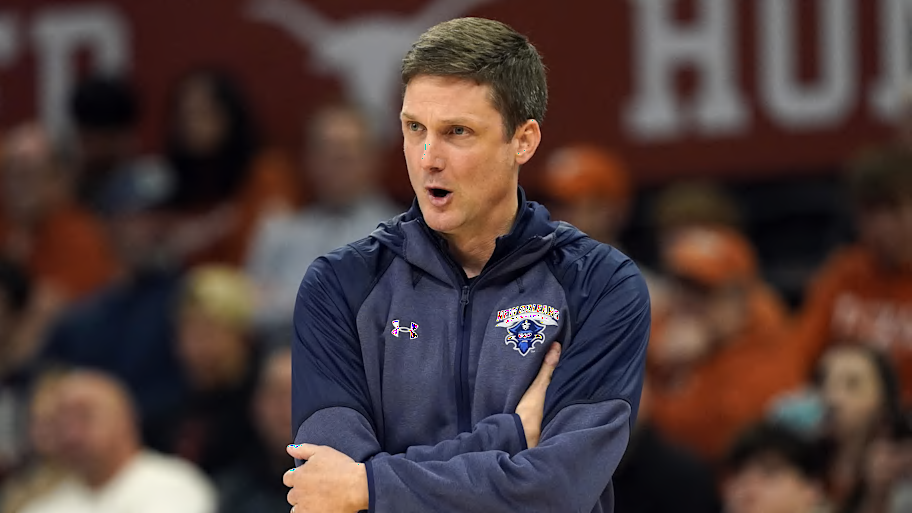
Stacy Hollowell remained stoic as he moved through the handshake line in TCU’s Schollmaier Arena on Nov. 3. Heart pounding, undoubtedly, but emotions submerged. He kept it together after his 22-point underdog New Orleans team shocked the Horned Frogs—right up until he pushed open the door to the visiting locker room.
The postgame celebration wasn’t perfectly executed. The players tipped the Gatorade bucket prematurely, and one of them slipped and ended up sprawled on the floor. The cascading liquid caught only the front of Hollowell’s blue quarter zip.
But that was enough to release what was welling up inside of the coach of the Privateers. After the year from absolute hell, the cold bath was a catharsis.
Hollowell stuck his right fist in the air, jumped and roared in unison with his players. They grabbed the 50-year-old and hoisted him into the air, literally and figuratively lifting him up from the wreckage of 2024–25. That was gone, finally.
He had to dismiss three players for allegedly fixing games
“It was heartbreaking for me personally,” Hollowell says, speaking slowly and guardedly. “I was hurt. I hurt for them. That’s all I can say about that.”
Meanwhile, a concurrent nightmare was unfolding off the court: His wife, Nicole, was being treated for breast cancer, undergoing surgery and chemotherapy. Hollowell’s personal and professional worlds were rocked to the core. His life’s work and his wife’s life were at stake.
“That was a double kick in the gut,” says Hollowell’s longtime friend and former boss at Loyola New Orleans, Mike Giorlando. “To go through that and keep it together—he’s a special guy, now.”
Tim Floyd, the new men’s basketball coach at New Orleans in the summer of 1988, was driving down his street in Mandeville, La., one day when he saw one of the neighbor kids out dribbling a basketball. Floyd pulled over and said to the painfully skinny boy, “Looks like you love ball.”
“Yes, sir,” 12-year-old Stacy Hollowell responded, and told Floyd he planned to attend LSU’s basketball camp that summer.
“Nope,” Floyd said. “You’re going to my camp.”
So Floyd picked up young Stacy every day and drove him across Lake Ponchartrain to camp. A lifetime relationship was born, with coaching and New Orleans forming much of the connective tissue.
Floyd’s star was on the ascent at that time. He took the Privateers to the NCAA tournament twice, then parlayed that into the job at Iowa State. After three NCAA bids in four seasons, he was off to the NBA for five years before returning to the college ranks at USC and UTEP.
Floyd’s fingerprints remained all over basketball in Louisiana, with former assistants becoming head coaches at LSU (John Brady) and New Orleans (Joey Stiebing). Along the way, Hollowell became part of the extended Floyd family.
“He became a hell of a young coach,” Floyd says. “He paid his dues.”
After playing collegiately at St. Edward’s University in Austin, Hollowell dove into the profession. His connections with Floyd helped take his coaching career to China and the Middle East. He was working with the Qatar national team’s feeder program, making good money in a six-months-a-year job, but Nicole preferred living back home in Louisiana. The couple had two small children at the time and would add a third later (Nicole also had an older child prior to their relationship), and she wanted to be closer to her family.
“We can live in New Orleans,” Stacy told her. “With no time and no money.”
Hollowell took an assistant’s job under Giorlando at Loyola, an NAIA program, making $38,000 a year. Food stamps helped make ends meet. Government assistance helped them buy a house. But at least Stacy was working in basketball.
“He was relentless,” Giorlando says. “He had one of the best offensive minds I’d been around. Some guys think about dream vacations. He fantasizes about running offense.”
Hollowell studied everything, eventually reaching out to Brad Stevens at Butler to pick his brain. That ended up with the Loyola staff spending a day with Stevens two straight summers, talking ball.
When Giorlando left college athletics in 2014, Hollowell was the natural successor. He won the NAIA national championship in 2021–22, then left to work for another former Floyd assistant, Kermit Davis, in an administrative role at Mississippi. But Davis was fired after that season, and Hollowell spent the next two as an assistant at Texas Southern.
In April 2024, the New Orleans job came open, but times were tough at the school. Battered by hurricanes Katrina and Ida, enrollment shrank from 18,000 during Floyd’s tenure to about 6,000. The Privateers had had four losing seasons in the last five.
But it was another chance to come home, so the Hollowells took it. What they walked into was worse than anything they could have imagined.
When the 2024–25 Privateers reached Christmas break, they were living the hard-knock life of a low-major program. Strapped for cash, New Orleans had scheduled a succession of games against power-conference opponents for six-figure guaranteed payouts, with predictable results—they were 2–9, having played just one home game. But they scored an upset of city rival Tulane, sparking hope that the program would be competitive when the schedule became less brutal.
Instead, fortunes went the opposite way. The losses kept coming, by wide margins.
Giorlando watched the games, shocked at how bad New Orleans was. Floyd texted him at one point during a blowout loss, asking, “What’s going on?” Giorlando responded with a series of question marks.
Here’s what was going on, according to NCAA investigators: starting guards Dae Dae Hunter and Jah Short, and backup Jamond Vincent, were shaving points. Vincent and Short had been recruited to the school by former coach Mark Slessinger, while Hunter was a new arrival from Pearl River (Miss.) Community College.
The NCAA infractions report that was released this month dispassionately details the sabotage of a season. For the innocent players and coaches on the inside, these were bitter revelations. New Orleans basketball became a crime scene.
“Now you’re dealing with the FBI, legal folks, your compliance people,” says Giorlando. “You’re trying to coach, and someone’s always calling for another meeting.”
The NCAA says that on Dec. 28, 2024, the day New Orleans was playing Southland Conference power McNeese State, Vincent “texted three third parties with instructions to bet on the McNeese State game because he and his teammates planned to ‘throw the game’ based on the 24-point spread. Vincent’s texts also included screenshots from FanDuel and DraftKings with specific amounts to wager on the McNeese State game.”
McNeese won by 25. According to the report, an unnamed New Orleans teammate said he was instructed by Short during a timeout near the end of the game “not to score any more points.” The Privateers didn’t score from the 1:44 mark until 12 seconds remained, when a little-used reserve made a layup that did not affect the spread.
The three New Orleans players allegedly complicit in fixing the game did not score in the final seven minutes. They combined for just 11 points on 4-for-16 shooting.
The NCAA report states that “after the McNeese State game, Hunter and Short met with someone to pick up cash at an unknown location approximately 45 minutes outside of New Orleans. This scheme repeated in connection with the following New Orleans games: Vanderbilt University, A&M Corpus Christi, Southeastern La., East Texas A&M, Northwestern State and Incarnate Word.”
Seven times, the NCAA says, New Orleans players were told to “lay it down” for bettors who were wagering against the Privateers. In those games, New Orleans went 1–6 and failed to cover the spread in each loss. The outlier was the Jan. 18 game against East Texas A&M, which New Orleans won by nine points as a 7½-point underdog, as Vincent scored 28 points.
Vincent also had a 24-point performance against Northwestern State on Jan. 20, and averaged more points during the games under suspicion (12.5) than the rest of the season (5.6). Hunter’s scoring average in games not flagged by investigators was 9.5 points and 5.7 in the seven games that were allegedly fixed. Short’s averages were 10.4 and 6.9 points, respectively.
The NCAA recovered text messages between Hunter and Short on the day of the Northwestern State game in which the players discussed receiving $5,000, with “plans to go shopping at Saks Fifth Avenue the next day.” The players also had FaceTime calls that day with “a known bettor flagged by sportsbook operators.”
Hollowell’s NAIA national champions of 2021–22 were 37–1. He knew how to coach. Watching his first New Orleans team spiral beyond anything he could correct was bewildering.
“We just could not figure out why we couldn’t turn a corner,” he says. “It was just like stacked misery.”
In late January, after receiving a tip from a player on the team about suspected point shaving, New Orleans suspended Hunter, Short and Vincent. They were ultimately dismissed from the team. The Privateers played just seven men Feb. 1 against Southeastern Louisiana, with walk-ons and role players thrust into major roles. At that point they were 4–17. They wouldn’t win again, finishing 4–27, but they at least had a core of players who were trying. New Orleans went 5–5 against the spread in its final 10 games, after going 2–8 in the previous 10.
“There was uncertainty for my family, uncertainty for those kids on the team,” Hollowell says. “And there was nothing I could really share with their parents. It was something I hope I never go through again.”
On Feb. 4, the NCAA was notified by gambling compliance monitors about suspicious wagering on a succession of New Orleans games. Federal investigators were also aware, sources tell Sports Illustrated, as part of a wide-ranging probe into gambling-related corruption at both the pro and college basketball levels.
The U.S. Attorney’s Office for the Eastern District of New York recently arrested 38 people in connection with the probe, including current NBA player Terry Rozier of the Miami Heat, former player Damon Jones and current Portland Trail Blazers coach Chauncey Billups, a Hall of Fame inductee as a player. The Eastern District of Pennsylvania is handling the criminal investigation at the college level, which sources tell SI is in the latter stages.
A ring led by two known gamblers with extensive criminal records, Shane Hennen and Marves Fairley, is suspected of being a target of both probes. The two already have been charged in connection with the NBA corruption case.
While waiting for the feds to disclose their findings on the college level, the NCAA has been doing its own work. Thus far, the association’s enforcement staff has announced investigations involving 16 former players from eight schools in what it terms “integrity cases”—point shaving, game fixing and performance manipulation.
Former players at Fresno State, San Jose State, Eastern Michigan, Arizona State, Mississippi Valley State and New Orleans have been assessed Level I rules violations. The NCAA also has publicly disclosed ongoing investigations at Temple and North Carolina A&T.
Other inquiries that have not yet been made public are ongoing.
The pattern of corruption in many of these cases is cynically shrewd: targeting small-college players on losing teams. With limited NIL opportunities, a $5,000 payoff can seem extravagant.
At New Orleans, at least, the worst was put behind it last year. Hollowell kept his job and was given the chance to rebuild in Year 2. Hollowell put together almost a completely new roster, in part with the help of a famous staff addition.
The assistant coach’s bio on the New Orleans basketball website says, “Percy Miller (Coach P).” He’s better known to the public as Master P.
The rapper has long had a bona fide love of the game, putting sweat equity into it as a college player and then as coach of a juggernaut AAU program. His sons have played collegiately as well. Envisioning himself as the Deion Sanders of college basketball, he joined the Privateers staff last February—first as a self-styled general manager, and now as both president of basketball operations and a full-time assistant.
Coach P gave a poor, low-profile program instant injections of marketing and money. The funding was needed to fix up New Orleans’s dilapidated home gym, Lakefront Arena, and the marketing was needed to get people in the doors of that arena.
Last year, New Orleans was 341st nationally in average attendance at 745 paying customers per game. That was 8.3% of arena capacity, second-lowest in the nation.
With Coach P’s push, New Orleans set up an exhibition game with Sacramento State—which has Shaquille O’Neal as its titular GM. Shaq didn’t show up for the exhibition, but about 2,500 fans did. They were treated to a major production, with a big New Orleans–style brass band and a new jumbotron in the arena.
“He is a high, high-level marketer,” Hollowell says of Miller. “The social media presence and the in-game entertainment, it’s fun.”
When the regular season opened at TCU, Miller packed a prop for the trip to Fort Worth. A plastic slingshot, symbolic of the Biblical parable about David and Goliath. After New Orleans sliced up the Big 12 home team with 54% two-point shooting, 39% from three and 79% from the foul line—for its first win over a power-conference team in eight years—Coach P reproduced the slingshot in the jubilant locker room celebration.
Meanwhile, Nicole Hollowell has undergone radiation and immunotherapy and is currently cancer-free, Stacy says. Her hair has grown back. She’s working and mothering at close to full speed.
For all the new positives at New Orleans, the surrounding landscape at their level of college basketball remains trouble. Tips about point shaving and game fixing have continued to flow. The scandal has continued to widen.
“It’s sad,” Hollowell says. “Unfortunately, it probably gets worse before it gets better.”
More College Basketball on Sports Illustrated
Listen to SI’s new college sports podcast, Others Receiving Votes, below or on Apple and Spotify. Watch the show on SI’s YouTube channel.
This article was originally published on www.si.com as How Stacy Hollowell Found Hope After a Gambling Scandal and His Wife’s Cancer Battle.