A growing number of new housing developments feature a little known but powerful bit of tech: smart rainwater tanks.
That’s where the rainwater tank next to each house is fitted with a little computer to open and close a valve that releases water. Software can tell the valve to open to let some water out when, for instance, a storm is coming and you don’t want the tank to overflow. Or, it can keep it closed when you want to capture rainfall to boost household water supplies.
Our research is investigating new ways to network smart tanks together. When the tanks are part of a network, a computer program can keep track of what every tank is doing, and which ones need to release water and where.
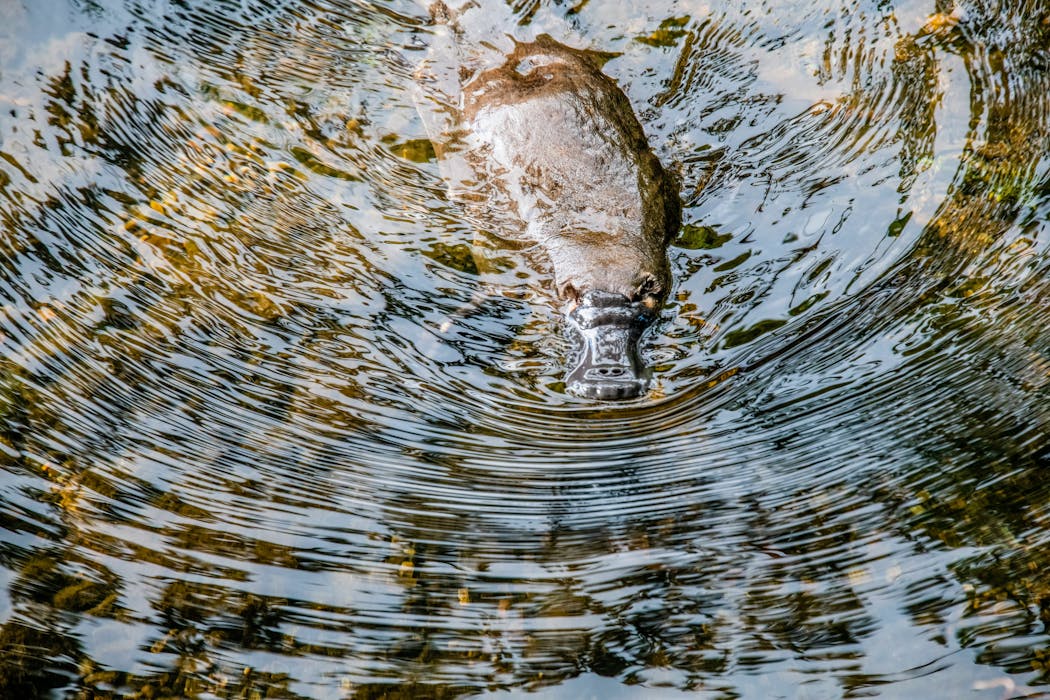
Our project is implementing this smart rainwater tank technology to protect and restore stream habitats for platypus in Monbulk Creek, east of Melbourne.
We aim to scale up this ecologically-informed approach so it can be used anywhere, regardless of what species needs to be protected.
Tanks for platypus
Our project, known as Tanks for Platypus, focuses on using a network of smart water tanks in Monbulk Creek to support local platypus populations.
Once widespread across Melbourne and surrounds, the iconic platypus is now listed as vulnerable in Victoria.
Reasons for this decline include urbanisation, changes to stream flows and habitat fragmentation and loss.
Platypus require water flow conditions that support waterbugs (their main food source). They also need space to swim and hide from predators.
The Tanks for Platypus project involves offering eligible residents in the Monbulk Creek catchment a free smart rainwater tank.
We aim to use these networked rainwater tanks and three urban lakes to provide more natural flow conditions for platypus. When finished, this smart rain grid will be distributed across both private and public land with the cooperation of local residents, schools and businesses.
What we did
We have developed a new algorithm that manages how water is released from tanks into waterways, to improve the habitat for platypus and other aquatic life in Monbulk Creek.
We surveyed the creek in detail and simulated flow to map creek habitat. We mapped how much habitat is underwater and where water is deep enough for a platypus to be fully submerged under different flow conditions.
We can now use this information to guide our stormwater release and storage algorithms. For example, when water is not deep enough for platypus to feed and hide, our algorithm requests releases from the rainwater tanks.
During dry periods, supplementing creek flow with water releases from these tanks could significantly improve habitat conditions for platypus.
At times, just 1 megalitre per day (less than half an Olympic swimming pool) can increase available habitat by more than 10%.
This makes the water available when it’s needed and reduces the risk of flooding due to tanks overflowing during rain.
In fact, our algorithms can calculate how much water the tank should release before a storm. This means the tank ends up almost full after a storm, keeping rainwater available for residents.
Where to from here?
We are now investigating how our designs and findings in Monbulk Creek can be applied more broadly, including in high-density housing and new urban developments.
One ecological objective might be, for instance, to reduce incidents where water gushes from overflowing tanks into waterways, eroding streambeds and banks, and potentially disturbing native species. Another might be to boost water levels in local creeks or lakes during dry periods.
Algorithms could be programmed to meet these needs, as well as others such as providing water from the tank to the household water for toilet flushing and garden watering.
And those lucky enough to live near a waterway with platypus will also know they are doing their bit to look after a unique part of our Australian wildlife.

Kathryn Russell receives funding from Melbourne Water and the Australian Research Council.
Darren Bos receives funding from Melbourne Water.
Rhys Coleman works for Melbourne Water. Has received federal and state funding for research.
Tim D Fletcher receives funding from the Australian Research Council, through an ARC Industry Laureate Fellowship (IL2301000020), as well as being a member of the ARC-funded IoT Water Hub (IH240100012) and an ARC Linkage Project (LP200200107),
Alison Miller does not work for, consult, own shares in or receive funding from any company or organisation that would benefit from this article, and has disclosed no relevant affiliations beyond their academic appointment.
This article was originally published on The Conversation. Read the original article.