When people are first diagnosed with a brain condition, they may not consider joining a choir to improve their wellbeing and regain their voice.
But as our research shows, there’s a strong link between singing in a choir and self-reported quality of life for people with brain injuries and dementia – as high as for community choir members without communication disabilities.
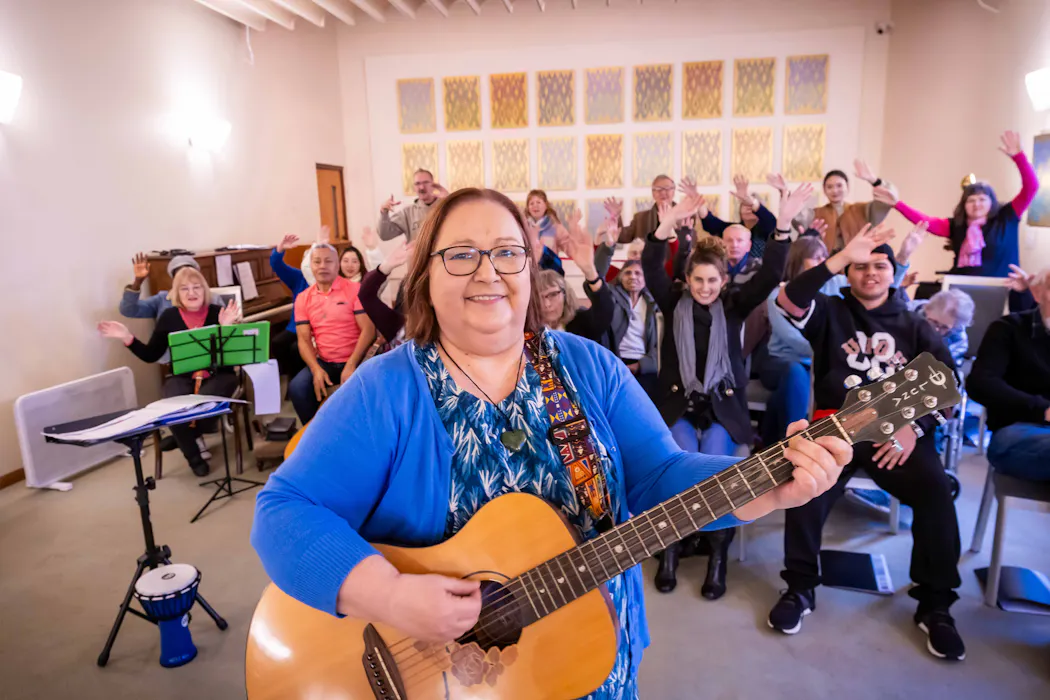
The University of Auckland’s Centre for Brain Research launched the CeleBRation Choir almost two decades ago to help stroke survivors and adults with other brain conditions through voice exercises and singing of familiar songs.
Singing in this choir has helped people overcome difficulties with speech, language, voice and memory.
Singing as therapy
Brain conditions such as Parkinson’s disease and dementia often impair people’s ability to communicate. This can undermine their confidence and ability to connect with others.
They are still the same person, but they might be treated differently and many become socially isolated because others can find it hard to talk with someone who can’t easily respond.
Singing in a neurological choir – a singing group designed for individuals living with acquired brain injuries and neurodegenerative disorders – reduces social isolation and the sense of loss that often follows diagnosis. Joining in with a favourite old song is uplifting, and singers usually leave choir sessions with a smile.
The body works in a similar way during speech and singing – both work the lungs, voice mechanisms and overlapping brain pathways lost to conditions such as Parkinson’s or stroke.
People with Parkinson’s disease can struggle to articulate their speech clearly and can have difficulty breathing adequately to project their voice. Singing helps them to speak more loudly and clearly.
A stroke or brain injury can also cause aphasia, a language disorder which makes it difficult to find the right words and process other people’s speech.
Singing as many words in a song as they are able to allows people to practise vocalising, without the battle to find all the right words. Stroke survivors can often sing their favourite songs more fluently than they can speak.
Emotional connection through song
Neurodegenerative conditions such as Alzheimer’s disease and late-stage Parkinson’s are associated with dementia, which affects people’s ability to function in everyday life.
Singing taps into a person’s emotional and autobiographical memory. Songs they recall from their youth can prompt lively conversations even if they seldom speak.
Group singing can increase levels of brain chemicals that boost mood. It can raise levels of oxytocin, a hormone that fosters human connection, and endorphins, the feel-good hormones that create runner’s high – and perhaps singer’s high, too.
At the same time, cortisol levels fall, encouraging stress release and relaxation. Singing in a choir offers meaningful activity, melodic pleasure, motivation and peer support.
Given one in three New Zealanders will be affected by a neurological condition in their lifetime, we need more choirs.
After co-founding and leading the CeleBRation choir, I set up another local group and was inspired to create The VOCCAL Handbook as part of my doctoral research for anyone wanting to start their own neurological choir.
Read more: We are hardwired to sing − and it’s good for us, too
No prior singing experience is required to join a neurological choir. Some participants are lifelong singers – for them, joining a choir means fun, friendship and therapy that harnesses their musical skills.
Others summon courage to quell often decades-long self-consciousness, even fear, about singing. Once in the room, the sense of camaraderie and give-it-a-go attitude is contagious.
Music that is well-known and well-loved is key, making singing easier for stroke survivors with the language disorder aphasia and people with dementia. However, picking everyone’s favourite songs poses a challenge in large, multi-generational groups with diverse tastes, so a varied repertoire needs to be negotiated.
Songs with complex verses and repetitive choruses offer a blend of challenge and accessibility. Vocables – short, meaningless syllables such as fa la la la la or dooby dooby doo – and humming can improve speech clarity and voice quality and help everyone join in.
Internationally, therapeutic choirs typically offer a space for people with one type of brain condition – such as Parkinson’s choirs. In Aotearoa, many neurological choirs are more inclusive, open to people with a variety of brain conditions.
Neurological choirs offer singers hope, fellowship and increased confidence. They provide a place to recover lost abilities in an upbeat setting. I wrote The VOCCAL Handbook because we need more singing, more choirs and more trained facilitators.
This article was originally published on The Conversation. Read the original article.