This week’s best city stories from around the web introduce us to robots that can transform neon signs into air-purifying devices, remember the fall of the Berlin Wall 25 years ago and find out how art can transform neighbourhoods in Caracas.
We’d love to hear your responses to these stories and any others you’ve read recently, both at Guardian Cities and elsewhere: share your thoughts in the comments below.
Air-purifying robots
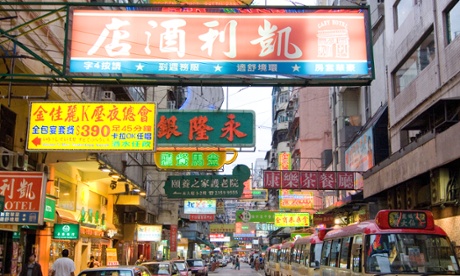
Designers in China have developed a concept for “parasitic robots” which attach to city billboards to suck in carbon dioxide and purify the air. As Fast Co Exist explains, the project is hoping to attach these drones to the neon signs in Hong Kong, where they would collect urban pollution in the daytime and use the heat from the neon lighting at night to harvest the carbon dioxide into an energy source.
At the same time, the carbon dioxide would help boost the growth of small plants on the “wings” of the robots, so they would double as minitature farms. “It’s purely fighting for a green on the street, for less air pollution, light pollution, noise pollution and information pollution,” explains the Beijing-based architect behind the project, Michal Jurgielewicz.
Remembering the fall
This week saw the 25th anniversary of the fall of the Berlin Wall. Smithsonian Magazine remembers the moment 25 years ago with a gallery of captivating photographs taken by Alexandra Avakian, showing the wall being broken down – as well as the anticipation and elation felt by onlookers.
Bringing us back to 2014, Wired magazine shares a video of the 8,000 glowing balloons installed to recreate the wall, stretching along its original path across Berlin. The white balloons were released into the sky on November 9 to mark the anniversary of the fall of the wall.
Glowing cities
A new project, Crayon the Grids, uses a complex set of algorithms to understand a city’s layout – and the result is an array of multicoloured, glowing maps. Urbanful shares some luminous examples, depicting cities from Boston to Berlin, with the different colour mixes representing different approaches of urban design.
The colours correlate to the directions and angles of the city streets: lots of different colours mean lots of different street angles, while a stripped-back palette represents a monotonous layout. We see Paris – with its complex pattern of streets – as a densely multicoloured map, while Chicago – known for its grid – is almost monochrome.
Painting the neighbourhood
In Caracas – often cited as one of the most dangerous cities in the world – the organisation Somos Posible works with vulnerable communities to promote a culture of peace and sustainable development. This Big City shares the story of the organisation’s project “Échale Color”, which brings people together to transform public spaces through paint.
The project involves families, volunteers and residents in various neighbourhoods of the city in a series of community workshops that explain why collaborative artistic interventions can be instrumental in reducing social problems; then, each community paints the designs they have selected together in the public spaces of their neighbourhood, to create colourful and collaborative murals.
The latest intervention was carried out last month as the project continues to be a success. “Artistic interventions boost a sense of pride among residents,” Tere Garcia explains. “The sense of community is strengthened, new opportunities arise for local residents, and public spaces become hubs for local artists to display their work.”
Urban ecology
Urban environments are terrible for nature to thrive in, right? All that pollution and paving? Well, according to the Boston Globe, street trees in Boston grow twice as fast as trees outside the city. What’s more, as development has increased around them, they have grown even faster.
Apparently, city life offers a number of advantages for trees: extra nitrogen and carbon dioxide, as well as trapped heat in the cold months. The city acts as a particular kind of ecosystem – and scientists say we should do more to understand this: “If cities truly want to make progress toward sustainability, it may mean moving away from standalone initiatives and toward a model more like that of ecology, with its broader view of how different elements of the city interact—including us.”
Would you welcome the “parasitic robots” in your city? Can art really reduce social problems? Share your thoughts in the comments below