There are many coping mechanisms you find yourself using when you’re put into the care system. Anger. Rebellion. Self-harm. Nightmares. Trusting no-one. Repression. Immersing yourself in a fantasy world.
I have experience of several of the above, but repression was my big thing. I was in care as my mother allowed her partner to abuse me when I was young. Because I told people that it was happening, social workers were able to separate my brother and I from them. We’ve stayed with our aunt since then, until recently, and despite the ups and downs we’ve managed to live a normal life. But at first, trying to forget and hide away was so much easier than facing what was happening to me. And computer games helped with this – they take you out of everything.
At school, I was really into an online game called Dragon Fable. I loved finding ways to recreate its art style, eventually learning the same software its used to make the artwork. Soon, I realised I was getting good marks at school for my digital art and that I wanted to make video games for a living.
I studied games art at Liverpool Community College, then went on to Bolton University. While in my second year, the university encouraged some friends and I to enter the Dare to be Digital competition, where you pitch a game idea and prototype for a chance to go to Scotland, compete for awards and have thousands of people play the game.
Our team had various ideas to pick from, but eventually we chose to base our game around the idea of foster care. It’s a topic that not many people really know about – how different the lives of kids in care are.
Our game, Pathos, is about what it feels like to be in the care system. It’s a puzzle adventure, featuring a main character called Pan whose world is flipped upside down, literally at one point in the game, and is built for handheld and mobile devices. The game is our character’s story in the care system, so there are times when the game is scary for Pan and she is confused – that’s what it can be like, frightening and confusing. But there are happy times too; we’re planning on having animal companions that come and go – just like if you moved foster care homes you would leave the pets there behind. The obstacles in the game represent the barriers you come up against – like being moved on, changing schools, uncertainty, feeling like you can’t trust people.
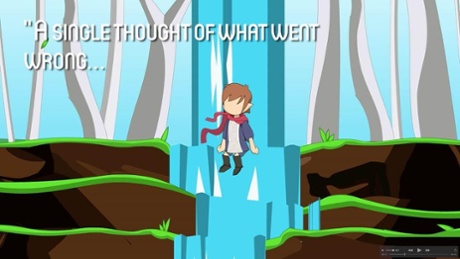
When we were working on the feel of the game, I was talking through the mechanics of foster care when another student, Christina, told us she knew all about it too. We based what happens to Pan on her story. The game’s narrative is a fantasy-style version of events in Christina’s life, and we plan for her coping mechanisms to be reflected in some of the puzzles. We’ve had an idea to use masks in the game, where certain characters won’t let you move on until you wear the same mask as them; this is about pretending to be someone you’re not to get by.
We won two rounds to get to the finals of Dare to be Digital, and spent 10 days working on our prototype and showing it to people attending the games festival. Teams from all over the world entered, so we were amazed to win two out of the six awards. The prizes give us financial support and means our team now have the backing to develop Pathos, which would never have happened otherwise. So many people struggle with being in the foster care system, so helping others better understand what it’s like is important.
We need to do more research on the best ways to get across our ideas in the game and want to be as careful as we can be to get that narrative across. When it’s finished, we want to release it as an app. Testing is going to be critical, so we want social workers to be involved in the next stage of development. Their views are going to be really informative.
Our original plan was to just raise awareness of what the foster care system is like – how it affects children and changes them, and also let people in that situation know that others are going through the same things too. But now we’re thinking it would be amazing if social services could give this game to anyone in care and see their reactions to it.
If it helps anyone that would be fantastic. Because when you’re in a position where you don’t trust anyone around you, and aren’t willing to talk to social workers or foster parents, maybe a game could get through to you.
Follow Pathos on Twitter @PathosGame. Pathos is made by Luke W Norman, Tom Pugh, Rob Green, Leon Gartland and Michael Hindley.