(In this series, Touchdown Wire’s Mark Schofield takes a look at one important metric per NFL team to uncover a crucial problem to solve for the 2020 season. In this installment, it’s time to take another look at Minnesota Vikings quarterback Kirk Cousins).
When I pitched the editors on the “Metrics that Matter” summer series, I had an ulterior motive.
Perhaps this is something I should not be admitting in open court…err…public.
But my line of thinking was this: Looking at each team in advance of the 2020 NFL season, whatever that might look like, would be a great way to do prep work on the year ahead. It would give me a look into their rosters, what they did well in 2019, where they could improve, and the like. Then, if I got asked a question out of the blue on a podcast or a radio hit, I’d at least have some little kernel of knowledge to pull out of the old noggin.
Along the way, some interesting things have come to light, such as Philadelphia’s struggles after the catch, to the Las Vegas Raiders’ struggles with defensive efficiency. But nothing prepared me for what I came across when it came time to discuss the Minnesota Vikings.
Before diving in, a step back. Some context, if you will. Prior to life as a sportswriter myself, I always appreciated when, as a consumer, a writer would shine light on their own potential bias when crafting a piece. I thought that was a wise step that gave the words that followed extra weight.
Last summer, at Matt Waldman’s Rookie Scouting Portfolio, I generated a piece that caused a little bit of a stir in and around Minnesota. Titled “Kirk Cousins–Baker or Chef?” I analyzed the Vikings’ passer and came to a conclusion, using what I though to be an interesting analogy: Cousins was more a baker than a chef.
What did that mean? Well, he was someone that was at his best by the book, following the “recipe” step-by-step. Which is, after all, a requirement when trying to bake. Chefs, however, can be a bit more open philosophically. There are some quarterbacks who are chefs, like the Brett Favres and Patrick Mahomes of the world, who can create. Bakers, on the other hand, follow the steps on each play and often miss chances to be more creative.
I will admit to being rather proud of the piece at the time.
But then, 2019 happened, and as I sat down this past weekend to craft the Vikings’ piece in this series, I was confronted by my past, the film and the data. Forcing me to a realization.
Was I wrong? Was Cousins, dare we say, good?
The first bit of data that led me down this road was what Cousins did under pressure. His play under duress has been a bit of conventional wisdom regarding him as a passer, in that when facing a collapsing pocket he would be prone to mistakes.
Using my analogy, “bakers” would tend to struggle in those moments, while “chefs” would survive, if not thrive.
According to charting data from Pro Football Focus, when pressured last season (175 dropbacks) Cousins completed 75 of 143 passes for 882 yards, seven touchdowns and just one interception. That translated to an NFL passer rating of 84.9 (sixth-best in the league), and an Adjusted Completion Percentage of 73.0%, third-best in the league.
That is not what I expected.
That sent me back to the film.

Another bit of conventional wisdom floating around these days is the idea that play-action is a “cheat code.” We have seen this come to life recently with teams like the San Francisco 49ers in 2019. Last year Jimmy Garoppolo attempted 168 passes working out of play-action (tied for fifth-most in the league with Mahomes) and on those plays completed 105 of 155 passes for 1,667 yards (second-most in the league) and 18 touchdowns. Garoppolo also had an NFL passer rating of 109.3 when using play-action.
The 49ers are not the only NFC West team in recent history to ride play-action to a Super Bowl appearance. As outlined in the “Metrics that Matter” piece on the Los Angeles Rams, play-action was a big component of the Rams’ success in 2018, and part of their downfall in 2019.
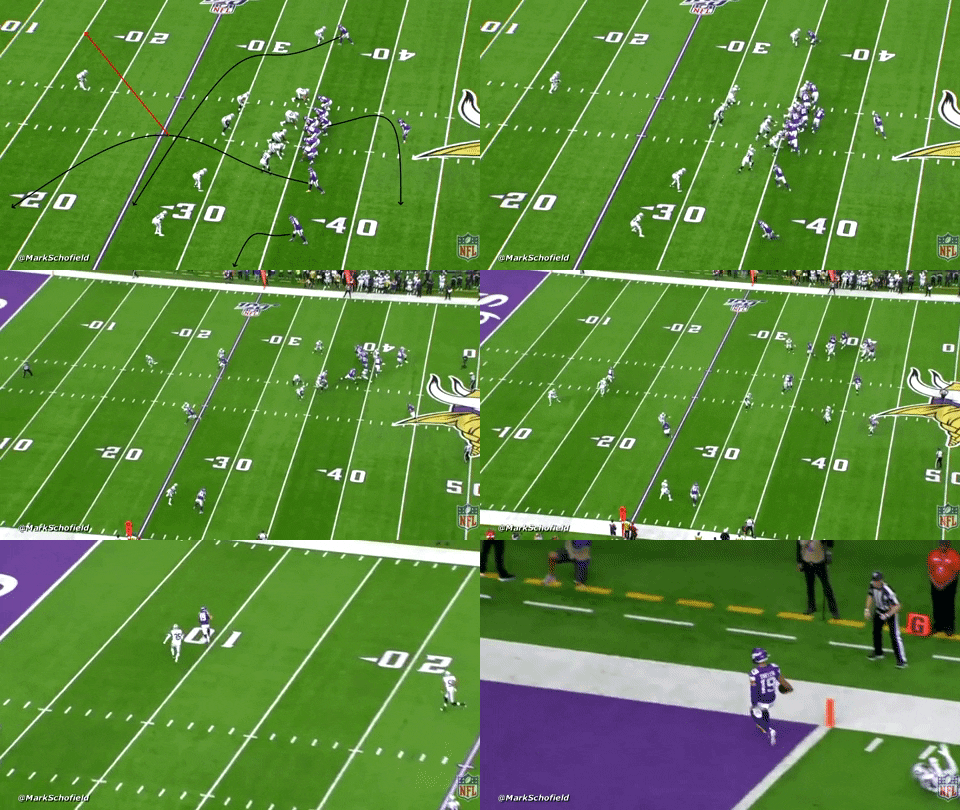
You can count the Vikings in among the teams that relied heavily on play-action in 2019. Out of his 481 dropbacks a season ago, 31.9% of those were play-action attempts, the fifth-highest percentage in the league. Cousins comleted 102 of his 142 passing attempts using play-action (a 71.8% completion percentage) for 1,373 yards and 14 touchdowns. Those 14 touchdowns were the most in the league. Cousins had a Yards per Attempt of 9.7 when using play-action, third-most in the league, and his NFL passer rating of 129.2 on play-action throws was the tops in the league.
This is something that showed up early and often when watching him on film. Such as this play-action throw off of an outside zone run fake:

Or this three-level design, also working off of play-action, that includes a throwback element:
But play-action is one thing, his performance when pressured is something different. Seeing his numbers when pressured in 2019 had me looking for what I might have missed from him in 2018.
There were moments like this:
Or moments like this sequence of plays:
As the numbers, and then the film, illustrate, Cousins was actually better under pressure than the conventional wisdom. Where it tends to go wrong from him is in the bigger games, and the bigger moments. After defeating the New Orleans Saints on Wild Card Weekend, the Vikings made the trip to San Francisco to take on the 49ers.
What happened in that game? Well:
Cousins and the Vikings struggled on that afternoon when the quarterback was pressured, and Minnesota fell on the road.
So where does that leave, Cousins, the Vikings, and us entering 2020?
Well, given that so much of Minnesota’s offense is based off of play-action and the outside zone running game, there are three big questions at the outset: One, what will the team do regarding Dalvin Cook’s request to get paid, second, how will the team handle the loss of Stefon Diggs, and third, how will the offense handle the loss of Kevin Stefanski?
Addressing the coaching switch first, Stefanski was the architect of the offense the past few seasons, first as the interim offensive coordinator in 2018 and the full-time OC in 2019. His loss is going to be felt by the team, but Gary Kubiak brings decades of experience and the same offensive philosophy to bear in Minnesota.
With respect to the potential loss of Cook, the Vikings do have Alexander Mattison as a potential replacement, and while Cook is a great talent at the position, we have seen the roadmap for this situation before. Those same Los Angeles Rams, when Todd Gurley was mentioned as a potential MVP before people began to realize that it was the offensive system that put him in a position to be successful. This was an argument advanced emphatically by Sam Monson over at PFF:
Cook is the latest example of the mounting evidence that running backs simply don’t move the needle when it comes to success at the position, and they remain far more a product of their environment than they are of their own talent advantage over other players.
Dalvin Cook may be as talented as any back in the league, but between his injury history and the data showing the Vikings can insert another back without any significant drop-off, he is the latest example of a player who sadly doesn’t have any leverage in getting paid and needs to rely on the goodwill of the organization to meet him in the middle somewhere.
Finally, there is the Diggs piece. While the new Buffalo Bills receiver was one of football’s best downfield threats in 2019, the Vikings might have a perfect replacement in Jefferson, from LSU. One of the best traits the former National Champion brings to the table is a willingness to work over the middle, without fear.
Perfect for some of those outside zone play-action concepts.
Which brings us back to Cousins. Is he truly better than conventional wisdom has us believe? I, for one, am starting to see the light. But after two years of looking like the guy you “win with,” and not the guy you win “because of,” it might be time for him to make that leap into the latter category.
The numbers, and the film, tell us it is more than possible.