Some 780 million people lack access to clean water, according to the World Bank. As the global population swells and urban migration intensifies, water utilities will be under increasing pressure to make every drop count. Yet delivering water to people in remote regions and peri-urban areas presents distinct challenges. Poor maintenance has resulted in an estimated 50,000 water supply points failing in rural Africa alone. Meanwhile, a lack of visibility over water consumption in developing countries exposes water companies to commercial losses of up to $2.6bn per year.
Harnessing the power of mobile technology to help people access clean water and pay for it efficiently could play a major role in tackling these challenges. This is particularly true in Africa, where an explosion of mobile money platforms has seen people increasingly paying for goods and services with their mobile phones.
Introducing Grundfos Lifelink
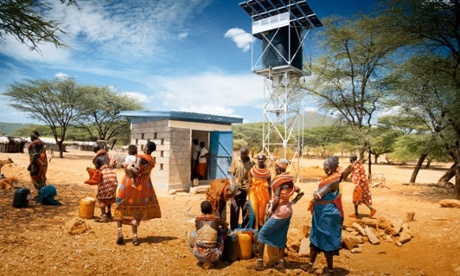
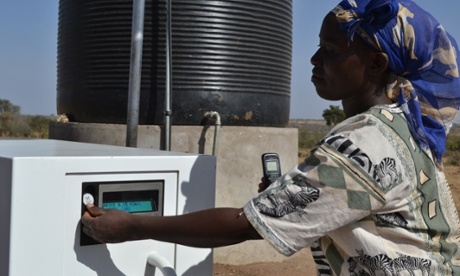
Grundfos Lifelink water dispensers take the form of standalone kiosks in urban areas (where they tap into the main water supply) or communal water points and mini-grids in off-grid areas (drawing water from the ground through solar-powered pumps, for example). To collect water, people charge a smartcard with credit via their mobile phones, insert it into the dispenser and pay for the water they need. With its first dispensers installed in 2009, Grundfos Lifelink water systems are now installed in seven countries, including Kenya and Uganda. It aims to reach 10 million people by 2019.
To set each project in motion, Grundfos negotiates with funding partners, identifies the right technology for the local context, and supports the water company with a robust system to oversee the water points and a service offering to ensure they are maintained.
Accessing clean water for a fair price
Using Grundfos Lifelink, some 100,000 people in Kenya have already been able to access clean water through 40 projects, developed in partnership with organisations including World Vision. In Uganda, the Ministry of Water and Environment is piloting Grundfos Lifelink technology in four rural and peri-urban areas.
Importantly, the price is clearly displayed on the dispenser, in contrast to some existing water collection points where prices can vary, meaning people can manage their households costs more easily.
“People are totally in control of their money and the transaction,” explains Peter Todbjerg Hansen, Grundfos Lifelink’s managing director. “There’s no exploitation, no cash handover. They know they’re getting a fair price.”
By gaining access to an affordable, reliable supply of clean water, families are able to raise their living standards. In addition, people are seizing the opportunity to use any surplus for entrepreneurial ventures, such as growing vegetables to sell at local markets.
“Water is life,” says Todbjerg Hansen. “Once you stabilise the supply, it’s amazing what people can do. Communities are using the water to boost their incomes, which in turn reinforces the long-term sustainability of the solution.”
“The partnership between World Vision and Grundfos is helping to change the reality that 1,000 children die every day from waterborne diseases,” adds Sean Kerrigan, senior director at World Vision. “Grundfos’ technical expertise, leveraged with our on-the-ground presence in vulnerable communities, has enabled us to dream big.”
Capturing revenue in a transparent way
With no cash changing hands, 100% of the revenues from the dispensers are automatically directed to the water utility. This enables companies to demonstrate the transparency increasingly required by donors, invest in running operations more efficiently and expand the water distribution network. Maintenance services are provided by Grundfos or its partners.
Using a web-based water management system provided by Grundfos Lifelink, the utility can control the price centrally and read meter readings remotely, saving on logistical costs and improving efficiency. Companies can monitor and report on all the water points in their area, and check for any discrepancies.
“By automating water kiosks in informal settlements, we are able to keep the prices low and secure payments for water services provided to consumers,” explains Philip Gichuki, managing director of the Nairobi City Water & Sewerage Company. “This will help us to address commercial losses due to illegal water use.”
Scaling up
Grundfos Lifelink has ambitious plans to help deliver a sustainable supply of clean water – at a stable price – to more people in developing countries. The company is working towards enhancing and expanding its technology, and plans to enter a further 10 countries in Africa and three in south-east Asia.
“We will keep scaling up by forging strong partnerships and raising the bar for this type of initiative,” concludes Todbjerg Hansen. “Importantly, we want to provide an inspiration to others. And perhaps one day, we’ll see a water dispensing standard emerge to bring further transparency to the vital quest for clean water.”
Content on this page is paid for and produced to a brief agreed with Grundfos, sponsor of the water hub