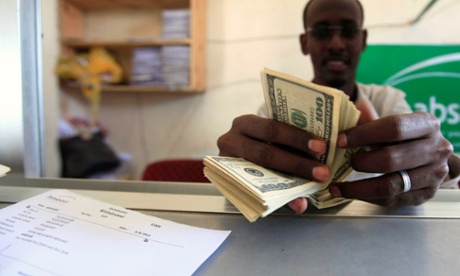
If there’s anything that proves the lie of foreign migrants as scroungers, it’s the global remittance market. An estimated 230 million migrants will send around $500bn to friends and family back home this year, the United Nations calculates – money that is used to invest in small businesses, education, health and so on.
Beneficial though this flow of money is, 60% of which goes from developed economies to the developing world, its impact could be larger. Under the current system, an average 8% of all remittances disappear in currency exchange costs and other fees along the way.
Much of the problem comes down to the physical nature of cash, says Max Chion, group executive of product platforms at US global technology company MasterCard. “Basically, you send money and the somebody on the recipient side has to go some place and pick up the cash”, he explains. People would go, of course, but only because there was no other option.
That’s now changing. The recent explosion in cell phone use in the developing world is opening the door to mobile-based banking. For the estimated 2 billion people without a basic bank account, the ability to pay bills and transfer money via their handsets is revolutionary.
Now MasterCard hopes what digital payment services such as Kenya’s m-Pesa have done for domestic banking, it can do for international remittances. In late 2013, the US firm teamed up with technology provider eServGlobal and carrier service provider BICS to create HomeSend. Pitched as the world’s first global mobile remittance platform, it allows consumers to send money to and from mobile money accounts, payment cards, bank accounts or cash outlets almost anywhere in the world.
Through agreements with money senders such as MoneyGram and recipient organisations, which tend typically to be mobile network operators, HomeSend is currently available to over 1.2 billion consumers. MasterCard plans to connect the service to its own network of over 24,000 financial institutions later this year – a move that would exponentially expand opportunities for sending and receiving money internationally, says Chion.
“This [digital remittances] is an area for MasterCard that is really important because it allows us to expand our reach to the unbanked consumers who we don’t touch today”, he explains.
It’s not just about MasterCard getting its foot in the door of a potentially lucrative industry, Chion insists. As well as being cheaper, transacting remittances digitally is safer for consumers (no more crossing town with large bundles of cash stuffed up your jumper), more transparent and less susceptible to fraud, he says.
That said, the global remittance market isn’t about to ditch using cash overnight. Major hurdles remain, not least of which is the relative immaturity of the mobile money industry. Despite the exponential success of m-Pesa and its ilk, cash is still king across most of the developing world. Six out of ten Kenyans may be using mobile banking, for instance, but only 3% of transactions by the country’s poor are conducted electronically (most of which are mobile top-ups).
For that to change, two things will have to happen. First, governments will have to provide clearer and more consistent standards. Regulations around mobile money remain patchy at best, admits Chion: “When you add international transactions into this mix, then a range of other [regulatory] issues need to be addressed too.”
Second, consumers need to be educated. Queuing at a money transfer branch may be a pain, but it’s what people know. In that sense telling consumers they can use their phones to send or collect remittances is “not a hard sell”, says Chion. But they need the right information first.
Uptake of digital remittances should be relatively easy in countries such as Bangladesh and the Philippines, where familiarity with mobile-based transactions is high. “In markets where mobile money is nascent and where consumers are only starting to adopt it, the investment needed in education will inevitably be greater,” acknowledges Chion.