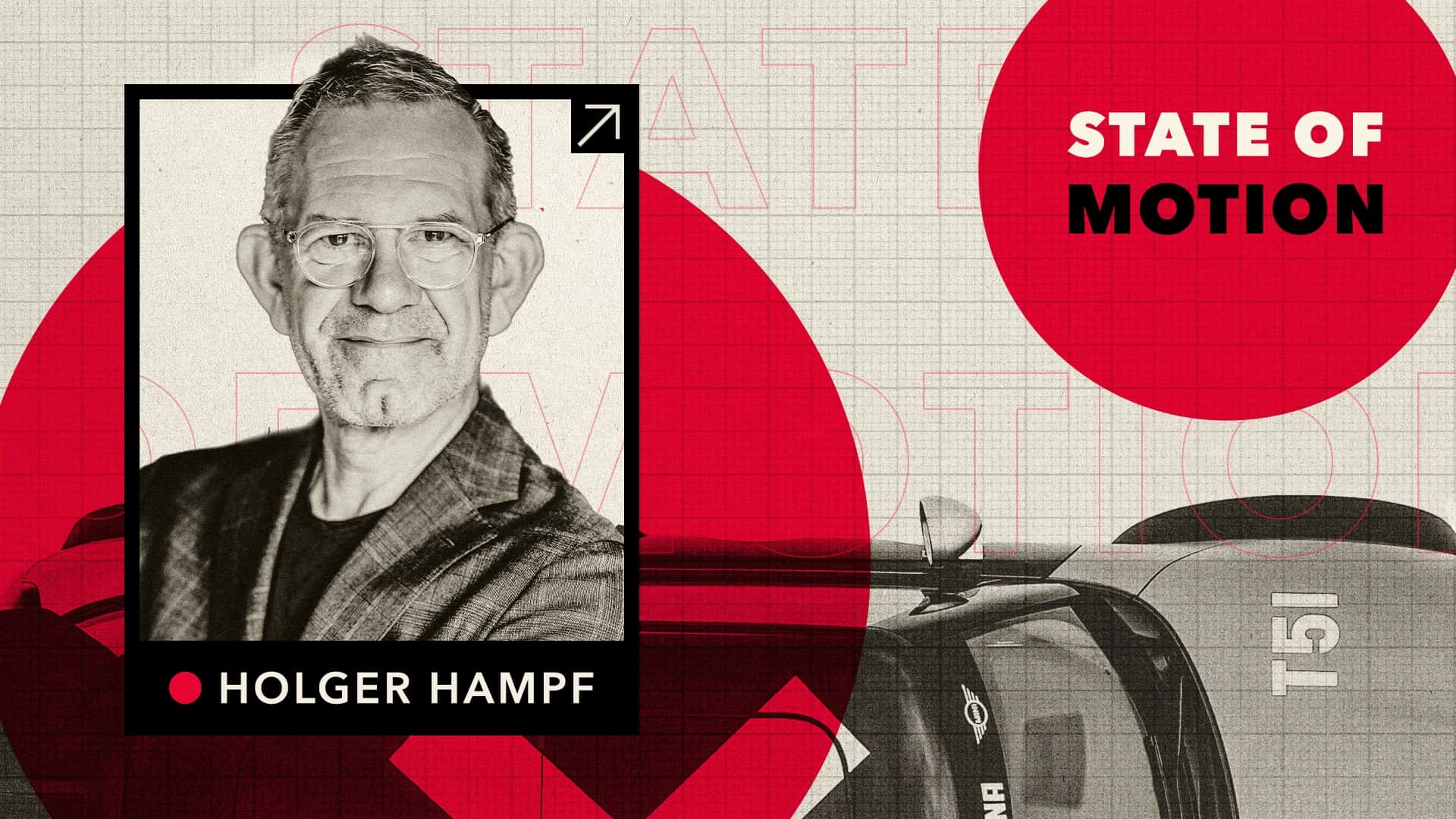
state of motion
Welcome to State of Motion, where we sit down with automotive industry leaders to discuss where the car world is headed. Expect insight and candor from those defining the future of the car.
Designing a car that appeals to the masses is challenging enough. Designing one that honors 60 years of history and also satisfies hundreds of thousands of devoted enthusiasts—that’s another level entirely. But if anyone has the right mindset to guide Mini’s future design direction, it’s Holger Hampf.
Hampf became Mini’s head of design early last year, after nearly a decade at BMW Designworks in California. He assumed the role of Designworks president in 2017, studying at the knee of former president—and now head of BMW Group design—Adrian van Hooydonk.
Not a career gearhead by definition, Hampf started in industrial and furniture design before moving into automotive. He joined Designworks (the first time) in 1998, gradually working his way from product design to user experience, before returning to the company a few years later and assuming the role of president.
After almost 25 years in automotive design, Hampf now takes on his biggest role yet: head of design for Mini. With the modern iteration of the company now celebrating 25 years in the US, we sat down with him to understand what it takes to steer design at a company where heritage and innovation collide. Spoiler alert: it’s a lot of pressure.
(The following conversation has been lightly edited for clarity and length.)

You Began Your Automotive Career At BMW Group Designworks. What Was Your Design Experience Before That?
Head of Mini Design, Holger Hampf: Well, I'm a trained industrial designer, so is Adrian van Hooydonk (Head of BMW Group Design); we’ve known each other a long time. As a matter of fact, I started at Designworks in the US in 1998, so it was almost 20 years overall with some interruptions at other design agencies. But Adrian and I go back to the time when he was president of Designworks in the US, from 2001 to 2004. We formed a very good friendship, and Adrian has been—if you want to call him that—a mentor.
I think I have Adrian's trust in terms of applying a broader design understanding to automotive design and to the brand of Mini. As you can tell from these first few sentences, I'm not a petrol head in the classical way. I'm not an automotive designer who trained at ArtCenter or the like, and there are many very good designers, obviously. But I would think of myself more as a generalist when it comes to design, looking at many influences and inspirations, other than just automotive design.
Many colleagues around me have a track record when it comes to automotive design. That's not me, but when it comes to the world around us and the context in which cars live and operate, I have a good understanding andI'm applying that to Mini. Having run Designworks for seven years also gives me a good understanding of international markets ranging from mobility and transportation to consumer electronics, charging infrastructure, and interior spaces.
I’ve worked very closely with creative teams in Asia, I’ve traveled to China quite a bit, and I lived in the US for a very long time. So I understand the US market and how I can apply those different insights to Mini.
Does Not Having A Traditional Automotive Background Give You A Fresh Perspective? What Are Some Non-Automotive Influences You Bring To The Table?
First of all, I have a very well-formed perspective on sustainability and care for the planet. Working for a small car brand is quite interesting in that context. An urban lifestyle very much forms my perspective on Mini as well.
In the field of product design, things like surface quality, geometry, form, and tactility are very important for a brand like Mini. I have no problems evaluating exterior and interior designs or assessing ergonomics.
But I also bring an additional perspective that has to do with creating fun for people using our product, digitally and physically. I think of that in anything I do. If I cook in the kitchen, what I put on the plate is very important to me—how it’s presented and how it tastes. So to me, life experiences are very important to bring to Mini.
In Your Opinion, What Are Some Of The Core Design Elements That Define A Mini?
Well, first of all, there is a strong commitment that goes all the way back to the classic Mini—to the original 1959 first-generation of cars, which is what we call the “Mini DNA.” That is a minimal footprint, an iconic design, a go-kart feel when you drive it, inventiveness, creative use of space—those types of things.
So, to me, it’s quite important to retain what goes all the way back to the classic Mini. And while we now have a larger car, because of technology, pedestrian safety, and everything that goes into a car today, I still feel very committed to the original kind of attributes of a Mini.
When you talk more specifically about design, probably the most important thing to me is the overall proportion and the stance of a Mini. The three-door hatchback—and let's leave the Countryman and other products to the side for a moment—is still the defining anchor of Mini. When you move away from those proportions—the stance of the car, the wheels, the very short overhangs, the greenhouse, the belt line, the fitted roof—if you start messing around with those elements, you quickly lose the iconicity of Mini.
The same applies if you experiment too much with the facial signature of the Mini, meaning the headlights and grille. The most iconic design features in the interior are, of course, the round user interface, the toggle bar, and the steering wheel. With our new design language, some details like side scuttles, air scoops, for example, needed to be reevaluated in the context of a cleaner form language, which we call Charismatic Simplicity.
Overall, Mini is all about balancing these aspects for product authenticity.
Is It Difficult To Translate Mini's Iconic Retro Cues Onto A Now-Larger Vehicle?
I think we managed, but the current portfolio displays the largest jump in design we've ever done with Mini—at least during the time Mini is owned by BMW, the last 25 years. It really has been a departure from this kind of richer experience, the cockpit experience, when you sit inside, chromed toggle switches, and so on, on the exterior, chrome frames, island taillights, and so on.
So we departed from that, and, you know, I think some Mini fans and also customers who owned Minis before had to get used to it. But it's very important for a brand to move forward and to introduce a bit of a larger change. And I don't mean a revolutionary step because we retained the proportions of the car overall, the driving behavior is still very typical Mini, very low center of gravity, low seating position, you sit a little bit, like, in a go-kart. All of these things are very important.
But here again, I talk about balance. You need to manage to connect to the past, and still move forward in any way. If you are not moving forward, certain design aspects turn into a formula that is perceived as repetitive. There are aspects that are untouchable, and at the same time, design needs to kind of point towards the future for the brand.
And then there is certainly character. This is currently quite a competitive market. As we all know, this is a tough business right now. We see a lot of new brands entering the market, and competition is strong. But I also see a lot of brands that start very fast, develop a portfolio, and don't necessarily differ in character. This is very important for Mini as a brand to retain a strong character, recognizability, and so on, and what Mini is known for.
If you drive around the city, I want people to spot a Mini from a distance, you know, and that's very important. How to achieve that is by designing properly, retaining some aspects of mini, but also refreshing them sensibly.
How Do You Take Those Retro Elements And Translate Them Onto An Even Bigger SUV Like The Countryman?
It's a very good question and also a topic that keeps us busy every day: how to stretch a brand and how to stretch a portfolio. First of all, it's possible, but again, it's something you need to do very carefully. You don't just want to take a Cooper and scale it up and make it bigger for five people and a dog. It has to become its own personality in a certain way, and it has to stand on its own.
The Countryman is an interesting product for us and definitely something we wanted to try out for one reason. Mini has always been the second or third car in the family. The countryman is a product that can potentially fulfill a different purpose, being the one and only car in your family. It does a lot of things that other cars in the segment do, but Mini so far hasn't been able to do. That also explains the size of the Countryman. It's also a car that comes with a lot more versatility than a Cooper. And that's something we wanted to offer.
With Technology Moving So Quickly And The Rise Of AI, How Do You Design An Interior For A Younger Audience?
There's no question that a certain level of technology is like table stakes at this point in time. There's no discussion anymore. So, even a Mini, a small car, has to come with a certain set of features and technology, and I think we are at a very good level compared to other brands.
I would say that with our round central display, we have paired technology with the iconic design that only Mini can do. However, for Mini, it’s of the utmost importance to find a good balance between digitality and an analogue experience. We need to offer a certain level and quality in tactility and tangibility that count for the materials that we choose, and physical characteristics that are important to customers. If you go too digital, you lose the connection or the character that the brand is known for.
On the one hand, you cannot miss meaningful technological advancements. On the other hand, for Mini, we always need to retain that analog quality that a Mini is known for.
We've Seen More People Wanting Volume Knobs And Switches Throughout The Industry. Is That True For Mini As Well?
I think it's a general trend that some customers are asking to bring physical buttons back. That is widely discussed in the industry right now. For Mini, I believe it's a very good thing, because we are looking for that mix of digital interface and physical affordances.
I like the idea of playing with those two elements. Mini has enough touch interface, if you ask me. That round display is everything we need. I would like to actually celebrate it even more in the future because it's so unique, and we get a lot of positive customer feedback on it. It’s the first generation of a round user interface, and that is a new ‘mental model,’ how we call it, for customers.
Everything has been rectilinear, screen size so far, and most manufacturers go with that format, and it's very much learned by customers—portrait format, when you look at your mobile devices, landscape, when you look at your computer. A round display is new.
I'm committed to developing the round user interface further. I believe it's very much on character, and certain functionality, as we know in software, is being developed. There are updates, we refine certain elements, make certain touch points bigger, smaller, less information, more information—that's something you can dial in because it's software. The display size is perfect, refining the digital interface and then pairing it with physical interaction is perfect for Mini.
Is AI Something You Are Implementing As A Way To Speed Up Design The Design Process?
At BMW Group, obviously, we're playing with AI, and it's becoming a tool in our design process, certainly. But we also feel very strongly that one of our designs, be it Mini or BMW, never comes solely out of an AI engine, and that's a very strong commitment where we feel that the designer is in control, be it in the decision-making process or the refinementof a product.
We feel it's more of a combination. We look at AI as a tool or a companion in our work process. There are certain components of a car, for example, rims. You very quickly get to a large variation of rims when you run a design idea through an AI agent. However, at this point in time, it’s more of a tool to offer you a broader range to choose from. But I'm choosing. Very important.
Does That Cut Down On The Design Time At All?
Yeah, it speeds up. One of the biggest arguments is to find efficiencies and do things in less time—shorten the design process. I think it reshuffles the process steps a bit. You can accelerate in some areas, and you can take a bit more time for the more important decision-making in design.
At the end, it's a very human thing. A colleague recently mentioned that AI offers a solution much quicker for review than, let's say, a sketch phase. But still, it kind of also challenges your brain with the amount of options that are very suddenly available to you. We have to be careful about processing all the information that is provided to us by AI, and still commit to choosing very carefully.
Electrificiation Is Obviously Important To Mini. How Does That Influence The Overall Design Of Each Vehicle?
It certainly influences it in terms of the package, the size of a battery, the weight of the car, and those are all very technical requirements, frameworks. On the other hand—you may have seen the Deus Project, the collaboration we did this summer—I very deliberately chose to take both a combustion engine and an electric car, John Cooper Works models, and treat them like siblings.
At the end, I wanted the audience not to decide on drivetrain—am I a combustion guy, or am I an electric guy? I wanted to purely have the cars be judged by aesthetics. ‘Do I like the yellow and silver vehicle better, or do I like the red, white, and black better?’ And I think it was successful. I completely wanted to decouple the discussion around the drivetrain and what that does to a car from the aesthetics and how it feels to me as a product.
The most rewarding thing in conversations after we finished the project was that people said, like, ‘Gosh, I have such a hard time choosing between them.’ We need to retain the driving behavior of a Mini when we go electric—that go-kart feel. We know how a combustion engine in a Mini behaves. It has certain driving characteristics, especially with the small footprint, that are very specific to the brand and to the product.
Translating that to electric is a challenge, but it's a challenge we took on. We deliberately wanted with our electric Cooper to achieve the same fun factor, basically. There was much time put into making sure that the electric Cooper delivers the same type of fun, the same type of driving behavior that we knew from Mini before. The type of cornering we know MINI foris very important to translate these aspects to the electric car. And I think we managed.
Mini Is Very Much A Lifestyle Brand. Do You Plan On Tapping More Into Fashion And Lifestyle?
Absolutely. Yeah. Clear answer, I think the collaboration with Deus was a good example of how well teaming up with a lifestyle company can work. So I would like to play more with some of these leading minds, and Deus is certainly one of these brands. It takes an approach to product design that really inspires us at Mini. The project wouldn't have been possible if there hadn’t been this chemistry between the two brands. And I would like to do more of it, absolutely.
It's Been 25 Years Since The 'New' Mini Debuted. Where Do You See The Brand Evolving Over The Next 25 Years?
We have a relatively small portfolio; it’s four cars: the Convertible, the Cooper, the Aceman, and the Countryman. And then there is John Cooper Works, which is kind of a little bit of an animal on its own. I think there's potential to stretch the brand into different character areas. What do I mean by that? I think Mini is well known for its racing heritage and rally activity. So that's something we've explored with Deus. Mini is very much known for its lifestyle, its urban chic—we've explored that with Paul Smith, and I would like to continue on that path.
Let’s say, ‘Okay, which other characters can I explore?’ One thing that I can point out is the trend of outdoor activity and independence—freedom that the car has always given us. That is something I would like to explore more with Mini. And you will certainly see some of that in the next couple of years. The Countryman hasn't played all of its cards yet, and I'm very eager to explore where else Mini can play. I think there is still a huge potential.