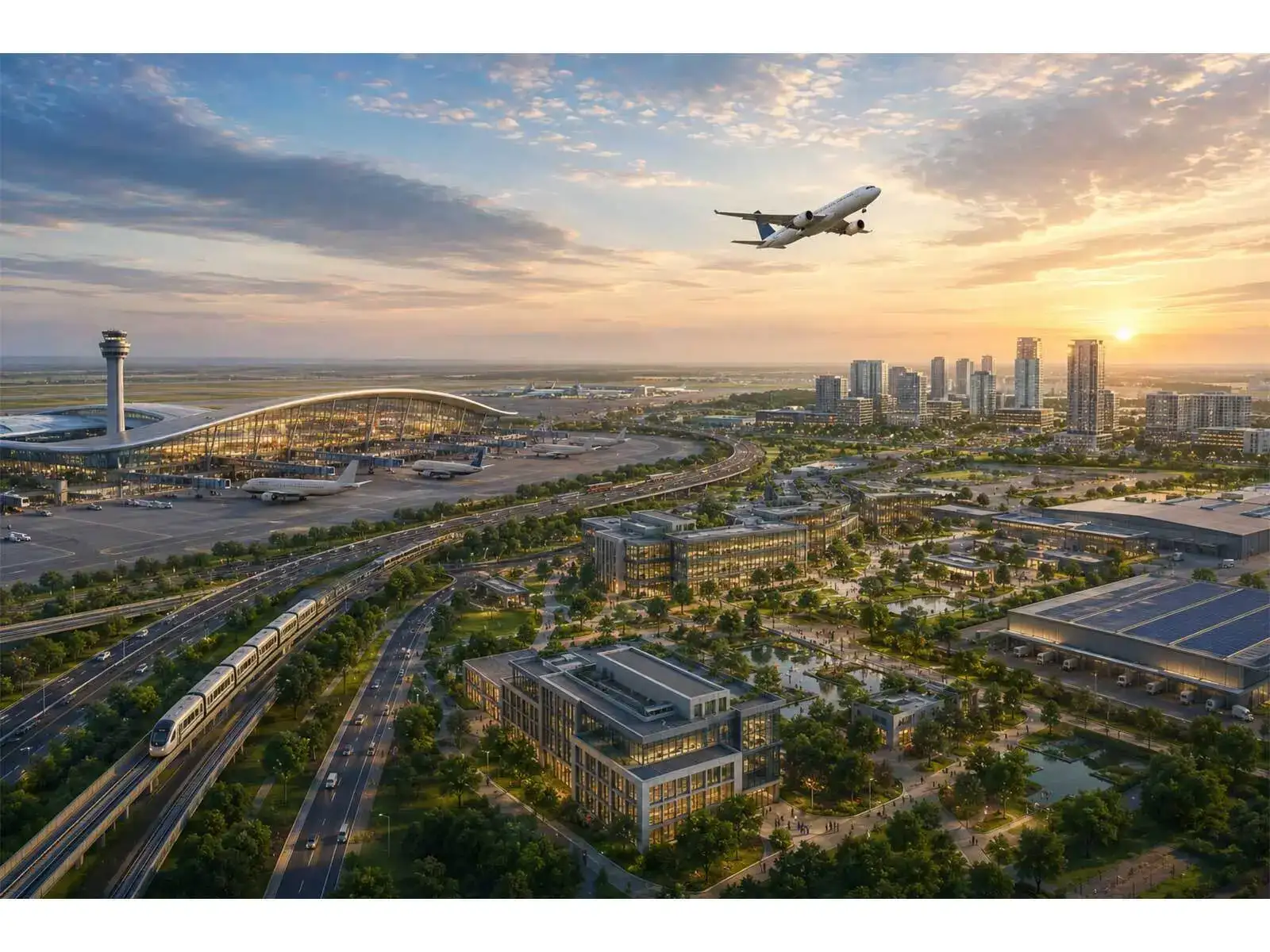
For years, Faridabad remained the quieter part of NCR’s real estate story. While Gurugram became synonymous with glass towers and corporate expansion, and Noida emerged as a major residential and IT destination, Faridabad quietly built a strong foundation for residential and commercial development, positioning itself for long-term growth. That perception, however, may now be changing rapidly, and the biggest catalyst could be the upcoming Noida International Airport.
Real estate experts and developers believe the airport’s expanding connectivity network, especially the proposed Faridabad-Jewar Greenfield Expressway, could place Faridabad in a position similar to where Gurugram stood in the early years of Delhi airport-led expansion.
Why airports change real estate markets
The impact of airports on surrounding property markets is not new in NCR. When connectivity around Indira Gandhi International Airport improved during the 2000s, Gurugram witnessed massive commercial and residential growth. Corporate offices, premium housing, retail hubs and infrastructure projects followed, transforming what was once largely suburban land into one of India’s most valuable property markets.
Industry observers say Jewar Airport could create a similar ripple effect across parts of South NCR, with Faridabad emerging as one of the key beneficiaries due to its improving road infrastructure and relatively lower entry prices.
“The airport is not just an aviation project. Historically, major airports have changed economic activity, housing demand and investment patterns around connected cities,” Manik Malik, President and CEO, BPTP said.
The connectivity equation is changing
The proposed Faridabad-Jewar Greenfield Expressway is expected to significantly reduce travel time between Faridabad and the airport region. Once operational, several parts of Greater Faridabad could potentially access Jewar Airport within 20 minutes.
At the same time, multiple infrastructure projects are converging around the city. These include the FNG Expressway connecting Faridabad with Noida and Greater Noida, upgrades along the Kalindi Kunj corridor, improved access to the Delhi-Mumbai Expressway and the already operational Violet Line Metro connectivity till Ballabhgarh. Together, these projects are changing how homebuyers and investors view the city.
“Connectivity changes the psychology of a market. Once travel friction reduces, demand patterns shift very quickly. Faridabad is entering that phase now,” Manik Malik said.
Greater Faridabad emerging as a residential hub
The biggest transformation is visible in Greater Faridabad, particularly across the Neharpar region. Over the last decade, the area has seen the development of wider roads, planned sectors, educational institutions, hospitals and large residential communities. Schools such as Delhi Public School, Modern School and Manav Rachna International School, along with healthcare institutions including Amrita Hospital, have strengthened the city’s liveability appeal for families.
Much of this transformation has been underpinned by early large-scale development that helped establish Greater Faridabad as a planned residential destination.
Price gap may become a major trigger
One of the biggest attractions for buyers is pricing. Residential rates in Faridabad continue to remain lower than several comparable locations in Gurugram and Noida despite improving infrastructure.
This pricing gap is attracting both first-time homebuyers and long-term investors who believe the city still has room for appreciation. According to market observers, the biggest gains in real estate often happen before infrastructure projects become fully operational. That expectation is already drawing attention towards sectors located near future connectivity corridors.
“Markets usually re-rate ahead of infrastructure completion. Once connectivity is fully established, affordability advantages begin narrowing quickly,” Manik Malik, President and CEO said.
Luxury housing is also entering the conversation
Faridabad’s real estate narrative is no longer limited to affordability. Developers are increasingly introducing premium and lifestyle-focused projects aimed at aspirational buyers looking for larger living spaces and integrated communities.
Industry analysts believe such launches indicate growing confidence among developers regarding Faridabad’s long-term residential potential.
Can Faridabad replicate Gurugram’s growth story?
However, experts caution that no two cities develop in exactly the same way. Gurugram’s growth was driven by a combination of corporate expansion, private sector investment and airport connectivity over two decades.
Faridabad today finds itself at a potentially important inflection point where infrastructure, affordability and urban expansion are aligning simultaneously. The city may not mirror Gurugram entirely, but the broader pattern infrastructure first, followed by rapid real estate expansion appears increasingly familiar.
For Faridabad, the Jewar Airport era could become less about competing with neighbouring NCR cities and more about finally unlocking the growth potential that has remained under-recognised for years.