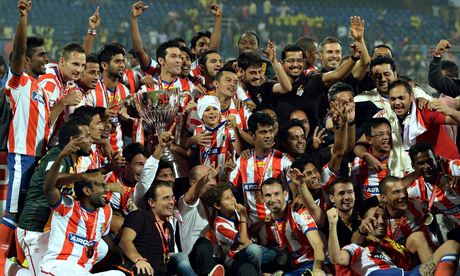
It was a fitting climax to a wildly unpredictable first season. A goal by Mohammed Rafique in the dying seconds of the final won the Indian Super League title for Atlético de Kolkata in what is now the fourth highest attended league in the world. None of that would’ve made sense a few months ago.
As if to add to the sporting state of flux in the country, two of its most favourite sons from its undeniably most favourite sport had a hand in the proceedings. Atlético, co-owned by the cricket legend Saurav Ganguly had beaten Kerala Blasters, co-owned by the cricket deity Sachin Tendulkar. Great friends on and off the field, they were filmed hugging and joking even after the result.
Bollywood celebrities mingled with the players as the 37,000-odd crowd cheered and clapped at the DY Patil Stadium in Mumbai on Saturday night. It was all in all, a tremendously sporting day in India – in all senses.
It would be just as accurate to describe the crowd as an audience – the majority were neutrals, there for the closing ceremony, the lasers and fireworks, the western fast-food brands and to spot their favourite actor in the VIP seats. Plus, of course, because they love football – they just never had a chance to show how much within a safe, family environment.
Everything that so many fans in Europe, and especially England, decry as ruining the game has seemingly enriched it in India. But it is the difference between a seemingly endless passion being mined for profit by greedy executives and soulless corporations, and trying to rejuvenate the dormant love for a game marginalised by its flashier cousin, using whatever means necessary to improve the experience.
That the interest was there is beyond question now. You need only look at some of the figures behind the ISL’s success. The average attendance is 24,357, which is lower only than the Bundesliga, the Premier League and La Liga. It’s worth repeating, it is the fourth biggest league in the world now. Bigger than France, than Italy, than Brazil, than Argentina and China – countries that have an established football tradition; and the only one that has more people.
The opening game drew 65,000 supporters into Atletico de Kolkata’s ground, the Salt Lake Stadium, for the match against Mumbai City. That game was also watched on TV by 74.7m, and the league as a whole had ratings of 170.6m in the first week. The figures for the first phase of this year’s cricketing Indian Premier League was 184m.
Embracing the modern sports fan’s need for constant interaction, organisers went large on digital media too. The ISL site had 16m online video views through the course of the tournament. Its online channel registered 28.7m visits. On social media it recorded more than 1.8m conversations on Twitter and Facebook, 10bn page impressions and 275,000 registered members. The semi-final between Chennaiyin FC and Kerala Blasters attracted 1.1m online video views – the highest ever in India for any single sporting event.
The Twitter hashtags #ISLfie, #letsfootball and my personal favourite, #fatafatifootball (a close approximation of a translation would be “zippy-zappy football”) trended on matchdays and beyond.
A must watch for #ATK fans. #Kolkata welcomes the #1stChampion of the @IndSuperLeague - @atletidekolkata Watch--> http://t.co/ZCYqFYVjo8
— Xtra Time (@greymind43) December 22, 2014
As the Times of India said, the ISL “has managed to recapture the imagination of football fans and effected a dramatic turnround in it, shattering old biases. Football had largely become a ‘sofa sport’ in India – fans sitting at home watching and debating about European leagues rather than going out to watch Indian players. ISL, however, managed to turn these couch potatoes into stadium goers.”
Having been to several matches recently while in India, I too could feel the palpable excitement around the league. People were treating it like a whole evening’s entertainment – they arrived early for the fireworks and to gawk at the media scrums around celebrities.
The Salt Lake district of Kolkata was a blanket of red and white on matchdays, while the royal blue of Mumbai City seemed to cloak the expressway down to their stadium, east of the city. The auto rickshaw drivers were talking about it in Delhi – the main topic at the time being how much of a disappointment Alessandro del Piero had been. Though he did then score this goal. A national conversation about a national game – football in India has never quite managed it before.
The ISL got a lot of it right: an eight-team format centred in hotbeds of football interest; a round-robin contest ending with play-offs for the actual title to avoid tedium or any one club dominating; revamped stadiums with proper facilities; sponsorship to enable ticket prices to stay low; a new level of broadcast professionalism; and the right level of stardust – but there are things it must do to ensure its fanbase grows.
It needs to remain affordable to different groups. In a country where corruption allegations are never far from any industry it must try and stay clean and transparent. And it must make good on its promises over grassroots campaigns.
But most importantly there will have to be the I-league conversation. The I-League is India’s older national league, but has never hit the heights the ISL has, and has ever had anything like the TV or media coverage.
The rivalries are older and fiercer – Royal Wahingdoh and Shillong Lajong in the state of Meghalaya, Churchill Brothers and Vasco de Gama FC in Goa, East Bengal and Mohun Bagan in Kolkata – so uniting fans behind a city-wide team is a feat in itself.
But despite most of the clubs releasing their players for the ISL – which runs September to December – before returning to duty in January until May; ultimately one assumes one overall league would benefit the sport’s development, even if the league was tiered.
The long-term desire is to get India back on to the world stage via better infrastructure and learning from seasoned professionals from Europe and Latin America. The All India Football Federation’s secretary, Kushal Das, told reporters: “The standard of play was high and it helped the Indian players to do well too by playing with international players and learning from top coaches. It has improved football infrastructure. It was a success on all fronts. There would be positives for I-League too.”
Rafique, the man who sealed the title, concurred, saying he learned much from the Kolkata club captain, Luis Garcia. “He is in a class of his own. There was a lot to learn from him – his practice, how he received the ball and just about everything. I learned a lot to improve myself.”
Besides making football popular again, one of the most important things the ISL managed was to allow young footballers to dream again of playing professionally, and hopefully one day for their country.
As Ganguly said after his side’s victory: “I am happy that an Indian boy, Mohammed Rafique, scored today’s winner. That is what it is all about. It is very pleasing to know that the Indian players are being watched by the world.”