

It has been just over a year since Professor Don Berwick produced his review of patient safety in England, offering a distinct shift in emphasis from the focus of the Francis inquiry. Most notably, it stated that “rules, standards, regulations and enforcement have a place in the pursuit of quality, but they pale in potential compared to the power of pervasive and constant learning”.
The review team was specifically asked how the NHS can “make zero harm a reality”. They came back and said sorry, this is just not possible (my paraphrasing), but instead filled the report with the broader ambition of a “continual reduction of harm”.
So what impact has the Berwick report had on the NHS?
In conjunction with Monitor and the Trust Development Authority, the Health Foundation sent a survey to every NHS provider in England. We received anonymised responses from 99 organisations (a 40% response rate) including acute, mental health, community and ambulance services. The headline results are set out in this infographic.
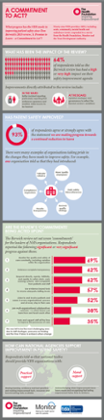
Two-thirds of respondents told us that the report had a “high” or “very high” impact on their safety improvement agenda. We heard many examples of action they directly attribute to the report, from the ward (where it improved incident reporting and helped spread learning) to the board (where it informed strategies, policies and governance structures).
Respondents told us that action was already under way before the report in areas such as monitoring safety and embracing transparency, but that it gave an added endorsement and the motivation to do more. Crucially, more than nine out of 10 respondents thought they were making progress towards the continual reduction of harm.
It seems from this research that the NHS has responded well to being praised for its efforts rather than being criticised for its “failings”. But while there is cause for optimism, it is this concept of “failure” that suggests the NHS hasn’t yet taken up the most critical recommendation from the report: to “abandon blame as a tool”.
For instance, we have just seen the Heart of England NHS foundation trust criticised for a “clear failure in leadership”, following concerns about waiting times and mortality rates. This led to the resignation of its chief executive, Dr Mark Newbold.
Mike Farrar, former chief executive of the NHS Confederation, came to speak to Health Foundation staff recently and pointed out that we have seen “responsibility [for safe care] increasingly externalised” to regulators and national bodies. If this is the case, have we created a system where oversight bodies will inevitably apportion blame as part of their legal duty to take remedial action?
In our survey, we asked what role national bodies should play in improving safety. Respondents told us they want practical and moral support – practical support in the form of sharing learning, evidence and best practice on what works and providing tools and resources, and moral support in terms of greater acknowledgement of where improvements have been made, and recognising that lasting change takes time.
Is it time to rethink the role of national bodies in supporting improvement? Rather than focus on the quality of care, should they focus on creating conditions that allow improvement to flourish at the frontline? After all, our survey showed that where providers are making the least progress is in supporting and training staff to improve care processes.
The manufacturing sector is a good example of an industry that has pursued quality by moving away from external assurance and towards empowering frontline staff to act when things go wrong. Inspections and audits play their part, but largely to help the operators deliver the best quality possible, not to take responsibility for it.
Similarly, our research report on safety cases illustrates how it is the primary responsibility of operators in other safety-critical industries, such as nuclear power and commercial aviation, to make the case for the safety of its services, products and infrastructure.
Whatever the future holds, this survey has given us cause for optimism about how organisations at a local level are pursuing safer care, and cause for thought at a national level as to how we can best support further progress.
The Health Foundation has created resources to support frontline teams to meet the challenges identified by the Francis inquiry.
Are you a member of our online community? Join the Healthcare Professionals Network to receive regular emails and exclusive offers.













