More than 1.5 billion tourists traveled the globe in 2025, but growing concerns about gas prices and geopolitical tensions have the travel industry worried about the upcoming year.
Reports show, however, that falling gas prices have boosted the travel industry, showing that there is no time like the present to hit the road and go on an adventure.
How Gas Prices Affect the Economy
When gas prices increase, it’s only a matter of time until it trickles down to your local gas station. This can have an enormous impact on your wallet, throwing your monthly budget into disarray.
There is also a direct correlation between gas prices and the economy, as high gas prices can affect the economy in several ways.
- Cost of living. An increase in gas prices significantly impacts the cost of living, especially in high-commuter areas that rely heavily on transportation.
- Higher business costs. When gas prices are high, businesses face additional logistics and higher costs, including shipping and delivery fees. This can lead to higher inflation.
- Supply chain disruption. With gas so expensive, transportation may be more limited than usual, directly impacting the availability of goods at your favorite stores.
- Decreased spending. With less to spend, consumers often have to rework their budget to cut discretionary expenses, such as dining out, shopping, entertainment and travel. This directly impacts businesses that now face reduced revenue.
- Stunted growth. With lower consumer spending, businesses are hesitant to spend on expansion and growth.
“The price of fuel helps determine travelers’ decisions and their interactions with the destinations they visit,” says Alyse Race. As the author and founder of The Invisible Tourist, she is a responsible travel expert focused on overtourism, etiquette, and crowd avoidance.
“Lower driving costs would put extra pressure on traditional hot spots, as would strong flight demand, unless travelers adopt a more deliberate approach,” she explains.
As CEO of luxury travel concierge company Revigorate, Steven Vigor and his team of travel advisors curate tailored travel plans for clients across the U.S., Europe, Africa, and Asia. He shares his observations.
“Driving has remained the most price-sensitive segment, with travelers limiting distance and duration,” he says. “In contrast, aviation and cruising have remained one of the most stable segments, as fuel costs were spread across fares, avoiding sudden price spikes.”
However, he acknowledges, “Margins in the travel industry are already thin, so even small increases in gas prices can directly affect pricing.”
Current State of Gas Prices
So, where do gas prices stand today?
Gas prices are significantly lower than in mid-2022, when they hit $5/gallon. Instead, gas prices were at their lowest since March 2021, falling to $2.819 in early January 2026.
In its mid-January Short-Term Energy Outlook report, the U.S. Energy Information Administration (EIA) projects retail U.S. gasoline prices to drop by 7% from 2025 to 2027, with a 20-cent-per-gallon decrease in 2026 alone.
In fact, the White House expects to spend $11 billion less on gas in 2026 than in 2025, according to White House Press Secretary Karoline Leavitt.
Despite concerns about Venezuela, AAA says, “Currently, the global oil supply is strong, as OPEC+, the coalition of oil-exporting countries, says it’s not planning any production hikes in the first quarter of 2026 due to lower demand.”
With increases in crude oil supplies worldwide, the EIA expects supply to outpace demand, leading to continued decreases in gas prices.
It sets the stage for a healthy travel season in 2026.
Impacts of Gas Prices on the Travel Industry
It’s only natural that gas prices affect the travel industry.
With higher gas prices, would-be travelers are priced out of their vacations due to rising costs in airfare, hotel and of course, ground transportation.
Cody Schuiteboer, President and CEO of Best Interest Financial, has seen this among his clients. “Gas prices are one of the major cost determinants that impact travel, how often, and where to travel,” he explains. “With prices rising, I see middle-class families cutting back on road trips, and when that happens, they spend less on gas, fast food, lodging, and attractions along the way.”
This can have a compounding effect on travel costs. “Airlines increase surcharges, which raise ticket prices, and cruises operate on lower profits because fuel costs 20-30% of their operational expenses,” Schuiteboer says.
“A single dollar increase in gas prices means $2 to $3 less spending on travel in the economy, as families opt for shorter trips or staycations rather than longer, more ambitious ones,” Schuiteboer concludes.
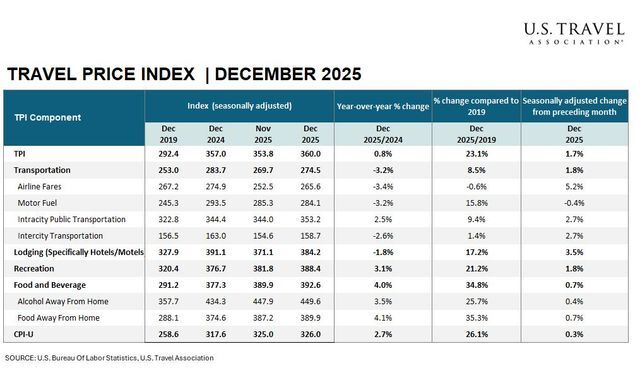
December 2025 showed only moderate increases, although air and hotel rates were enough to give the Travel Price Index its highest monthly increase since September 2023.
S&P Global expects that steady increases in passenger volume and trade will spur economic growth.
For example, corporate travel budgets are projected to recover from the rise of remote work, rising 5% globally in 2026. This will help increase hotel bookings by over 6%.
“For digital nomads, fuel costs can be the ultimate trip killer,” agrees Ayushi Tandon, Founder of Laptops & Landscapes. A travel planning expert, he has visited over 50 countries while working full-time. “In 2025, facing greater cost uncertainty, remote workers crafted more efficient itineraries, using hubs with good transport links and reliable local options, rather than hopping between far-flung spots.”
Schuiteboer expects that gas prices will divide tourism into two markets. “The affluent market will be able to travel at leisure,” he predicts. “In contrast, middle- and working-class families will become increasingly selective about road trips and vacation destinations.”
He explains why. “Inflation, high mortgage and credit card interest rates and stagnant wage growth put pressure on household budgets. Therefore, high gas prices will amplify this pressure, making families less inclined to travel.”
“With gas prices high in 2026, I predict 12 to 18 percent fewer road trips to secondary and tertiary destinations, as families will limit vacations to closer destinations and do fewer multi-destination vacations,” says Schuiteboer. “High gas prices will benefit destinations within 300 miles of large metropolitan areas, while more remote destinations will see less visitation.”
More specifically, gas prices will affect how consumers travel, whether by flying, cruising or road-tripping.
Flying the Friendly Skies
As we make strides in global trade and tourism, airlines are expected to reap the benefits with greater business. AAA expected a record-breaking 52.6 million passengers to fly over the 18-day holiday travel period in December 2025.
That will continue on into 2026, with an estimated 5.2 billion people expected to fly over the course of the year, up 4.4% from 2025. International travel is expected to dominate 2026, as the FIFA World Cup, the Winter Olympics, the America 250 Celebration and Coachella all take place.
Prices are already going up. In December 2025, airfares increased by 5.2%, although they still fall 3.4% below last year’s prices.
2026 international arrivals should surpass 2019 pre-pandemic visitation, according to the National Travel and Tourism Office’s (NTTO) International Visitor Forecast. These arrivals are projected to increase from 6.5% 2025 to 10.2% in 2026, and another 6% in 2027.
Cruising the Seas
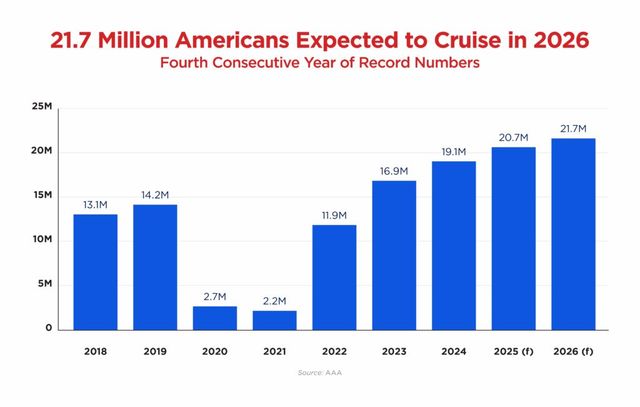
Nearly 22 million Americans will go on cruises in 2026, according to new AAA estimates. This is up from 20.7 million in 2025 and 14.2 million in 2019.
The Caribbean remains a hot spot, with Florida’s ports serving as popular departure points. Alaska and Mediterranean cruises are popular, as well.
“As fuel prices fall, travel — particularly easy-to-reach travel — is appealing to more and more people,” explains Race of The Invisible Tourist, “resulting in overcrowding when too many flock to the same trend-driven itineraries.”
Rates can be higher in the summer to set sail since many families are forced to go when children are out of school, but Caribbean cruises also remain popular, with peak season running from November through March.
One of the best parts about cruises, however, is the flexibility they offer. You can choose from all sorts of departure points, itineraries and cruise lengths to truly customize your trip to your budget.
“Despite the growth of new styles, mainstream ocean cruising remains the largest and most loyal category, with Boomers making up a strong share of customers,” says Internova Travel Group in a statement.
With new ships expected from popular cruise lines like Norwegian Cruise Line, Carnival Cruise Line and Disney Cruise Line. These new ships, while over 200,000 tons, are increasingly incorporating green technologies into their design to reduce operational impact and cut costs. These cost-cutting measures can trickle down to the consumer in the form of lower rates.
Schuiteboer of Best Interest Financial also discusses the psychological impact that ticket prices can have on decision-making. “Families cruised more and perceived better value when they included experiences. To some extent, the cruise lines absorbed the higher controlled fuel costs into their margin, compression, and surviving cruisers.”
However, ports are increasingly imposing new taxes or limits on cruise ships that visit their ports, with these measures confirmed in 2026 for countries such as Greece, France, Hawaii and Iceland. This may affect falling rates in the form of extra fees or rate increases.
Road Tripping
In lieu of a busy airport or crowded ship, many travelers are opting for a good, old-fashioned road trip.
“Falling fuel prices in early 2026 actively changed customer behavior,” says Alen Baibekov. As CEO of Economy Bookings, he leads a global car rental platform that operates in over 150 countries. “In 2025, with fuel costs a concern, travelers did not curtail trips but did tend to cut down on driving distances, opting to stay close to an airport or major metropolitan area.”
That is changing in 2026, he says. “Coastal resorts, national parks and cross-border routes saw a return to bookings as prices became more affordable and longer routes, which had been sentenced to death during the more expensive periods, saw a revival.”
With airfare so high, many passengers are opting for the comfort and flexibility of their own vehicle. During the 2025 holiday season, AAA projected that over 122 million drivers would travel 50 or more miles from home, with 89% traveling by car. What’s more, Hilton reports that 71% of Americans plan to drive on their next vacation.
It is no wonder why. The average household is expected to spend about $2,000 on gas in 2026. It is the lowest it has been since 2021.
“GasBuddy’s forecast projects the national average price of gas to fall to $2.97 per gallon in 2026, marking the fourth consecutive annual decline and the lowest average since 2020,” says Patrick De Haan, Head of Petroleum Analysis at GasBuddy.
The rise of autonomous vehicles is also encouraging, with many travelers opting to drive due to the cost savings or automation.
Consumers are also choosing to benefit from the ease and convenience of ground transportation via coach buses.
LP Maurice, Founder and CEO of Busbud, has had a front-row seat to this trend as an expert in ground transport, sustainable travel, and route planning across 80+ countries.
“We know that demand for ground transportation is influenced by fuel prices,” he says. “We have also seen more travelers consider the entire journey in 2025, as costs have become stable. The shift follows greater interest in long-distance coaches and cross-border routes.”
He expects travel demand to only increase as we progress into 2026. “Destinations that are easy to reach and don’t require a final, expensive flight or long solo drive may be more attractive. Mobility becomes part of the travel experience, not something you have to overcome first to enjoy the vacation,” he says.
Bottom Line
Travel continues to be a driving factor in the economy, propped by fluctuating gas prices. As we enter 2026, low gas prices are supporting a surge in record-setting travel, whether by land, sea or air.
“In the longer term, I expect that driving and flying will continue to play complementary rather than competitive roles,” says Baibekov of EconomyBookings. “Add to this equation mega events and long-haul travel, and we see a world that is traveling more and wider than it has in the past.”
While travelers continue to keep an eye on ongoing geopolitical events and conflicts, they show no sign of slowing down, even if they are moving with a little more caution.
“Regardless of whether gas prices rise or fall in 2026, traveler behavior is likely to remain conservative,” says Vigor of Revigorate. “Current decisions reflect ongoing price caution, with travelers favoring destinations that are easy to reach in order to reduce both travel costs and time spent in transit.
At the end of the day, he says, “Travelers are trying to justify value above all else.”